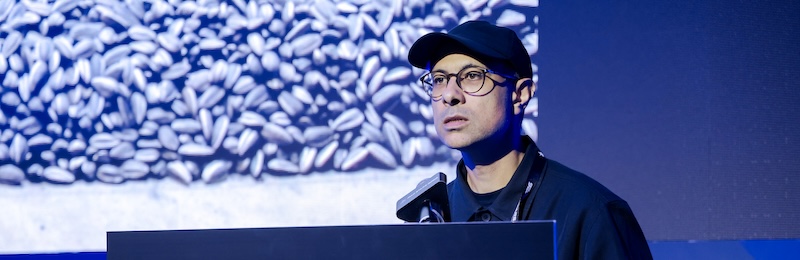

David Griner, co-founder of the new non-profit Creative Ladder, will be president of the Epica Awards jury this year. Previously, Griner worked for more than 15 years as a writer and editor at Adweek, most recently as international editor.
Creative Ladder offers student outreach and leadership training to help make creative careers more accessible to people from all backgrounds. Griner founded the organisation with actor and founder of Maximum Effort, Ryan Reynolds, and Dionna Dorsey Calloway, founder of fashion brand, District of Clothing, and now also chief executive officer of Creative Ladder.
Griner has a long experience in both journalism and advertising. After a stint on a newspaper in California, in 2006 he became an advertising copywriter
“I lost my job on the newspaper, and as I couldn’t afford to stay in Northern California with no income, I came back home to Alabama. By then I wasn’t confident that newspapers were my future – but I was still passionate about journalism,” Griner recalls.
A friend recommended advertising copywriting as a backup, so David applied for a position as a junior copywriter – even though he had zero experience and knew nothing about advertising. “My cover letter was a memo to my boss, dated a year in the future, recounting everything we had accomplished together in my first year.” It was filled with “dumb jokes”, but also with references to the agency’s clients.
As a result, he found himself working for Alabama-based agency, Luckie & Company (which is still going strong), getting embroiled in social media in its infancy and rising from copywriter to director of digital content. Early on in his new career, he discovered a magazine called Adweek.
“On day one, when I started at the agency, I knew nothing. It was not imposter syndrome – I was literally an imposter.” Tasked with familiarising himself while the rest of his team were away on a shoot, he Googled “Adweek blog” in the hope of rapid industry immersion. “The blog was called AdFreak and I loved it straight away…In fact I became obsessed with it. I’d constantly leave comments and send ideas for stuff they should write about. After about a year of that, Adweek said, ‘D’you wanna just write for us?’ So that kicked off my 16-year relationship with Adweek.”
He freelanced for the magazine for seven years while working at the agency, then joined full-time in 2014. He only quit this summer when he embarked on his new adventure at Creative Ladder. How does a journalist end up starting a non-profit with a Hollywood star?
“Every journalist realises that one of the biggest perks of our job is that we get introduced to people we’d never get to meet in our normal lives,” Griner explains. “I interviewed him [Reynolds] a few times and I admired his intellect and passion. I think a lot of celebrities do advertising because it makes money or they feel it’s a cool thing for them to do. Ryan is in advertising because he’s passionate about storytelling – and he sees a lot of potential to bring what he loves about Hollywood to the marketing world.”
Just as in Hollywood, Reynolds had noticed that most of the people who worked in advertising looked like him – white. He’d already begun bringing under-represented voices into Hollywood production via his Group Effort Initiative.
“During our conversations I told him that, with the right partners, it could have a huge impact. Because unlike working in Hollywood, where you have to be based in Hollywood – or maybe Atlanta, Vancouver and a handful of other places – in advertising you can work anywhere. I’ve worked in Birmingham, Alabama since 2005. There are literally opportunities in every city. That gives us an incredible scale.”
And that’s not even accounting for international opportunities. “We’re US-focused for now, but we’re certainly not going to turn away people from other countries who are interested in our virtual trainings or mentorship programmes.”
Everything came together when entrepreneur Dionna Dorsey Calloway, who David also knew through Adweek, agreed to come on board as chief executive officer. Creative Ladder was officially launched at the Cannes Lions festival in June. At the time of writing, more than 8,500 people have signed up to find out more. The non-profit is currently hiring staff and moving into a higher gear. Its main tasks will be student outreach and training, exposing high school students, in particular, to the huge range of jobs available in the industry. And leadership training for people in the first ten years of their careers. “We’re really focused on developing the next generation of creative leaders – and making it more inclusive,” Griner states.
While he’s stepped back from journalism, he retains the external viewpoint that’s required of an Epica Awards jury president. He’s also served on the jury several times, with great enthusiasm.
“Epica for me has been career-changing, even life-changing,” Griner comments. “It’s introduced me to so many different people around the world, and so many different perspectives. I feel personally connected to countries, people and issues that I would never have been exposed to. Epica is a priceless opportunity to meet peers around the world who are writing about things that you would otherwise never get to see, and are experiencing life in way that you would never have imagined. Even when you’re not actively engaged with the jury, those conversations stick with you – and those relationships continue.”
As jury president, Griner adds, his role will be to ensure that “every voice gets heard”. Even journalists can occasionally hesitate when it comes to expressing strong opinions. But in 2022, everyone will be encouraged to weigh in on the entries that belong in the ranks of the world’s best creative work.