In March-April last year, Michael Ritchie, was feeling dread, as was almost every production company head in the world. It wasn’t long, though, before things changed dramatically in Australia. Australian production reopened for business and work from overseas was flowing down here to be made. Revolver has had a spectacular twelve months, capped by Ritchie’s being jury president of Film Craft at Spikes Asia, which put Australia’s work in the perspective of its region and hinted at the effects of a strange year in filmmaking and what needed to be done.
Ritchie spoke to The Stable about an awards show with no Grand Prix in film craft, a shift in the top filmmaking countries and most importantly, the challenge that Australian production is about to face.

The Stable: What happened to the year that threatened to be an annus horribilis?
Michael Ritchie: It really has been an extraordinary twelve to thirteen months. For those who have good international relationships, I think it has been busier than ever before. Australia went back into production before other countries and managed everything better on every level. We have a lot of production happening here, from Netflix to Hollywood films as well as international commercial production; our economy is not doing badly, coming out of a short-lived recession quite nimbly, bringing in confidence from local clients. From this, you’re actually seeing new crew come through, film crew training up new crew. That hasn’t happened for a long time. The upside of that is great. The downside is that it’s hard to get crew and shoots could get more expensive to run if we don’t keep a lid on things. There are different kinds of stresses happening. Good stresses, I guess, but different.
TS: Lockdowns overseas are not going to last forever…?
MR: Exactly. We have to be careful as an industry that we don’t get complacent because as soon as production opens up internationally, we’re going to be vulnerable. You can see crew lifting rates a bit so we’re trying to keep everyone calm and realise that we’re going to back in a very competitive market very soon. The great thing is that the crews get it, and if they don’t they will pretty quickly. My thing is that if we, as an industry, hold onto 20%-30% of the extra overseas work that we’ve got over the last twelve months, if we can hold onto some of the Americans who came down here and thought, “that was a great experience”; if we can get them back in a non-Covid situation, that’s a really good outcome. That’s what we’ve all got to do, think about the next three to five years and make sure we can sustain our competitiveness. I know we are good here. Everyone who shoots here from overseas appears to be blown away, even if just being here via Zoom. Let’s make sure we put this front and centre.
TS: Let’s talk about Spikes. No grand prix?
MR: It was tricky. When we said there was to be no grand prix, I had to give all the good people who run Spikes the reasons and also make sure the whole jury was comfortable that we didn’t. Everyone likes to have a grand prix, but I’ve done a couple of Spikes as a judge and I’ve run that jury once before; you kind of know when you see something that changes the game and really lifts production. You know when you see something you’ve never seen before, something done better than you’ve seen before using technique you’ve not seen before or perhaps using other elements in a that makes it new and unique. That’s what I think a Grand Prix winner is – importantly with a great idea on top of that. (Albeit I think the best work we’ve ever done didn’t even get a finalist spot.) As a consequence, the thing that got close to a Grand Prix was a seven-minute Indian film for Facebook. It wasn’t shot like a Covid project although Covid was its central idea. The film wove this beautiful story of a failing business, decimated by Covid, and how the woman who ran the business held onto her people to get through, and in fact employed others who lost their jobs elsewhere. There were tears shed among all of us. It’s hard to do that with the cynics that we are. It was the standout gold for us but not quite a grand prix.
TS: India stood out for the first time. What was it about the country’s work that shone?
MR: They’re an amazing nation of filmmakers, full stop. I think they’re just more engaged internationally with shows like this now, so you get to see more of their work. Really, they’ve always been great. When you’ve got 1.4 billion people you also get some extraordinary talent and we’re just seeing the tip of it. I think we’ll see more coming out of there that’s exceptional.
TS: Was Covid’s presence obvious in the work? Was this an odd year?
MR: I was expecting to see Covid’s impact a lot more, really a lot more. From March to June last year, all of us around the world were shooting on Zoom, or remoting in various guises and trying to adapt. You did see a lot shot in people’s houses and it did feel very myopic in vision, but it was very real to the time. I was expecting to see a lot of it entered but there was very little. If anything, what was noticeable was that we awarded more bronzes than in other years but fewer silvers and golds. That shows that a very high level was sustained through Covid. There was an ability to keep making the work, but there was just nothing incredible.
TS: 1 gold, 2 silvers, 5 bronzes in Film Craft. Australia did quite well?
MR: Spikes is a unique forum. Chinese work is very different from Indian work is different from the Malaysian work etc. There wasn’t very much Australian work in there but what was there was very good. And it seemed to go well with the jury. Some things I thought were really good didn’t see the light though. Culturally, it didn’t translate for the jury and that’s just the way it rolls. We were lucky to get a few things in there that did well, but we had what I thought was great work in there that didn’t even get shortlisted. There were a lot more entries from other parts of Asia this year, so from that point of view we did very well.
NRMA First Saturday with CHE Proximity and director, Justin Kurzel, won silver
XMess for Plenty with AMV BBDO and director, Steve Rogers, won Silver for Revolver & Somesuch
TS: Any obvious trends?
MR: In the Asian market there’s a lot of work that runs longer. There are longer films that play in different media and different contexts to what we’re used to in Australia and NZ. While some of the longer films are brilliant, some are a bit flabby. They’re not edited tightly and don’t hold you. I think there’s an indulgence, a lack of discipline sometimes. But look at the gold for Facebook and you see it done beautifully. The brand is not claiming front and centre, but is beautifully integrated and it does not weaken the story. It’s something many strive for but fewer succeed in.
What I was expecting to see were trends that made things more shootable and maybe concepts that were in animation because of Covid. Also, things mitigating Covid risk. As it turned out people seemed to find a way to shoot, to the credit of everyone in the different countries that were badly afflicted. Because of that, though, the risk quotient for a client was smaller and I think that’s why we didn’t see some of the most amazing work. In other categories some really great stuff happened but in filmmaking we just didn’t see the ideas that were pushing the boundaries so much. The trend was a more conservative overall.
TS: What do you never want to see again?
MR: The longer film (as mentioned above) that’s undisciplined in its filmmaking and not really holding its audience. There’s an indulgence there that I’d like to see cleaned up. I really don’t want to see a long film that’s long for the sake of it or to call it content. That does feel like something we have to improve and if we want to be an industry that’s moving forward in longer film it has to be as good as anything else that we see on Netflix or whatever. If it does reach that standard, then great, we’re in good shape.
TS: What about your best work this last year?
MR: I think the best thing we were involved with this year was something we shot here with Steve Rogers for a game called Brawl Stars. It’s an incredible bit of film. it’s about six minutes long too. But it’s the most out there thing we’ve ever made and it’s in high circulation among the gamers. They’ve got theories about it and there’s a whole counterculture about this film, so we’re not allowed to put it on our website. But I can’t wait for other people to see it.
Because we have our partners in London and L.A., in particular, we’ve also been lucky enough to do a lot of work for W+K through Biscuit, which we shot here. And they loved it. We’ve also done some Apple work with Kim Gehrig via our partners Somesuch in USA. here.
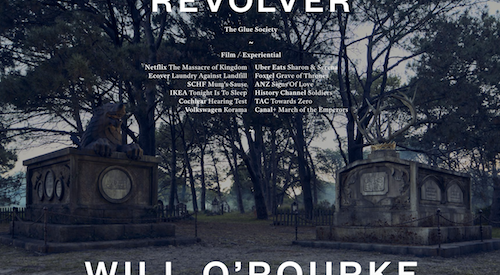
But then we’ve also done some really remarkable work with The Glue Society, some of it local, some not – the Netflix Kingdom museum in Seoul is a great example, and the extraordinary Human Mart project, which we began before Covid and got to finish this month.
I was also really pleased to see Dani Pearce’s work for NRMA do well in the show, think this is a gem actually:
Just having the opportunity to shoot here and not in parts of Europe was really nice for all of us to show the rest of the world how good our crews are, how good our production is and how good our production designers and actors are. We won’t be able to hold onto what we’ve done in the last twelve months but if we can all hold onto a bit it will be really great for our whole industry.