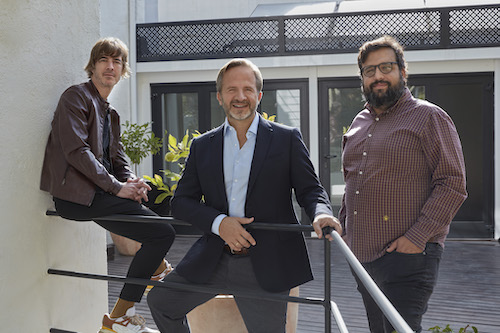
Pablo Alzugaray, Nacho Guilló (chief creative officer) and Abelardo Bethencourt, (chief executive officer), are founding a new Spanish creative agency, Ernest, that demands a break with fear. All three come from the top tier of agency, Shackleton.
“If we had to sum up Ernest with a single message, it might be, ‘Break with the fear of breaking things…in order to rebuild them. Because breaking things disrupts things; and it’s analogous with starting over. And with being born. We’re all born breaking water, but only a few continue with the urge to break thing,” stated Guilló.
“We’re starting over and thinking again. With everything we’ve learned, but also with the innate and unbroken curiosity of someone who’s taking their first steps on an unimaginable journey,” added Bethencourt.
“Beginnings are incredible places, where you return with great humility, and the value of which you only discover when you get there. Suddenly you have a blank sheet of paper in front of you with all the freedom that that entails,” commented Alzugaray.
The value proposition of Ernest rests on four pillars: 1. Audience-centric design. 2. Intelligence-based. 3. Creativity-driven. 4. Performance-based fees. 1. Audience-centric design
They partners add that it is the first ever audience-centric as opposed to discipline-centric agency.
At Ernest, specialisms are not defined solely by what one person or another knows about SEM, CX, the metaverse, content or events, but what one person or another knows about the silver economy, generation alpha, the LGTBIQ+ community, animalists, runners, motoring reporters or environmental lawmakers, among other things.
“We’re digging deeper into each audience to find out how they feel, think and act, and what messages they expect from brands and institutions. What could motivate them, what they yearn for and need, what touchpoints and formats they react to the most, amongst other things,” noted.
The agency has five specialist divisions: Customer audience: 1. Consumers, users, buyers, etc. 2. Internal audience: Employees, shareholders, distributors, etc. 3. Opinion audience: Journalists, advisors, consultants, opinion leaders, etc. 4. Institutional audience: Public decision-makers, lawmakers,regulators, organisations, etc. 5. Citizen audience: voters, members, activists, contributors, donors, etc.
In each audience, the agency combines what it knows about them with demographic/psychographic data and their behaviour, to create relevant audiences for its clients and, within each division, it develops the corresponding applied practices, from loyalty building or product design to influencing strategies or alternative storytelling.
“This is unprecedented, because in spite of trotting out the “customer-centric” mantra, we were still organising ourselves by emulating factory assembly lines. Agencies, with areas of specialisation based on disciplines (advertising, digital, events, content, etc.) and consultants, with areas of specialisation by sectors (banking, telco, industry, public services, etc.), but why not have teams focused on specific groups of consumers? That sounds much more customer-centric,” Alzugaray noted.
We have decided to call ourselves Ernest, based on its original meaning, originating from the German Ernst or Ernust, which refers to being “brave”, “honest” “persevering”, “solid” or “implacable”, and which was so honoured by the Oscar Wilde work, The Importance of Being Earnest. Furthermore, we celebrate the coincidence that it just happens to be the first name of Ernest Shackleton, the British Antarctic explorer whose surname christened the agency which the founders of Ernest, among other friends, were also partners of.”