
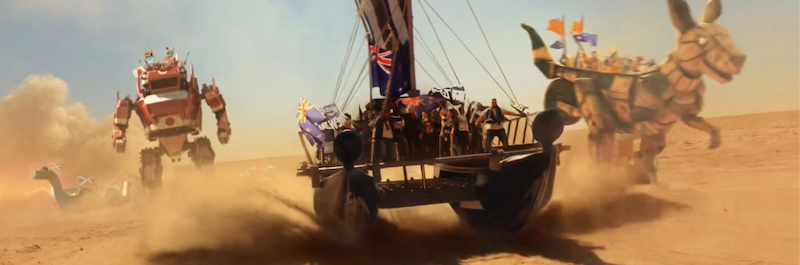
Start with a 90-person cast. Add custom-built miniatures, real remote-control vehicles, and a distinctly Mad Max look and feel. Photoplay director, Scott Otto Anderson has mirrored the Rugby 2027 World Cup mantra, Go All Out, with 90 seconds of all-out visual splendour. It took 180 make-up mock-ups, terabytes of test footage, and hours spent running in the sun, Anderson says, but the result did agency, Akcelo’s, idea proud, underlined the grandeur of the Rugby World Cup and produced a spot you’d actually be happy to watch over and over…and over.
Scott Otto Anderson and Photoplay producer, Emma Thompson, took The Stable into the vastness of the world behind the scenes:
The Stable: Plenty of commercials call themselves epic. This one really is. Can you please describe how some of the remarkable effects were achieved?
Scott Otto Anderson: Well, thank you. We really did want it to be big. The slightly counter-intuitive part is that the way we got there was by going small.
It mostly comes from sitting with the project for far too long, thinking about it at inconvenient times, losing sleep, worrying quietly about safety and logistics – and slowly accepting that the sensible option was also the more interesting one. That, plus constant board revisions and a slightly unreasonable number of tests. I always try to get as much in camera as possible. Real shooting gives you those small, happy accidents, and it reassures everyone involved, myself included, that what we’re making isn’t theoretical. It will, in fact, exist.
So, the convoy itself was made using miniature vehicles, shot very much in the Mad Max tradition – just scaled down. Over-cranked cameras, carefully matched light, camera height and lensing, all shot in the same desert locations at the same time of day as our rugby players. That gave us realism, weight, and a shared visual language and the kind of wonkiness you only get when things are real, like the New Zealand waka hourua “sailing” across the sand by being pulled a rope.


Where we needed scale and physicality for the fans, we went the other way. For example, with the Japanese Mecha – one of the few elements built partially in CG – we constructed a full 1:1 moving section on a gimbal in the studio that could carry twenty performers and move. It shook, pivoted and tilted, so the chanting, drumming, and energy between the fans remained completely real. That was then composited with the CG body, the miniature convoy plates, and the full-scale rugby players running alongside.
Every shot had a slightly different recipe, which makes it hard to explain without sounding unhinged, but the goal was always the same: make it feel physical, immediate, and slightly out of control.
The Welsh Dragon was a favourite because it leaned into old-school trickery (also because it was designed as though built from old Welsh fire engines – hoses and all). It was a miniature, puppeteered and shot almost in the original Star Wars style, tracking past it while it flapped on a giant rotating rig, then composited so it feels like it’s racing toward and over us. Very hands-on, very analogue, beautifully detailed for something that looks completely bonkers for a fraction of a second on screen.


The Stable: This must have really tested your creative inventiveness and production resources. Tell me about your vision for the commercial and how you made it a reality.
Scott Otto Anderson: Every project eventually reaches a point where the creative ambition and the budget start having a very polite but very firm argument. I’d say one thing I’ve learned over time is that flexibility is a creative skill. The job isn’t to cling to a single method, it’s to find the approach that best serves the idea, safely and convincingly.
Once we committed to the miniature-led approach, the challenge became holding that line. Keeping the designers, builders, performers, and crew supported, protecting the people doing the hard creative work, while also giving the client and agency confidence that, even if we couldn’t yet explain every step, we absolutely knew where we were going.
(Maybe it’s because I’m on holidays right now… ha, but…)
Directing commercials is a bit like booking a holiday. The pitch is the fun part. You choose an incredible destination and imagine yourself already there. The middle bit is logistics – flights vs trains, transits, disagreements about luggage. Too much? Too little? You always forget how complicated that part is, but you also forget it because it doesn’t really matter. The complexity is baked into the reward.
What helped here was trust. Trust in the process, trust in the people, and trust built over years of doing this slightly masochistic job. And a producer, Emma (Thompson), who could hold the ambition steady while making sure we didn’t tip into chaos. The result looks wild, but it’s held together by a lot of quiet, careful decision-making.
Or put more simply: we made something epic by being very methodical – and then letting it get just a little bit messy.

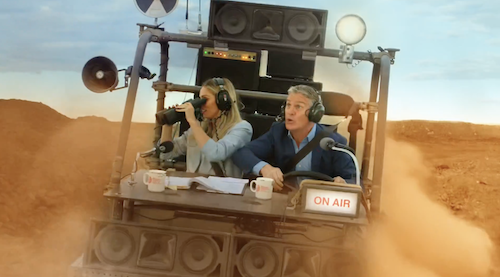
A hugely ambitious idea. Budget constraints. Time constraints. Photoplay executive producer, Emma Thompson, found that something far outside ordinary had landed on her desk.
Emma Thompson: This was an exciting script to land on our desk but it wasn’t a quick decision on what our approach would be…There were days of “how are we going to tackle this?” before the answer was fully formed. It could never have been ‘let’s just do it all in CGI’ because we didn’t have the budget to go 100% in that direction and that just wouldn’t have been as fun or as visually arresting. There were a lot of initial conversations with Scott and the post-production team throwing around ideas until we landed an approach that got Scott really excited. Then my job was to break down the schedule and how we balance the approach of miniatures, CGI, live action and the budget. For 6 months – from the day the job was awarded to the day we delivered – we were working 100% on RWC in partnership with the Akcelo team. It was hectic.
For a commercial, it was a very ambitious endeavour, but we surrounded ourselves with awesome crafts people who were passionate about the project and what Scott wanted to achieve, that elevated every department.
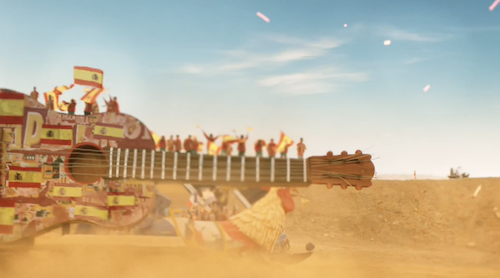

Challenges to conquer? There were many.
Emma Thompson: The greatest challenge perhaps was getting people’s heads around the sense of physical scale we were trying to achieve for each shot and how many elements made up just one frame. In some frames we had vehicles shot at 1:10, exterior shots of people at 1:1, interior shots of people shot at 1:1 but would then be added to the 1:10 vehicles and then the 3D, 2D & CGI elements. It was a lot to brief and get your head around and each time we brought a new department in on the 6 month journey, the compounded back knowledge of qualifying teams, players, approach, equipment, design and scheduling that Scott and I were living and breathing had to then be shared. The greatest part of that challenge however was how excited everyone was to be working on this.





Leave A Reply