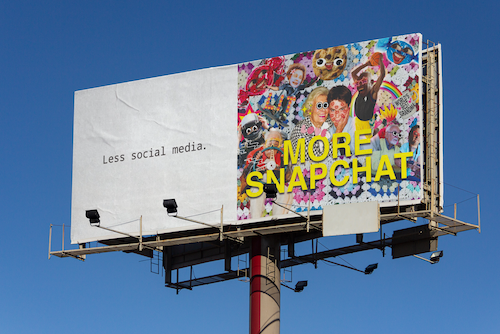
Snap Inc.’s Less Social Media. More Snapchat, has arrived in in Australia, following its launch in other key international markets such as the US and UK, that began in February.
The campaign plays into social media dissatisfaction with the pressure to post “perfect stuff” and clock up thousands of likes, comments and followers. Snapchat was built during the dawn of social media when people were starting to feel these pressures and was designed to offer people an alternative focusing on ephemerality, privacy and “real friends only”. The campaign presents a Snapchat alternative, where people can easily share what matters to them in the moment, with the people that matter to them most.




The local campaign contains out-of-home across key commuter hubs and hotspots in Sydney and Melbourne, as well as high impact and unmissable tram wraps on the Sydney Light Rail and the Malvern Depot line, alongside a targeted B2B campaign across paid content, media agency screens and sponsored events.
Tony Keusgen, managing director, Snap Inc. Australia and New Zealand, stated,“From the very beginning, Snapchat was designed to be different. Snapchat is not social media and it never was. In fact, it was built as an antidote to social media, to offer a place where people could be their real selves with their real friends. That’s why our growing community of 8 million Australians love Snapchat.”

Snapchat’s number use case has always been messaging with the people who matter to you in real life. New research conducted by YouGov, released alongside the launch of the campaign, reveals that Australians feel happy when direct messaging with family and close friends.
The study also found that Australians are more likely to feel happy when using messaging apps compared to social media. Australian adults and teens reported higher levels of happiness communicating with their friends and family on messaging apps (63% among adults, 86% among teens) compared to social media platforms (57% among adults, 75% among teens).
Direct messaging, picture, or video sharing with family and close friends is the most likely feature to be viewed as important (84% of adults, 92% of teens) and make adults (73%) and teens (82%) feel happy.
According to the research, messaging apps are more likely to support emotional health than social media platforms, with Australians roughly 2-3 times as likely to view messaging apps as better than social media platforms for being their authentic selves, developing or fostering relationships, and avoiding misunderstandings. Key findings are:
- Being quick and convenient (42% vs. 19% among adults, 59% vs. 19% among teens)
- Being your authentic self (34% vs. 18% among adults, 45% vs. 25% among teens)
- Developing or fostering your relationships (37% vs. 18% among adults, 48% vs. 21% among teens)
- Avoiding misunderstandings (39% vs. 12% among adults, 47% vs. 14% among teens).
Meanwhile, social media platforms are also more likely than messaging platforms to make people feel overwhelmed or pressured to post content that makes them look good to others:
- Less overwhelmed (32% vs. 44% among adults, 41% vs. 50% among teens)
- Less pressured to only post content that makes them look good to others (31% vs 42% among adults, 51% vs. 59% among teens).
Furthermore, according to the study, Snapchat helps support and deepen friendships. Australian adults and teens who use Snapchat weekly or more are more likely to be very satisfied with the quality of their close friendships.
- Adults who use Snapchat weekly or more (57%) are more likely to be ‘very satisfied’ with the quality of their relationships with close friends than adults broadly (50%).
- Teens who use Snapchat weekly or more (62%) are also slightly more likely to be ‘very satisfied with the quality of their relationships with close friends than the broader teen audience (60%).
Snapchat reaches 80% of 13-24 year olds and 75% of 13-34 year olds across Australia. While the visual messaging app is loved by Generation Z, almost 45% of Australian Snapchatters are 25 years or older.