

TBWA\Hakuhodo and Japanese care facility, Nichii Gakkan, have invented an AI-powered Radio Time Machine, for dementia patients. It automatically generates era-specific radio-like audio content, historical news and popular music to help to stimulate memories, cognition and communication, while also enhancing the well-being of residents in elderly care settings.
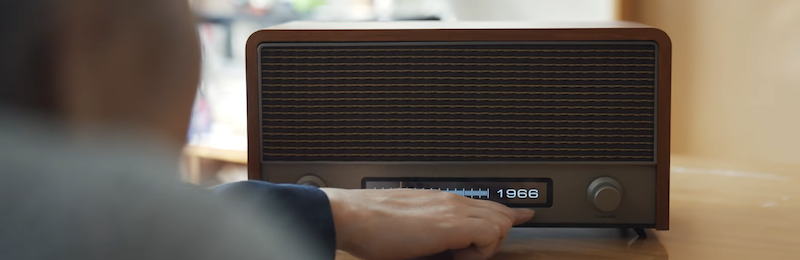
The device concept is founded on Reminiscence Therapy, a non-pharmacological approach that uses familiar stimuli, such as old photos or music, to support cognitive and emotional well-being and help prevent dementia. The device features an intuitive design reminiscent of a 1950s-60s radio, complete with a classic radio dial. Users can select a desired year, instead of frequencies, by turning the dial, operating the pointer in one-year increments from 1950 to 2025. Once the pointer aligns with the chosen year, the AI instantly generates a unique radio broadcast that plays content “from” the present date in the year selected.
The generated content blends news headlines from that era, selected based on a curated topics list, with period-appropriate hit songs. An AI-generated voice, based on human voice recordings ranging in age and gender, acts as the radio personality. The voice delivers the content in a style designed to evoke a sense of the period selected, while triggering memories in listeners of their chosen era. The system is engineered to ensure a varied and engaging experience as users explore different historical periods. The playback duration of the audio content can be freely controlled by AI, ranging from several-minute loops to several hours depending on the purpose.
A pilot project to introduce the Radio Time Machine into Nichii Gakkan’s care facilities yielded promising results.
The initiative focused on two key objectives: enhancing resident wellbeing and improving communication between residents and staff. Feedback from the pilot program included that residents were able to recall details of their past, that they previously struggled to remember due to dementia-like symptoms, and staff noted increased memory recollection and quicker responses to questions from residents. By measuring facial and body movements, such as smiling and hand gestures, the Radio Time Machine also showed its ability to provide an emotional uplift and more vibrant social interactions.
TBWA\Hakuhodo has also initiated joint research with Kitasato University (Tokyo, Japan) to validate the device’s impact further. The project aims to measure the benefits of the Radio Time Machine on cognitive functions and emotional health scientifically. Nichii Gakkan will plan for wider implementation of Radio Time Machine based on these research results, including the development of an affordable version using smartphones.
TBWA\Hakuhodo also believes the AI device has potential across various fields, not only in eldercare and welfare, but also in music, entertainment, and many other domains. They also see strong potential for product development, including new hardware designs and more affordable models.
Find more info on the Radio Time Machine website.








Leave A Reply