
As many countries emerge from lockdowns, the e-scooter trend has also reawakened. Its global market size was estimated at US$18.6 billion in 2019 and while lockdowns caused its growth to slow somewhat, increasing concerns over carbon and greenhouse gas emissions and stultifying traffic jams in major cities still fuel its growth.
To be fair, they are both liked and loathed. They don’t sit comfortably in any vehicle category and having to share the road or the pavement with them is not always well received. There is a lot of ambiguity about the new phenomenon’s “rules” and “rights”.
In Russia, three top e-scooter sharing (kicksharing) companies, Urent, Citymobil and Whoosh, have launched a joint social awareness campaign on electric scooters’ safe behaviour practices in urban environments.
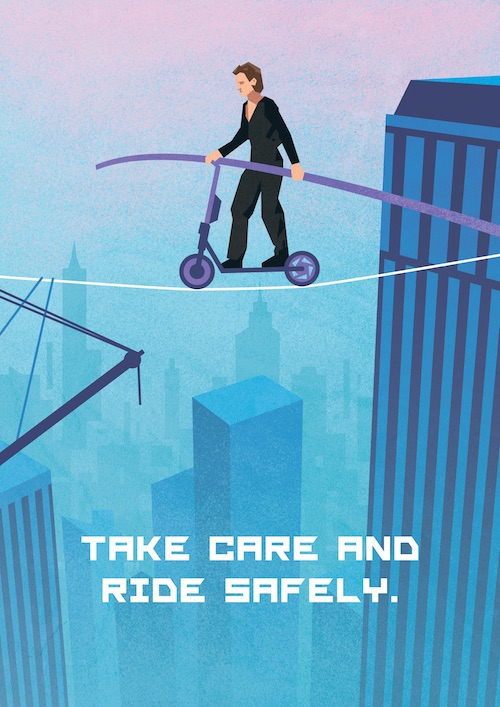
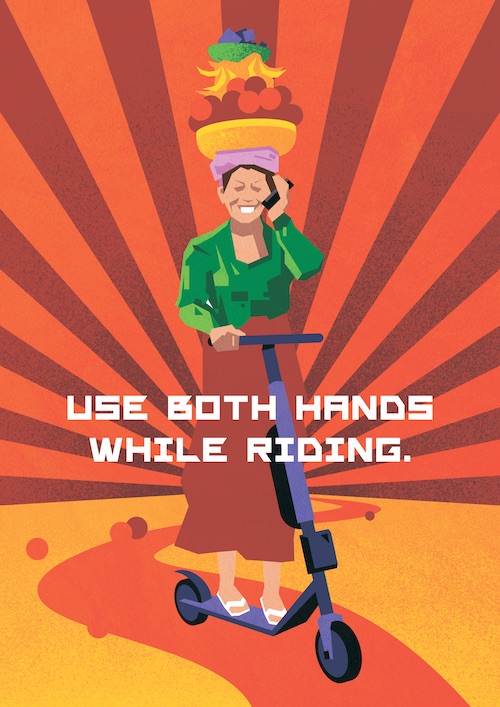
The partners have called on St. Petersburg street artists collective, Yav, to create posters, which inform people about the e-scooters’ ethical code of conduct. The posters have been placed in OOH sites around Moscow and will soon be seen in other Russian cities.
Urent, Citymobil and Whoosh have defined 8 main rules of ethical behaviour practices for scooter riding:
- Dismount before crossing
- Take care and ride safely
- Use both hands while riding
- Don’t drink & ride
- No tandem riding
- Don’t rush through crowds
- Park like a human
- No honking from behind
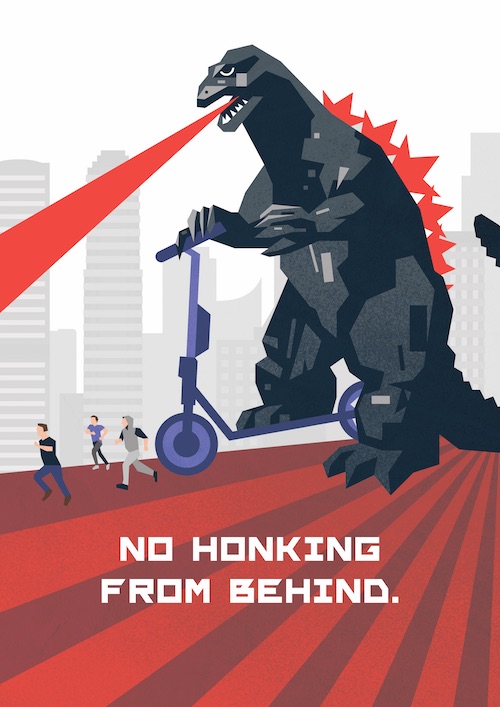
Each rule’s poster illustration references popular artwork or a familiar pop-culture phenomenon. For example, a poster with homage to Albert Eisenstadt’s V-J Day in Times Square alerts riders that speeding through a crowd can result in “kissing” other road users; the four Beatles crossing Abbey Road, dismounted from their scooters, and giant Godzilla terrorises pedestrians, honking them in the back and breaking the rules.
Art group, Yav, commented, “We live during the times of heightened responsibility concentration. Not only for oneself, but also for other people. Even if a couple in love riding the same scooter seems romantic, this does not mean that it is safe and correct. Simple truths need to be repeated for the future to have a solid foundation to be built upon.”
The three companies and Yav have also given free access to the advertising campaign’s materials. The safe scooter posters may be used by other kick-sharing services as well as by the administrations in other regions of Russia and worldwide. Find the posters for print in high-res.
Andrey Azarov, Urent co-founder and business development director, stated, “We believe that micro mobility changes the life of the city and all of its residents for the better. However, the path to a brighter future must be cleared from several directions: from the side of the companies, the cities, which must develop infrastructure, and from the side of the riders. Our task, as a mass service, is not only to bring Russians joy and freedom with scooter movement, but also to teach them how to ethically coexist with all road users and pedestrian traffic. We are glad that our market colleagues support us in this endeavour.”
Evgeny Lukyanchikov, Citymobil Business Development director, added, “We wish for a modern city to be accessible and safe for its residents. An important part of this safe environment is the respectful and ethical behaviour of every single person on the street: electric scooter users, pedestrians, motorists. Therefore, we are glad that such an important topic for everyone has become a reason to unite the leading players in the market.”
Dmitry Chuiko, the founder of Whoosh kicksharing service, noted, “We are creating a new kind of urban mobility – electric scooters are convenient and popular, they decongest roads and replace cars for 5-6 km journeys. The vehicles themselves are safe – what is dangerous is reckless riding, the absence of electric scooter riding culture and the ignorance of traffic rules. These are current problems not only for shared scooters, but for private riders as well. Our goal is to raise the culture of safe riding, with projects like this being a part of the larger scope.”