

With the Pentagon rolling out everyday AI tools to three million staff in August, autonomous warfare isn’t sci-fi anymore. The film, Trenchers, echoes the qualms you may feel about that. The dark, minimalist sitcom exposes the fatal consequences of everyday AI on the battlefield. The five-part dark comedy series for Lex International, has been releasing one episode a day during this week, November 16-20, as UN talks on autonomous weapons took place in Geneva.
Trenchers was co-created by writer and director, Trevor McMahan, and writer, Blaine Kneece, and produced by Tinygiant. The series grounds every AI error in the real world and no longer in science fiction.
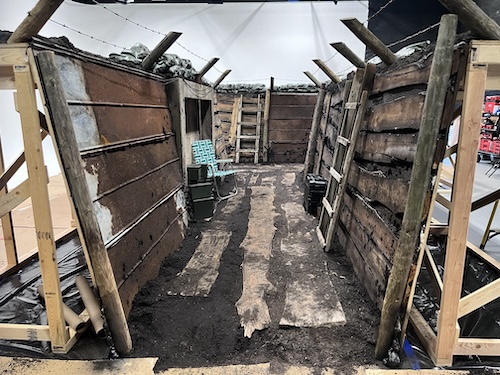
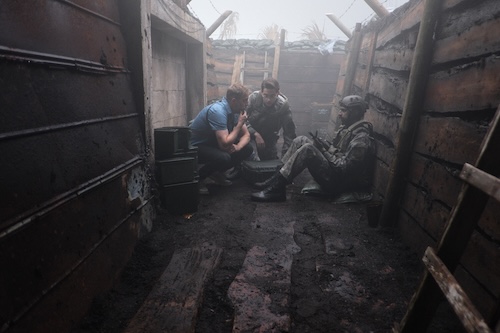
This is its story: In a single trench, a soldier, Bailey, is stuck with his AI comrade, Truman – eager, polite and completely out of his depth. Each episode resets and starts again, introducing a new and all-too-familiar AI failure, from acting before reading the instructions to answering a crisis with a list of tips and tricks, with every mistake costing life. McMahan sets the comedy against stark war imagery – a contemporary but deliberately unnamed conflict, with each episode opening on the debris of battle.
MontanariPR PR executive, Katie Huelin, interviewed Trevor McMahan, and Tinygiant EPs, Sara Eolin and Veronica Diaferia, for The Stable. Here is the story behind the provocative film:
What sparked the idea to drop familiar chatbot glitches into a muddy trench?
Trevor McMahan: My good friend, Beatrice Fihn, leads Lex International whose goal is to prove that international law beats war. She asked if I’d write and shoot something bringing attention to the debate around autonomous weapons. The goal was to premiere it during the Seventh Review Conference of the UN Convention on Certain Conventional Weapons (CCW) where governments were set to decide whether to negotiate a treaty, and hopefully keep AI from being allowed to kill people.
In talking with her about autonomous weapons, we realised the AI used on the battlefield is the same type of AI we use to rephrase our emails – friendly, eager, and sometimes totally wrong, but with 100% unshakable confidence. So we wondered, what if we took one of those AI agents, gave him a uniform and a grenade, and dropped him into the heat of battle? It felt like the kind of wrong we couldn’t ignore.
Teaming up Tinygiant and Rocket Surgery with Lex International, led by Nobel Peace Prize winner Beatrice Fihn is a real collision of industries. Why did you pick comedy as a genre to highlight such a serious issue within international diplomacy?
Trevor McMahan: Beatrice didn’t want us to make a policy paper or anything tailored specifically to diplomats. And this topic is so terrifying it didn’t need scare tactics. Humour felt like the right way to disarm viewers and bring them into a conversation about something so frightening that might otherwise turn them away. And what better way to frame AI on the battlefield than a workplace buddy comedy… in the middle of all-out war. Like a good icebreaker, we hope these films get people talking.
Audiences often easily tune out bleak PSAs and policies. What did a stripped-back, trench sitcom allow you to say about AI warfare that traditional advocacy couldn’t?
Trevor McMahan: Sitcom is right. My co-creator and writing partner, Blaine Kneece, and I love the sitcom format. Not just the humour, but the storylines that reset with each episode, where audiences aren’t drawn back by cliffhangers, but because they genuinely enjoy spending time with the characters. We wanted this trench to (somehow) feel just as welcoming as pulling up a stool next to Norm and Cliff in Cheers. That comfort level is what makes the last episode hit so hard. And because every joke along the way comes from the same real-world flaws, the ending feels earned rather than like a cheap shock. A PSA can tell you AI makes mistakes. But a sitcom lets you laugh at the same dumb mistakes your phone makes… until suddenly it isn’t funny.
Making people laugh about AI getting soldiers killed could be seen as a massive creative gamble. How did you keep the comedy sharp enough to make the fatal ending hit harder without trivialising the level of threat?
Trevor McMahan: I think Bailey was the key to anchoring things. We let Truman go pretty big, hitting on all those fun, ridiculous, dumb things we recognise about our own AI agents, with a really big smile. Our scripts read pretty silly on the page, too, so we knew the stakes had to stay real. But it was our human soldier who held it all together.
For Bailey the trench is purgatory, and every glimmer of hope or “help” from Truman only makes it worse. He wears the exhausted frustration of a man who knows this is insane but can’t do anything about it. Sort of like how we feel about all the AI things happening now.
Production companies today no longer stay in one lane, moving between commercials, branded content, features and short form series. How does Trenchers reflect the way that Tinygiant works across formats to tackle urgent, real-world issues?
Sara Eolin & Veronica Diaferia: Tinygiant is format and genre agnostic. We tell the story that needs to be told and deliver it on the platform that’s most impactful. Our directors have talents and ambitions that vary between short and long form and we love to exercise that muscle. Trenchers is special in that it brings together every strength of Trevor– finding human truths that are both scary and humorous and portraying it in a visceral, beautiful way. Nothing in life is just one emotion. Trevor loves to dig into the reality of life’s messiness – an emotional soup of serious situations which often can be so absurd. Some episodes are short, and some play out a little longer. This always made sense as short webisodes rather than strict :30 spots. We’re not selling anything, we’re just showing a reality just like Veep or Scrubs– which arguably are the most accurate medical and political portrayals.
Dropping one two-minute episode a day alongside the UN talks in Geneva turns the series into a live political intervention. What tangible impact do you hope film production can have on urgent issues like this and how do you see it shaping Tinygiants future work?
Sara Eolin & Veronica Diaferia: Our objective was to make it unbearable for the delegation in Geneva to do nothing. This is a critical issue that few have thought about, even though this treaty has been discussed for thirteen years. Politicians keep kicking the can down the road and that cannot be anymore. The point of no return is here. We’re already seeing the ground swell in Geneva causing pressure. Art is a powerful social pressure. Shaping the message in a way that’s incredibly engaging to watch is the goal behind everything we do from features to commercials and everything in between. We’d love to change hearts and minds along the way. Projects that bridge the gap between commercial or PSA messaging and entertainment is a sweet spot we’d love to sit in more often.
BTS:







Leave A Reply