“We are together even while we are apart.” This message became a Covid cliché very quickly. Something – panic, fear…creative constipation – happened in advertising at the beginning of the pandemic. There was a wave of advertising and so much of it felt the same. Was the same.
Rich Wakefield, creative director at Union, explains, “I kept hearing the, ‘We are together even while we are apart.’ messaging, which became very redundant along with the preachy, ‘Stay home. Stay safe. Wear a mask and keep social distancing’. It was all so similar, paired with the same dramatic, sappy piano music. While the message was important, the manner in which it was delivered quickly became a ‘sea of sameness’. Everyone across the globe was dealing with adjusting to a new way of life, and many of us were struggling. It certainly was not a happy time, and the doldrums of this messaging weren’t helping.”
Wakefield had an idea. A collection of different messages, delivered in a different way.
“In times of grief it’s been documented that when done appropriately, humour is a great escape. I tried to strike the right chord, mixing simple graphics with clever and humorous copy,” he states.
Wakefield turned his messages into simple animations and sent them out into the world via LinkedIn. That started a movement, a movement that spread throughout the world. Now there are hundreds of them – every one unique and uniquely relevant to its country of origin. Every one meaningful to the community from which it comes.
(Everyone is welcome to contribute. Find how to do that at the bottom of this story.)
Wakefield’s messages began with a simple premise, “It’s better to be above ground and alive, rather than underground and dead.” Each is a set of parallel phrases – one an idiom, one a statement. He gave them bright colours, graphics only, a happy feel – and published a few of them on LinkedIn to see what people thought.


“There were likes, some shares, but there were also people who sent their own copy ideas. So I created a few of them in the same style and tagged those people. That’s when it really started to catch on. Before I knew it, creatives from all over the globe started jumping in on it and sending me funny messages. I started making animations for anyone and everyone, so that they could share them with their networks and the people in their countries. Currently, I have close to 300 messages from countries as far away as Brazil, Russia, Pakistan, South Korea, Egypt and Tunisia. The first creative to reach out came from Ghana of all places. He gave me French and Ghana-related ones.”
“Additionally, these new connections and conversations taught me a lot. I was able to interact with and learn about subtle cultural differences all while working from the couch in my home,” Wakefield adds.
Here are a few of Wakefield’s “learnings”:
“You can’t just use Google translate to make these. Languages are idioms that can be confusing, but our sense of humour, even about life and death is similar across the globe.
“In Russia, they say, отбросить коньки for ‘to die’. The direct translation would be ‘to lose skates’, which makes no sense to us.”

[Google translation: Buy Skates/Lose Skates]
“Then while we say, ‘Happy as a clam.’ In Venezuela they say, ‘Happy as an earthworm’. Or we say, ‘ants in your pants’ but in Norway they say, ‘worms in your butt’.

[Happy as an Earthworm/Happy Earthworms]

[Worms in your Butt/Worms in your Body]
In the US, Grubhub is a restaurant food delivery service.

Here are two from Australia:


The entire project is housed in a website Wakefield built, where the messages are group by country.


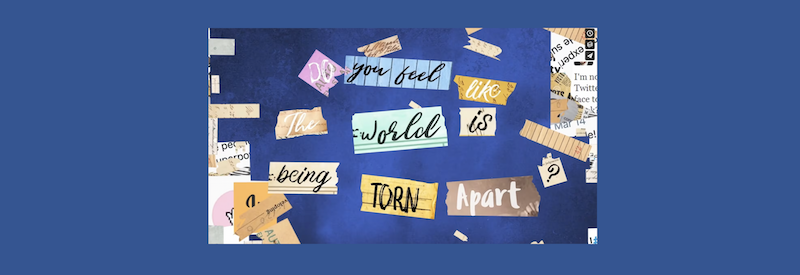
Here’s what the project looks like collectively.

“This was a fun way to share and connect with others while being locked in. It’s incredible how one little idea and some basic gifs have led to so many connections with people whom I might not have had the opportunity to connect with otherwise,” he says. “To me, this is why I joined LinkedIn, not to be spammed by sales attempts, but rather to connect with other like-minded individuals in hopes of creating something great.”
You are all welcome to contribute your messages. “It’s a living site to help people live,” Wakefield notes. Send your contribution here.
You might also like