
Old people are not sexy. Not interesting. Not the target market. That’s how brands and advertising agencies have felt for decades. It’s time for them to rethink that. It’s costing them money.
Australians over the age of 50 have the highest levels of wealth and disposable income, outspend millennials in entertainment, auto, health, travel and almost every other category – but are largely ignored by brands. That’s news to no one over the age of 50 but will be an annoyance to marketers and ad agencies obsessed with talking to young audiences and filling their own ranks with young staff.
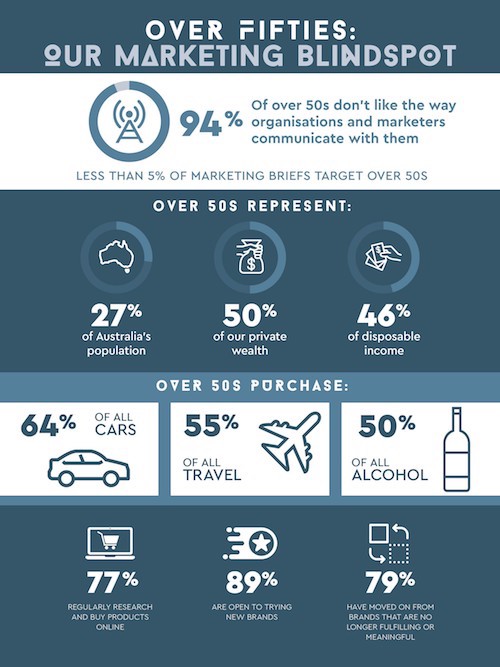
The WPP AUNZ report, Secrets & Lies – Ageless and Booming – also reveals that 94% of the over 50s dislike the way organisations and marketers communicate with them. Again, no surprise to those over 50 and, no doubt, a gobsmack to brands and agencies. That it is impossible to know what it feels like to be over 50 until you’ve experienced it has never been grasped by anyone under 50.
Moreover, WPP AUNZ’s study mirrors results just released by SBS, which commissioned RMIT University to do its research. That study found that Australians aged 55 years and older don’t believe that brands cater for them in their advertising despite their controlling more than half of Australia’s wealth. Found too that older people reject advertising that insults their intelligence, and campaigns which perpetuate stereotypes of them, including the use of terms such as “silver”, “mature” and “senior”.
Rose Herceg, chief strategy officer and futurist with WPP AUNZ said the WPP AUNZ study shows Australians aged 50+ are clearly booming in number, and lifestyle, and embracing life with ambition, purpose, and money in their pockets. But this ‘ageless’ outlook by the over 50s is poorly understood by marketers who often misfire with the demographic.

Rose Herceg
“More than a quarter of all Australians are over 50, they have 46% of our disposable income, and 50% of our private wealth and yet it’s almost impossible to find organisations and brands that understand this high-value audience,” she said. “This is all the more startling when you consider the unrivalled opportunity that lies in their enormous purchasing power.
“It appears that marketing has an ageing blind spot – and as a result, many may be missing out on a significant new target. As an industry, we need to deconstruct every outdated idea about people over 50. We need to realise that they’re connected, they’re calling their own shots and they don’t like being labelled. To ignore them is folly – and misrepresenting them with bland imagery or assuming they are winding their lives down risks rejection. That could be a very expensive communications mistake to make in what is a highly challenging, and ever-changing marketplace.”
Herceg said that contrary to popular belief, the over 50s are not slowing down, disconnecting or opting out. Instead, the new Ageless & Booming report shows:
- The over 50s spend about $40 billion more than millennials and Generation X each year on consumer goods purchased online
- They spend an average of 27 hours online each week; two hours longer than Millennials and Generation X
- 77% regularly research and buy products online
- They also purchase a huge 64% of all cars, 55% of all travel, 50% of all alcohol and more than half of new clothing, household items and furnishings
Despite this incredible purchasing power, as an industry, less than 5% of the briefs received from marketers specifically target the over 50s, Herceg noted.
Read the Australian Financial Review’s WPP AUNZ story (with my fifteen minutes of fame), Marketers miss mark on what over 50s want.
“It appears that most brands and marketers fail to understand that the over 50s audience is a new kind of mass consumer, just as interested in ‘new’ as everyone else. So instead of continuing to ignore them, we need to get smarter and start targeting them with the vibrant and optimistic messaging that reflects their outlook on life. We need to engage them with the rigour and vigour they deserve.”
The new research also shows that despite what many may assume, the over 50s are not blindly loyal, with 89% of the over 50s open to trying new brands, while a further 79% having moved on from brands that are no longer fulfilling or meaningful: “Change is in the generational DNA of the over 50s,” Herceg explained. “We know they’ll happily move on from products or services that no longer meet their needs, and they are happy to forge new relationships with brands and people.”
Some more “surprising” facts (from SBS) for those locked into age stereotypes:
- Chronological age tells us very little – age is a fluid concept, with chronological age a poor predictor of attitudes, interests and behaviour.
- Older consumers don’t feel valued – advertising targeted at this group tends to feature negative stereotypes and caricatures of ageing over positive ones.
- This demographic is brand aware, but generally not brand loyal – quality or functionality are valued, but brands as status symbols may not be.
- Progressive attitudes are not age-dependent – there is an increasing interest in ethics and corporate responsibility as people aged over 55 want a better future for their children, grandchildren, and themselves.
- People aged 55+ are staying in the workforce longer – almost two-thirds of Australians aged 55-64 are working, and 13 per cent of those aged 65 years and older.
- Spending remains stable throughout retirement – almost 60 per cent of people spend about the same throughout their retirement.