The global disabled community is one of the world’s largest underserved groups at 1.3 billion people or 16% of the population, according to the WHO. It includes people who cannot use hands or have limited hand coordination. According to a study by the CDC, nearly 1 in 50 people live with paralysis, or approximately 5.4 million people. Until now, this has hindered their ability to use devices.
Now a tongue-controlled interface created by MIT Media Lab spinoff and hardware start-up, Augmental, lets people explore the digital world hands-free. They use their tongue. The MouthPad^ uses the innate dexterity of the tongue, considered by Augmental as “the 11th finger”. The device converts the user’s tongue position and pressure into cursor actions by processing signals through a machine-learning algorithm inside its processor. The commands are then sent via Bluetooth to the connected device and translated into cursor movements and clicks, allowing the user to do everything from simply sending an email or turning on the lights, to editing a photo or playing a video game. MouthPad^ is customised to each user’s mouth and has the ability to connect to several personal devices.
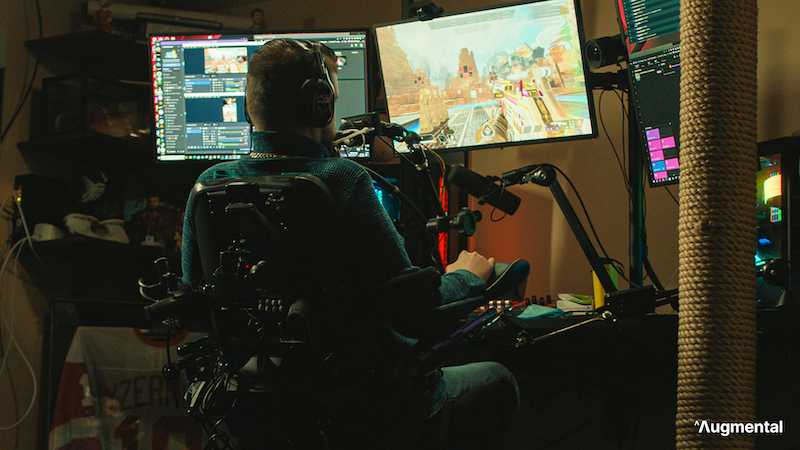
While eye-tracking technology, ‘pure’ voice assistance, and even lip-controlled joysticks all offer degrees of hands-free access to the digital world, users can be left frustrated, fatigued, or with damage to their teeth.
“As our lives become increasingly intertwined with technology, and the world expands from the physical to the digital, it’s more important than ever to ensure that everyone has equal access to control inputs and new interfaces,” stated Tomás Vega, co-founder and engineer at Augmental. “Interactions with these systems must be designed to cater to how humans perceive, process, and act.”
Augmental worked with the disability community to gain invaluable insights that helped it to develop the device. The goal now is to scale up the MouthPad^ so that it can be used by the broadest possible audience, allowing people to carry out everyday tasks hands-free and enjoy digital control with greater ease and independence.
“Universal design has the power to greatly expand digital access for everyone, not just those lacking mobility. In exploring hands-busy scenarios and contexts in which users have limited hand control, we have developed an in-mouth platform that enables convenient device interaction today, while also setting the stage for a future of more human and less distracting heads-up displays,” commented Corten Singer, co-Founder and engineer at Augmental. “Our technology should meet us where we are — not the other way around.”
Though the MouthPad^ has been found to address relevant needs for people with quadriplegia and limited hand control, its reach extends beyond these cases as assisting those in ‘hands-busy’ scenarios to enhance productivity and performance of people such as surgeons, gamers, astronauts, lab technicians and factory-line workers.
“It is very exciting to see this technology becoming widely available, not only because it can empower millions of differently-abled individuals, but also because as digital access becomes ever more important in our lives, there will be a need for novel, more seamlessly integrated methods for device interaction. I applaud the Augmental team for exploring creative new opportunities,” stated Pattie Maes, MIT Media Lab, professor and director of the Fluid Interfaces Group.
Wunderman Thompson Lima and Wunderman Thompson’s Inclusive Experience Practice developed the creative campaign and brand experience support for MouthPad^.
Josh Loebner, PhD, global head of inclusive design, Wunderman Thompson, stated, “Sharing this news surrounding Global Accessibility Awareness Day shows that we’re moving beyond awareness to actions through innovations such as the Augmental MouthPad^. This device goes beyond an advancement in technology to advancing opportunities for people with disabilities that dream of showcasing their creativity to disabled consumers and so many others.”
Patan Tarazaga & Dany Minaker, chief creative officers, Wunderman Thompson LATAM, added, “We have been and are committed to promoting inclusive and accessible design work at Wunderman Thompson by implementing several accessible initiatives. Collaborating with this incredible tech device is truly inspiring as It can give access and make life easier for millions of people with disabilities around the world.”
Credits:
Agency: Wunderman Thompson
Global Chief Creative Officers: Daniel Bonner & Bas Korsten
Global Executive Creative Directors & Chief Creative Officers, LATAM: Daniel Minaker & Sebastian Tarazaga
Global Head of Inclusive Design: Josh Loebner
Chief Executive Officer, Peru: Paul Thorndike
Managing Director, Peru: Carlos Bernal
Chief Content Officer, Peru: Augusto E. Landauro
Global Senior Account Director: Dana di Lello
Account Director: Chiara Mavila
Creative Director: Augusto E. Landauro
Art Director: Diana Tamayoshi
Creative: Camille Morgan
Senior Head of Production: Rodrigo Sanchez
Agency Editor: Daniel Ayllon
Creative Collaborator: Bruno Reggiardo
IT Project Manager: Diego Jimenez
IT Project Manager: Beatriz Rosales
Technical Architect: Edgar Soto
Developers: José Andrés Monge, Merelyn Rodriguez, Carlos Loayza & Jocelyn Roman
QA Analyst: Jan Kubny
Global Creative Operations Director: Nora Farley
Global Campaign PR Lead: Jessica Hartley
Global Communications & Public Relations Manager: Emilie Sharp
Public Relations Director, North America: Rebecca Sullivan
Client: Augmental
Co-Founders & Engineers: Corten Singer & Tomás Vega:
Head of Biomechanical Engineering: Julian Castellón Odabachian
Head of Business Operations: Fernando del Campo
Head of Software Engineering: Corbin Halliwill
Head of Electrical Engineering: Jana Marie Hemsing
Head of Business Development: Gabi Muñoz
Head of Design: Oscar Rosello
Augmental’s champions
Brooke Ellison
Krystina Jackson
Tisa Peyton
Kimberlee Jackson
Ronald Jackson
Rocky Stoutenburgh
Christine Stoutenburgh
Jacquelyn Smith
Nico Clothier
Nic Moyrong