Wine advertising has traditions. Pereira O’Dell and Rumble Studios have broken all of them for [ yellow tail ]. The campaign idea even began with a song and the result is fresh, vibrant, musical and accessible. Adam Moses, senior composer at Rumble Studios in Sydney, and Simon Friedlander, creative director at Pereira O’Dell in the US, took The Stable behind the scenes of the making of the campaign.

The Stable: Simon. This is a very different wine commercial. How did it come about?
Simon Friedlander: I moved back to Sydney after seven years in the US at the start of Covid, so I had been working remotely for just a few weeks when the Yellowtail pitch came along. The brief was to reintroduce the Yellowtail brand to the US market and reinforce its core values of optimism and happiness at a time when the world needed it most. We first came up with the line, Hello Yellow. It had a cheery, optimistic feel. I started to hear this little melody in my head, and it evolved into a full song with lyrics that referenced all the simple things that make life great.
I went to my parents’ house to use their old, out-of-tune piano, and worked out the chords to match the melody. (I’ve been playing saxophone since I was nine, so I have a decent musical ear, but I really can’t play piano for the life of me.) Once I had the chords down, I recorded a demo on GarageBand and sent it to the team in the States. I eventually found myself performing the song live for the clients over Zoom, plinking out the notes on my parents’ piano during the first round of the pitch.
The client loved it and we moved ahead to the next round of the process.

TS: Adam, how did you get involved?
Adam Moses: Simon gave Rumble Studios a buzz and told me about the pitch he had just done. I was a.) in awe of his chutzpah, but b.) really eager to make a TVC in this style. The agency wanted to go into the final round of the pitch with a more polished demo so the client could get it stuck in their head and fall in love with it. We made a couple of demos of the piano parts and got a VO artist in to sing the guide track. We wanted it to be more conversational than sung. When we presented it to the client, they loved it so much Pereira O’Dell won the Yellowtail account and the first thing they wanted to do was make the exact spot we had pitched.

TS: Simon, you and Adam worked extremely closely on the music, how did this collaboration work?
SF: Collaborating with Adam came naturally. We’d known each other for years so there was no ego or awkwardness — we just sat down in the studio and hashed it out on the spot. I knew exactly what our team wanted to achieve with the song – to create something simple and charming yet polished enough to carry a visually rich TV spot. Adam was able to make that happen. Doing it this way, versus working remotely with a music company, spared us from the constant back and forth over email to get something right, which can often happen. We were able to work a lot faster and get a lot further in a short timeframe this way.
I’d sit with Adam, send off our work to the team in the States in the afternoon, wake up to feedback and get on the phone with Adam in the morning and have changes back to the team in California by their end of day. Working remotely with people on another continent does have its advantages and we were able to maintain a constant workflow.

TS: Adam, this was rather a unique process…?
AM: It sure was. It felt a bit like Tin Pan Alley. Simon coming to me with a great song idea, and all it needed was for me to flesh it out and drive the project musically. The great bit was just having the “client” in the room. Getting instant feedback from someone sitting right next to you means you can explore, experiment and create so much faster, together.
TS: Simon, a global project under Covid’s challenges. How did that work?
SF: I’d start work around 6:30am, which was late afternoon in San Francisco and end of the day in New York. I met with our team every day to get on the same page and work out what needed to be done for the following day. Working this way – a sort of “follow the sun” model – actually made us really productive and meant we were constantly moving, constantly improving the work. New York would pick up only a few hours after I ended my day in Sydney. Our agency producer was in NYC, our ECD and team in San Fran, production company in LA, music house and CD in Sydney, casting and talent in London and the shoot was in Kiev. A very global undertaking indeed and although there were a lot of moving parts, when you work with pros, everything works really well. Covid only really impacted us in the logistics of producing the spots. You end up finding a way to get it done.

TS: Adam, what happened once you got the go ahead to create all the spots?
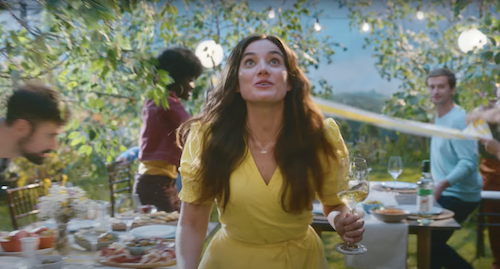
AM: Simon and his team had written three main 30-second spots. An evergreen, a holiday, and a Super Bowl spot plus a bunch of 15s. We had to get all the demos in a great place prior to shooting in Kiev, so that the talent could sing to camera on set. There were some intricate tempo shifts to the music to fit things together for the 30s and the 15-second cutdowns, and luckily we were able to work with a pre-viz to make sure we were on the right track. We did a source connect session with our actor/singer, Ebony, in a studio in Kiev prior to the shoot, so we could edit the songs and have them ready for filming and playback.
Interestingly, I think it also actually helped Ebony prepare for her role in the ad, because she was able to take Simon’s direction before the shoot and deliver it the way we wanted her to. This meant the sync to camera felt very natural. Once it was filmed, the edit was quite easy. The music dictated much of what the editor could do and it was up to us to arrange and orchestrate the parts to make it better and fuller.
TS: Simon, have you had an opportunity to work this closely on the music for a commercial you’ve done before?
SF: Music is so subjective. What’s in the minds of the client, agency and music house can be surprisingly different for the same brief, so being able to sit there with the composer and lock in the musical vision in real time saved countless hours and emails. I’ve never worked this closely with a composer in the States, so it was as fun and efficient for me as it was for Adam.
TS: Adam, Do you usually collaborate with creatives so closely?
AM: Firstly, Simon is extremely musically gifted, so it was an easy process to begin with, as there was a very effective base level of understanding from the outset. There was also strong trust and respect between us, and that truly made the process a delight and one of my favourite ever jobs. This process was indeed a unique one, but I don’t necessarily think it should be. Creatives and producers often sit with the post engineers at Rumble, and directors will sit for days with their editors, and yet I have often thought there should be more involvement with the composers too. Not everyone likes to work that way, but I love it.
As a seasoned composer in the ad industry there is something so fresh about collaborating in-person with creatives and directors. To have creatives in the room makes a huge difference, as it allows the opportunity to be involved in critical decision making and be a major part of the process. If you can see where you have come from, you can get to the end of the process with more understanding, while maintaining the track’s original integrity and making less revisions. More than all that though, music is a collaborative venture, and be it film, TV or advertising, it’s always best and WAY more fun to do it together.
TS: Last thoughts?
AM: I think with everything that has gone on this year, and the highly stressful level of “news-watching” and general negativity across the airwaves, a commercial like this stands out as a bright, fresh, and fun bit of advertising. It’s a super catchy tune, it’s not taking itself seriously, it just has some magic and some positive vibes.
SF: Ditto.