
Some laws become absurd over the years. Europe’s Official Catalogue of Authorized Species is one of these. Its original aim, guaranteeing food safety for everyone in the European Union, was well-intentioned, guaranteeing food safety for everyone in the European Union. Currently, it prohibits the sale of more than 2 million varieties of seeds grown in France and inhibits the ability of French people to vary their diet.
Farmers have to depend on expensive hybrids patented by the agrochemical industry. Consumers miss out on a wide range of products that are often richer in nutrients and taste, and better for the environment.
French retail chain, Carrefour, is leading producers in a campaign to make fruit and vegetables grown from farmers’ seeds available to consumers. Farmer’s seeds are seeds that farmers select themselves and then cultivate from one year to the next in their own climate and soil conditions. The resulting fruit and vegetables are all different out in the field. This practice is essential for maintaining the planet’s biodiversity.
90% of the planet’s cultivable varieties having already died out in the 20th century [source: FAO]. The campaign also hoped to preserve the planet’s farming and food heritage, as well as safeguarding its biodiversity.
So Carrefour was asking for two key points of the current legislation to be changed:
• Simplify the law so that small farmers could sell their freely reproducible seeds via short supply channels
• Open up the official catalogue to include these farmers’ seeds, so that the resulting fruit and vegetables could be sold as widely as possible among all consumers.

So on September 20 2017, Carrefour, began selling a selection of fruit and vegetables grown from farmers’ seeds, which had never before been sold in supermarkets or hypermarkets, in forty of its stores in Paris and Brittany.
Around ten species of fruit and vegetables were grown using organic farming methods – Armorican pink onions, Camus artichokes from Léon, Glas Ruz artichokes, half-length Cléder shallots, Angélique pumpkins, Kouign Amann butternut squash, Kanevedenn tomatoes, Trégor white beans, Brittany tangy rhubarb and Armorican black radishes, and the products grown using farmers’ seeds it sold changed with the seasons.
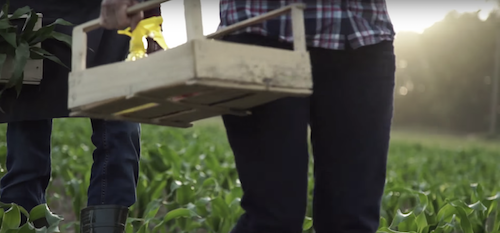
Carrefour also set up an online petition at carrefour.fr and Change.org in a bid to get the public authorities to think again about farmers’ seeds and allow consumers to show their support for the Carrefours initiative.
To point out the absurdity of the law, Carrefour’s “black market” (Le Marche Interdit – in English, The Forbidden Market) was promoted through TV, online and print media, where Carrefour depicted its farmers and producers as illegal veggie dealers.
The Black Market began on September 19 with an “illegal dinner” that ran concurrently with the French National Food Forum. This put Carrefour itself at risk for heavy fines. The following day, when the Black Supermarkets opened, 600 forbidden varietals were displayed in massive herbariums, over which hung the faces of illegal producers who had been sued by agrochemical lobbies.

Over the course of the National Food Forum, the Black Supermarkets generated over 300 million media impressions—69% of which were online, driving people to the petition. Carrefour’s in-store traffic rose 15%, its produce section by 10%. There was an 8% rise in positive brand sentiment toward Carrefour, lifting its score from 65% to 73%.
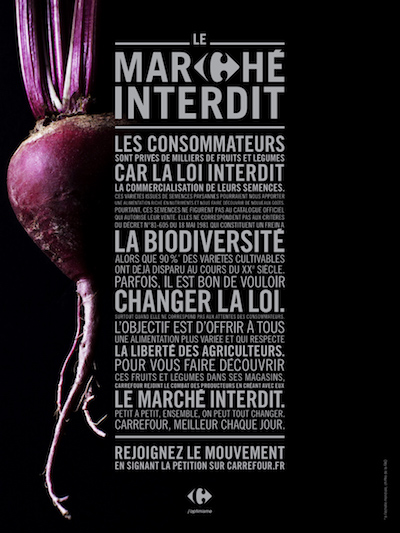
And on April 19, the European Parliament ratified a new organic agriculture regulation, re-authorising the sale and cultivation of farmers’ seeds. Now Carrefour has launched another web film through Marcel Paris which spreads the word about the campaign and its success.