“Australia is a sporting nation.” The problem with having this as a defining statement is that it doesn’t leave room for all the other things that make up Australian culture. And the problem with that is advertising doesn’t get a chance to talk to all of us. Not all of us even run, although sports brands seem to be fixated on the idea that most of us want to. Not all of us surf, but health and wellbeing brands seem to think most of us want to.
Football, cricket and tennis. We get it. They’re popular. And they’re backed by sophisticated corporations that make it easy for advertisers to align with them.
Last week, Nike placed itself at the spearhead of popular culture – globally – with an ad that had nothing to do with football, cricket and tennis. Or running. Its focus was dance. Nike has recognised that dance, music, fashion and what’s trending live together comfortably. Influencers like FKA Twigs and Yanis Marshall are putting dance at the forefront of what’s happening. Beyonce, Rihanna and Justin Timberlake (inter alia) are making that accessible to all. There are more people trying to master JFH (the dance style of Beyonce) in Studio 2 at Sydney Dance Company on a Saturday afternoon than there are surfers on Bondi Beach (OK, that’s a generalisation, but I did count both last Saturday).
International dance legends like Yanis Marshall and Mia Michaels have noticed that dance is surging in Australia. Marshall is currently hosting sold out workshops in Sydney, Melbourne, Brisbane, Adelaide and Perth. Mia Michaels’ kicks off in February.
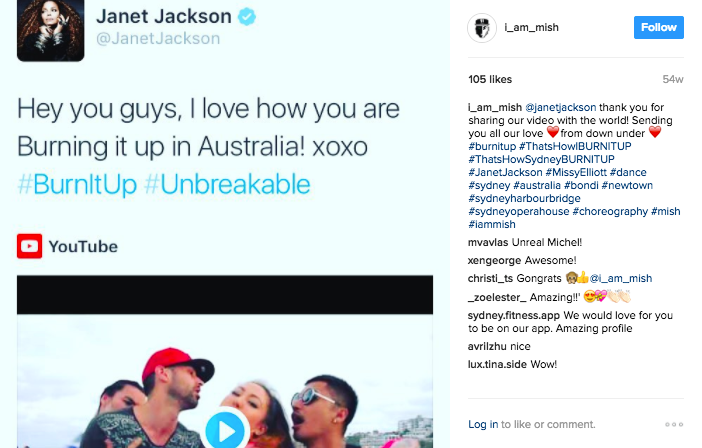
Australian choreographers are quietly influencing culture. When The Dream Dance Company co-founder, Stephen Tannos, produced a dance video for Macklemore & Ryan Lewis’ Dance Off, a bit of it ended up in Macklemore’s own music video. Choreographers like Tannos, Marko Panzic and Michael Boyd and dancers like Bec Morris have thousands of followers on social media, watching what they write, like, think, wear and do.
Bec Morris is part of the top tier in dance in Australia, with an entourage of young people who “want to be like her”. That’s not an easy place to get to and Morris began when she was two and a half years old at one of Australia’s most famous dance schools, Brent Street.

“I became a professional dancer purely for my love of dance and music. Everything I dance to or create is driven by beats and lyrics but most of all passion. I also want to be a success dancer in Australia and around the world to inspire the young generation, people my own age and the older population so they can feel the love and dedication I have to my art,” she noted. She trained in many styles including classical, tap, musical theatre and contemporary, and now specialises in hip hop and jazz.
Morris knows that the dance community here has a significant imprint on aspiring dancers and is making a growing impact in the wider community. There is a huge dance school network catering to interest in the dance styles seen in music videos as well as traditional dance styles, beside the “establishment” dance companies, like Sydney Dance Company and Bangarra. “Australians in LA are known for being some of the most talented dancers in the world as we have a great training system and a lot of passion.”
Morris has seen that interest grow especially in the last five years. “Our dance community here is still young and hopefully will continue to grow outside of ‘our community’ and into regular households. There are many young students from around Australia, but particularly in Sydney, that admire what I do as a dancer and choreographer which is extremely precious to me. These are the dancers that will keep changing our culture throughout the next decade or two.”

Dancers like Morris tend to be cast in ads because they look good, are good at taking direction and learn how to “sell it” from a very young age. Those ads are rarely about dance. Morris’ list of advertising work includes Royal Caribbean, Ssangyong, Destination NSW, Coles and the Lambnesia Australia Day campaign. Her first advertising job in which she was the sole focus, was Telstra. In 2014, she was the face of Telstra and appeared in its OOH and online mobile campaign.
Much of her work, though is performance, and that began as Cody Simpson’s back-up dancer at the Nickelodeon Kids Choice Awards in 2010. She has been a regular performer on X-Factor Australia over the past 4 years, dancing behind Little Mix, Jessie J, Redfoo, LunchMoney Lewis, Aston Merrygold and Charli XCX, and appeared in Justin Bieber’s video, Company.

Like most dancers and choreographers, she teaches, and this gives her a huge fan base of people from 7-18 years of age. Morris looks after the Young Performers School and Performance Training Program at Brent Street, and also teaches the Full Time Cert IV and Diploma students. From time to time, she also conducts open classes for adult/pro dancers. The videos of these, she noted, are very popular on social media. “Dance videos with kids, teens and adults all have a strong potential of going viral,” Morris stated.

And sadly, like nearly all of those with ambition, she keeps one eye open for opportunities overseas. “Australian dancers and creatives fit in everywhere in the world. There are dancers from many areas of Australia working abroad and quite successfully so. Unfortunately, Australia does not have the same opportunities as places like Los Angeles. All these hotspots are known for LOVING Australian dancers. We dance with a different energy and style, which makes it exciting.”