

London responsible fashion and creative design studio, RÆBURN, has announced its return with a campaign that does not at all follow the predictable pattern of fashion advertising. And that’s the point. Since the closure of its webstore in May 2026, the brand has relocated its studio to the Greenwich Design District and sharpened its focus on craft, creativity, and community. It has also expanded into architecture and furniture, transitioning into being more design-led than fashion-led.
The campaign, RÆBURN, REBORN, was created by RÆBURN founder, Christopher Raeburn, and Elliott Starr, founder of Belief Studio, and illustrates the brand’s move from a traditional fashion brand toward a slower and more considered model.
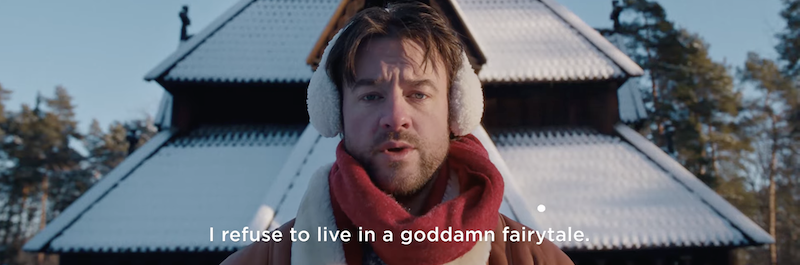
The AI-generated film was inspired by William Rankin’s The Man Who Rode the Thunder. It has launched on the brand’s website and across its social channels, marking a new chapter for RÆBURN and builds on a long-standing curiosity about new tools and formats. The brand launched its first CGI film in 2014, and using AI in a considered way for experimentation forms part of the next step in its evolution.
“Christopher has been rethinking what design can be since the inception of RÆBURN in 2009. We wanted to apply that same logic, rethinking how a boutique brand like RÆBURN can show up in the advertising space, by leveraging AI,” explained Elliott Starr, founder of Belief Studio. “There’s something about committing completely to a leap of faith. You don’t know exactly where you will land, and while you believe, you also know storms will come, and they’ll chew you up, and spit you out. That’s what a launch/relaunch can actually feel like from the inside.
“The reference in my head was the story of William Rankin, but in reverse. Rankin was a pilot who ejected into a thunderstorm at 47,000 feet. He rode the clouds for 40 minutes before landing. RÆBURN’s first ever collection was made from parachute canopies. Once we knew that, the film wrote itself.”
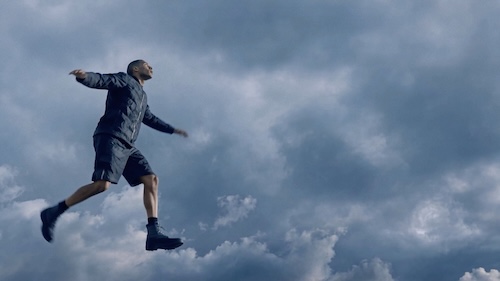

The film’s carbon footprint is estimated to be a fraction of what a traditional shoot would generate. It was generated using a combination of Belief Studio’s owned AI workflows, combined with Google Nano Banana, and Seedance, with sound by Forza Sound.
Christopher Ræburn, founder of RÆBURN, commented,“RÆBURN has always been about testing, learning and doing things in a considered way. Over the years we’ve built films using a host of emerging technologies, and this experiment with Elliott Starr has been a natural evolution of that ongoing thinking.
This film is part of a wider partnership with Elliott Starr, whom I first met in 2025. What struck me early on was Elliott’s curiosity and willingness to experiment, but also our shared understanding that the technology should only be used to create something we simply couldn’t achieve in real life. We’re very conscious of the environmental impacts associated with AI, so throughout the process we’ve been considering how to minimise those impacts and mitigate what remains, including through appropriate verified offsetting.
2026 has been a period of refinement for RÆBURN. We’ve moved our studio to the Design District on Greenwich Peninsula, developed a new website and have been perfecting a curated capsule of RÆMADE products alongside a host of varied partnerships. This film forms another part of that process; experimenting, learning and refining as we continue to evolve the RÆBURN vision for its next chapter.”
RÆBURN’s ethos centres around RÆMADE – the conviction that surplus materials, properly reworked, can become something entirely new. That principle was applied to the production of the ad, with RÆBURN and Belief Studio seeking to offset the project’s footprint through donating to water and carbon-offsetting projects.
Starr commented,”The tools for measuring this stuff are still incredibly rudimentary, but they are better than not trying. We have assumed the absolute worst-case scenario of this film’s footprint, and then doubled it, in turn RÆBURN has also mirrored this contribution. Even then, it’s a fraction of trying to produce this traditionally.”






Leave A Reply