
The biggest untapped market in history has been revealed.
627 million people* around the world are unjustly excluded, or red-flagged, from essential digital services most people take for granted due to bias stereotyping based for reasons such as issues with identification documents, lack of digital literacy, physical appearance changes and country of origin.
New AI-driven fraud threats are causing businesses to become increasingly risk-averse, leaving everyday necessities—such as financial services, education, healthcare, and employment platforms—out of reach. Once locked out, regaining access becomes nearly impossible without significant changes from businesses.
On World Inclusion Day, October 10, online verification platform, Sumsub, has launched a global awareness campaign, Greenflag, with creative agency, Cloudfactory, that aims to unveil the massive issue of digital exclusion and attract businesses to help solve it. It urges them to rethink their verification processes by adopting fairer, more inclusive solutions.
Greenflag is built around the launch of the first ‘nation’ for a people-friendly digital world, where unfairly red-flagged digital exiles can have their chance to rejoin the digital economy. The campaign’s online film directs businesses to the website and uses imagery depicting a floating server, seemingly lost at sea to illustrate the isolation and disconnect felt by the 627 million individuals excluded from essential digital services. It is also supported by influencer activity.
An accompanying whitepaper by Sumsub**, in collaboration with The Catalyst Group, highlights that digital exclusion is not only a societal injustice but also a significant economic oversight, as the lack of accessibility restricts economic participation. In addition, Greenflag will be presented at worldwide tech trade events and rolled out across all global B2B outreach.
Sumsub’s people-centred and inclusive verification products or features can address some of the reasons why people are unfairly flagged. However, other causes of exclusion require more than just technology. Sumsub hopes for a collaborative approach where businesses, governments, and verification providers can recognise the scale of the issue and are encouraged to work together to develop comprehensive solutions, ensuring a fairer digital economy for all.
Greenflag speaks for a largely untapped market with a collective spending power of US$1.75 trillion dollars. For businesses, embracing inclusivity through updated verification processes unlocks vast opportunities. Those ready to rethink exclusionary practices stand to benefit from engaging this economically powerful population.

Julia Kim, chief marketing officer of Sumsub commented: “At Sumsub, we believe that access to digital services is a right, not a privilege. The exclusion of over 627 million people from essential services is a global crisis that demands urgent attention. Through the ‘Greenflag’ campaign, we’re shedding light on this hidden issue and challenging businesses to rethink how they approach verification. By implementing more inclusive solutions, we can empower people and unlock enormous economic potential, while ensuring that digital services are accessible to all. It’s time for the industry to come together and take action for creating a fairer digital economy.”
César García, creative director at Cloudfactory, added, “Our goal was to create a tangible representation of a very real problem that has remained invisible for too long. The concept of the floating server, seemingly lost at sea, powerfully illustrates the isolation and disconnect felt by the 627 million individuals excluded from essential digital services…
“As an agency rooted in Creative Activism, we are dedicated to driving action. Many companies are swayed to tighten security due to new AI driven fraud, meaning businesses become too risk-averse when accepting new customers. We envision Greenflag as a genuine pathway to change, offering actionable solutions businesses can adopt immediately. We aim to show the value in this marginalised group, shifting the perception of risk to a nation that’s now open for business.”
Greenflag will run globally including the US, the UK, Singapore, Hong Kong, Mexico, South Africa, and UAE.
*The Research
Sumsub’s latest research, conducted by Catalyst Group, underscores that digital exclusion is both a societal injustice and an economic oversight. Key findings from the research include:
- Over 627 million people are unfairly excluded from or struggle to access essential digital services.
- Greenflag ranks as the third largest ‘country’ in the world by population.
- Greenflag’s potential untapped purchasing power stands at $1.75 trillion USD.
- Digital transactions for Greenflag citizens could exceed $2.46 trillion by 2028.
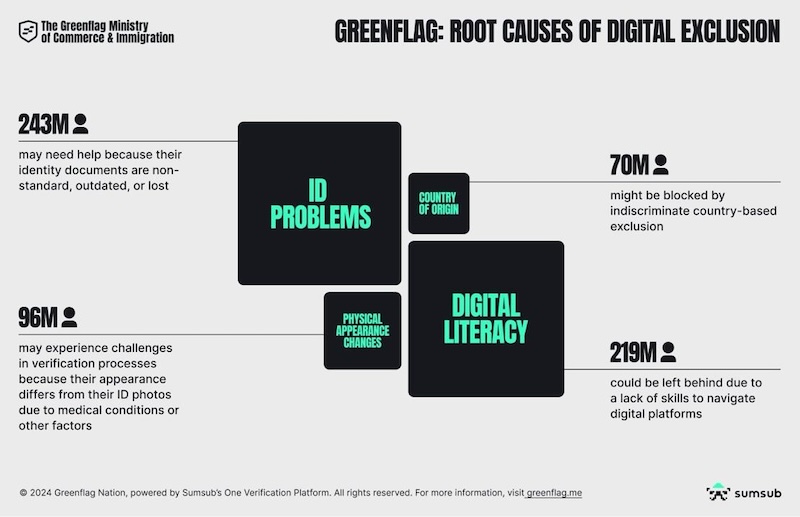
- Identification document issues – 243 million individuals struggle to access services due to non-standard or outdated ID documents.
- Lack of digital literacy – 219 million people are left behind due to insufficient skills to navigate digital platforms. This is due to various factors, including providers neglecting to provide sufficiently accessible support.
- Physical appearance changes – 96 million people face verification challenges due to medical conditions, hair loss, facial injuries, or personal decisions like cosmetic surgery and gender transitions.
- Country of origin – over 70 million people are blocked by risk-based exclusions, with businesses often generalising entire nations as high-risk, unfairly excluding innocent individuals.
Digital exclusion stems from several barriers, often due to verification systems failing to accommodate the diversity of human experiences. Additional research from renowned institutions like Amnesty International highlights that exclusion can be driven by systemic discrimination and repressive governance, which disproportionately affects marginalised groups. For instance, discriminatory policies, barriers for refugees and migrants, and limitations on freedom of expression prevent many from accessing essential digital services. Additionally, economic instability and inadequate social rights further marginalise vulnerable populations, making it harder for them to engage with digital services.
**The White Paper: