

Making content is fun. Clearly. Everyone is doing it. But marketing is not for fun. It’s for business. “You can’t bore people into buying your product” with dull or irrelevant content either. Didn’t the industry learn that with ads?
Atomic 212°, the little agency that thought it could – and has – launched a content business called The Firecracker Factory, in February. In March, it marked its emergence as a full service agency in March by winning eight Shorty awards, the most ever won at the world’s largest digital awards program. And reconfirmed its media might by winning Media Agency of the Year at the AdNews Awards.
The job of winning Atomic’s trifecta has gone to Firecracker’s general manager, David Blight. The Stable asked him to say a few words about that.

Throwing crap at the wall is not a content strategy
By David Blight, general manager, The Firecracker Factory
The content train has left the station. According to the Content Marketing Institute, 87% of brands are going to invest more money into content in 2016 compared to 2015. But does this mean they’ll do a good job in the process?
An overwhelming number of marketers believe they are not producing quality content in their marketing efforts. In fact, the CMA research revealed that only 28% of marketers thought their companies were effective at content marketing. They cited difficulties in creating compelling and engaging content as one of the key hurdles. In other words, a disproportionate amount of brands are releasing content to the market that is sub par in terms of quality.
This is a disconcerting fact, but is also an opportunity for those marketers who invest in quality, as opposed to focusing only on quantity. One well-produced article, targeted perfectly with just the right tone and a strong distribution strategy, is worth considerably more than a hundred poorly produced pieces of content that sit on a Facebook feed. Quality content, backed by a solid strategy and on-point insights, can work wonders for a brand.
Gone are the days when SEO meant cramming keywords onto a page, or when reaching a social community was no more difficult than pressing ‘Post’. Changes to Google’s algorithm in the last few years give preference to strong content; while alterations in 2014 to Facebook’s content feed, and the more recent alterations to Instagram’s feed, favour quality over quantity. Brands can no longer rise to the top by simply churning out as much content as possible. Instead, the giants of search and social favour engaging content above all else.
But forget Facebook and Google for a second, and think instead about customers. This is where brands should be focussing anyway, on providing customers with value. As more marketers realise the need to generate more content, consumers are increasingly exposed to limitless streams of information across an ever-growing maze of channels. In such an environment, brands need to be firing to get cut through. Vanilla content is the kiss of death. It’s a mantra as old as time. But in a world where data and analytics reign supreme, it can become easy to forget that getting your message in front of the right consumer means nothing if you don’t approach them with an engaging message.
Content marketing is something of an unstructured and nebulous term. But one thing is certain: people want to consume engaging stories. It’s a concept that should permeate a brand’s entire existence, from owned, to SEO, to social, to PR and outreach, to advertising and beyond. If your marketing output involves content, which it almost certainly does, it needs to be top notch. Strong content will improve click through rates, drive engagement, promote site authority and brand reputation, generate inbound links, improve your search rankings, spawn shares, and lead to a boost in leads and conversions.
Of course, if you have the resources to produce large quantities of quality content, and if you have the means to fund strategic and widespread distribution, then you’re onto a winner. Red Bull is the obvious example, from its endless stream of super-exciting extreme sports documentaries to its bespoke magazine, The Red Bulletin.
When Felix Baumgartner hurtled to the earth from space, my heart was literally in my throat. Well, figuratively. It was branded content that had me sitting on the edge of my seat like a blockbuster movie. GoPro is also dominating the space, handpicking thousands of hours of quality user-generated content and using it to drive engagement with its products.
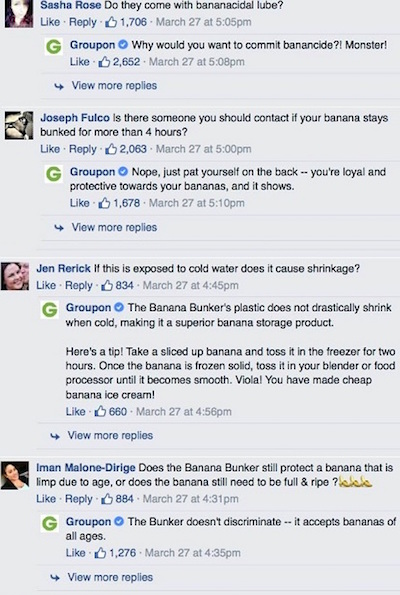
But it doesn’t need to exist on such a grand scale. In 2015, Groupon posted images of its ‘Banana Bunker’ product on Facebook – the device was a phallic-looking object which housed a single banana. Groupon’s marketing team knew the internet trolls would be out en masse, and that sexual innuendo posts would be coming in thick and fast. Instead of shying away from the challenge, the company met the sexual posts head on. Groupon responded to every comment with witty responses of its own (while remaining appropriately coy), despite the fact the product is, in fact, a device for holding bananas and not a sex toy. The post engaged thousands of people and the device sold out. It’s a single example of effective, responsive and quality content generating engagement and sales.

Content marketing is shifting from the throws of adolescence into the unforgiving arms of maturity. Brands that invest in producing consistent, strategic and quality-driven content will have a competitive advantage over those who merely create content for the sake of it.
You might also like