The advertising industry’s attention tends to ping from one international awards festival to the next, obsessing only over what won the top awards and whether or not the judges got it right. The current focus is likely to be on D&AD Impact, Spikes Asia, Sharks Awards Kinsale and Ad Stars, all of which are currently taking submissions for the next waves of Grand Prix and Gold hopefuls.
But last night, DDB Sydney did something everyone should do. It examined in depth the last international awards festival, Cannes Lions, and found a lot of very useful information.
Useful, because as the IPC pointed out, awarded creativity and effectiveness don’t currently go hand in hand, and as DDB Sydney ECD, Tara Ford, pointed out, 89% of ads are not remembered.
Tara retold Richard Brim’s story about the genesis of The Boy and the Piano for John Lewis and Partners’ Christmas campaign last year. What a story. It was originally told by Brim at Cannes Lions to highlight the importance of the What the Fuck factor in advertising. The original presentation was called The Power of What The Fuck (and not being afraid to say something stupid). It was also a lesson in bravery. Agency bravery, not the client bravery that the industry touts. (You can’t have one without the other.)
adam&eveDDB was confronted by a terrifying task – how to come with the most important UK ad of the year, after seven of its predecessors (in a row) had been massively successful. The Boy and the Piano was a wonderful idea – except for one small?? problem. It broke two of John Lewis’ advertising rules. And there are only two of them – no celebrities in ads and don’t tell other people’s stories. The agency could have ditched its idea when the client gave it a resounding no. Most agencies would have. adam&eveDDB didn’t. It worked around the problem and with the client, offering adaptations to its idea that eventually made John Lewis see that the story of Elton John and his piano, and its line, Some gifts are more than just a gift, were unbeatable.
https://youtu.be/5cA7RjKcbk8
As inspiring as this talk was – and it really was – the one by creative partner, Matt Chandler, was spectacular. It demonstrated its own truth. Chandler’s point was that humour had slipped out of favour and had become an underused power. The three ads he chose to make this point triggered belly laughs and spontaneous conversations from the audience. An audience of ad people and clients who’ve seen it all – presumably a pretty hard audience to thrill. His three chosen commercials achieved bronze Lions. That’s no mean feat, but as he pointed out, the top honours went to the very grave and very heartfelt – a sign of the times rather than an antidote perhaps?
Creative partner, David Joubert, highlighted the importance of “finding the enemy within the brand”. (It could also be used as an example of not following the current ad fad. One of these is brands doing good: ed) Brands today are too nice, he said. Standing against something has power. A brand that stands for fresh, stands against using frozen burgers, for example – which led Jackson to one of the most fiendishly brilliant campaigns at Cannes this year, VMLY&R’s hacking of Fortnite on Twitch for Wendy’s, Keeping Fortnite Fresh.
…as well as Cannes favourite, Whopper Detour, the campaign with the balls to offer $1 Whoppers to people if they activated the app at McDonald’s. In case you hadn’t noticed, in this case, the enemy was the competitor. (Burger King also launched Unhappy Meals this year, taking a stand against fake happiness.)
DDB Sydney’s Young Lions winner, Jared Wicker, and partner, Elaine Li, talked about the Young Lions competition., or as Jared calls it “The Olympics of advertising for those under 30”. It rates as one of the industry’s great torture tests. Survivors should be considered capable of handling anything their agencies or clients can throw at them. Along the way, he also unwittingly highlighted one way to be memorable by wearing the same green t-shirt in all four images taken of him on various days at Cannes Lions – and in his presentation. It became an easy game of Pick the Sameness for the audience. As the pair ended up in the top five internationally in this year’s Young Lions, perhaps Jared will be able to afford to boost his wardrobe in the near future?
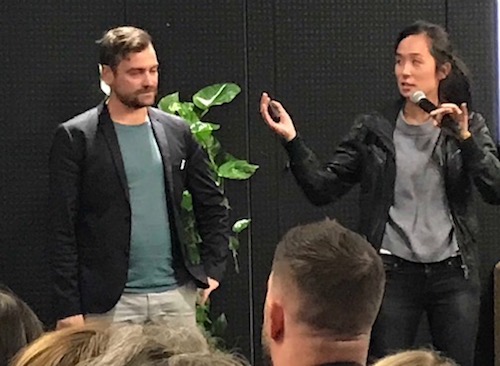
Apologies to the other presenters for not giving them a mention, and especially the awesome Ben Welsh, who closed the presentation. The message I took home is that awards and their festivals may only exist for a few days but they have lasting value. The industry should probably take the time to look back to solve its problems as they arise. (No need to point out that now would be a good time to do that.) If an industry can’t solve its own problems, how can it ask to solve those of its clients?
Candide McDonald, editor.
You might also like