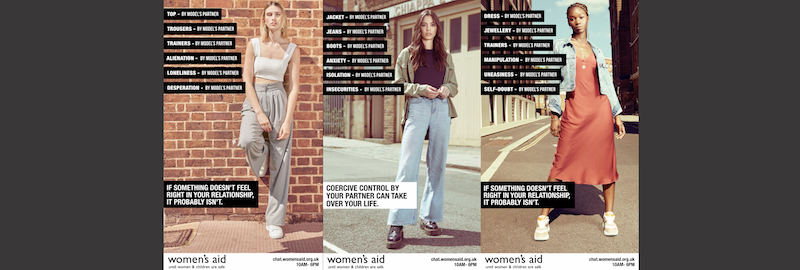
On Valentine’s Day, people are thinking about what love is. This Valentine’s Day, Engine Creative and Women’s Aid, the UK charity working to end domestic abuse against women and children, are interrupting those thoughts by presenting what love is not.
The DOOH and social campaign will run across the UK on Valentine’s Day and is being handled pro bono by Engine Creative.
The brief was to disrupt people’s expectations of Valentine’s Day, a time when relationships are front of mind, and teach them about the signs of unhealthy relationships and coercive control.
While a successful Women’s Aid campaign made it illegal in December 2015, records of coercive control offences have been steadily rising. Police recorded 24,856 coercive control offences in England and Wales in the year ending March 2020, a huge rise of more than 50% from the 16,679 recorded the previous year.
The pandemic has only exacerbated the problem. Within the first two weeks of lockdown alone, there was a 41% increase in users visiting the Women’s Aid Live Chat site to seek help on the issue.
Research by Women’s Aid and Cosmopolitan in 2019 found that over a third of teenage girls had been in abusive relationships and more shocking still, when the remaining two-thirds were asked about their relationships, 64% had been in abusive relationships without even realising it.
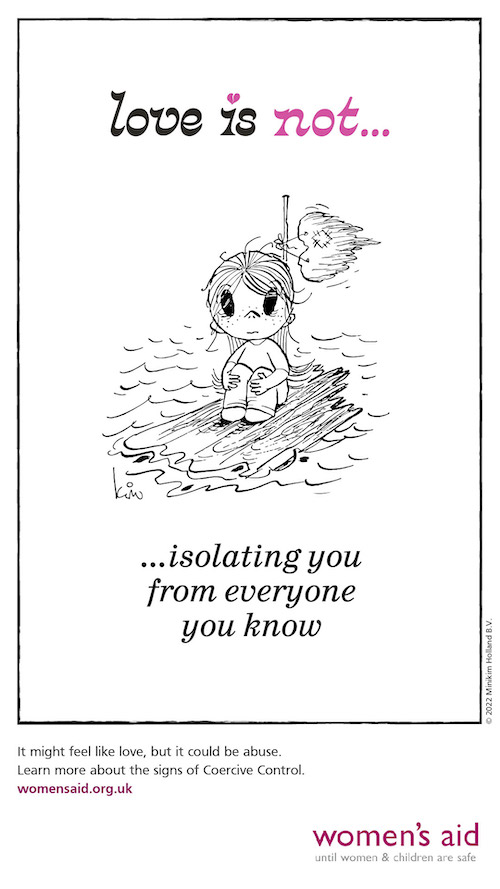
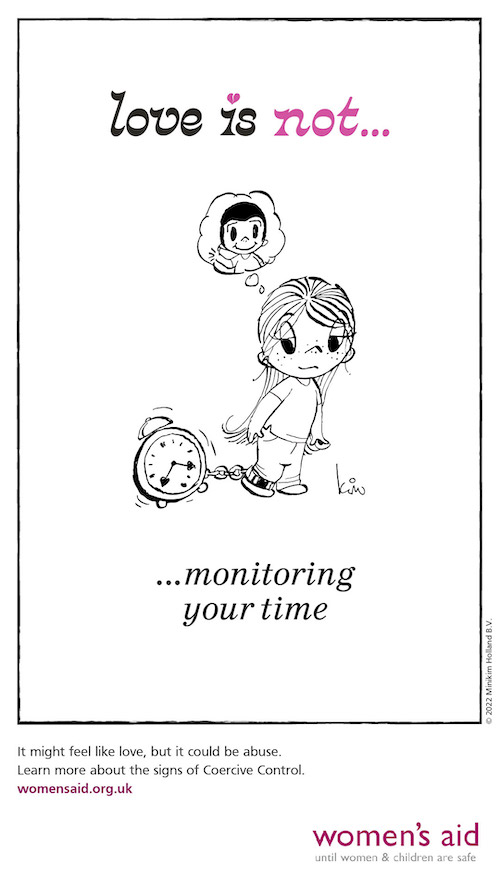
The work is born from the agency’s Truth and Friction creative philosophy, which pits the “truth” against “friction” to tell a story. The truth in this campaign, being that many people mistake controlling behaviours in their relationships for love; with the friction element built around subverting the norms of traditional Valentine’s Day imagery. The campaign, therefore, uses the traditional iconography of love and relationships to encourage audiences to question what healthy relationship behaviours are.
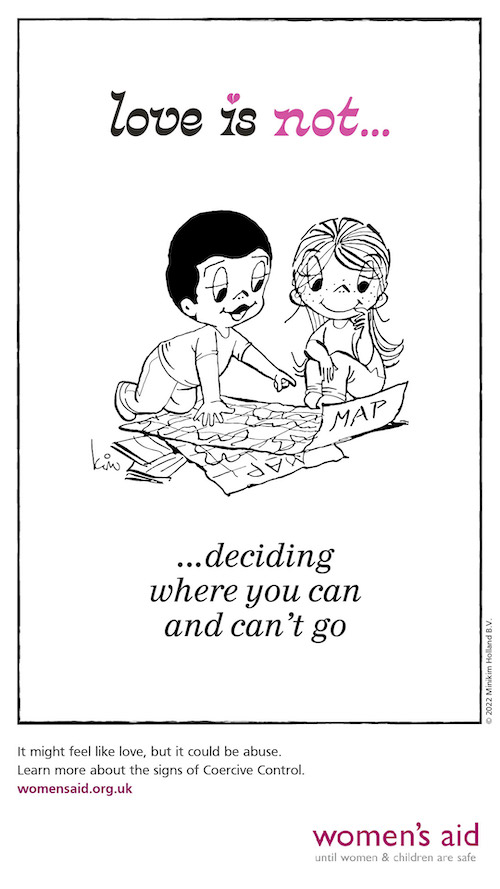
Farah Nazeer, chief executive of Women’s Aid, stated, “This campaign helps spread the vital message that many behaviours commonly perceived to be romantic – such as jealousy, demanding constant contact, and somebody wanting you all to themselves – are actually dangerous. Domestic abuse isn’t just physical: perpetrators use controlling behaviour to make a person dependent by isolating them from support, exploiting them, depriving them of independence and regulating their everyday behaviour. Coercive control creates invisible chains and a sense of fear that pervades all elements of a survivor’s life. Women’s Aid will challenge this abuse, help survivors recognise it, and continue to transform the lives of so many women.”
Christopher Ringsell, creative director of Engine Creative, added, “These playful but hard-hitting executions illustrate what love is not…After all, love does not mean repeatedly putting you down, telling you they’d die without you, or controlling where you are. We were honoured to bring the iconic ‘Love is…’ illustrative brand back this Valentine’s Day, but with a new twist. These cartoons have been adored for decades; by subverting them, we are able to provide a simple way to educate audiences about coercive control.”
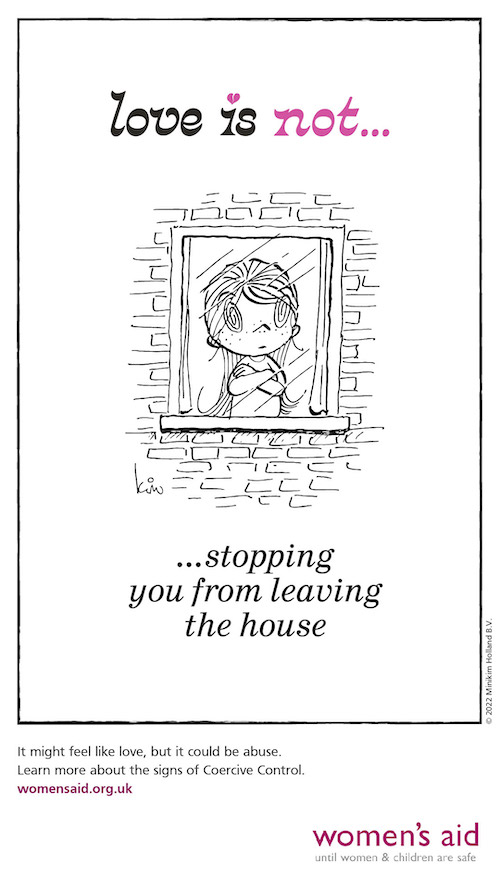
DOOH executions will be displayed at prominent sites up and down the country on February 14. In some locations displaying a series of executions will be shown to convey the variety of types of coercive control that can go unnoticed. Media was donated by Ocean Outdoor & Rapport.
The campaign is built with the famous ‘Love Is…’ illustrations, that were originally created by New Zealand cartoonist, Kim Grove, in the 1960s and originated from a series of love notes that Grove drew for her future husband, Roberto Casali. Each of the little notes involved a small drawing and a personal sentiment that captured Kim’s thoughts for the man she loved. She would hide these little drawings where he would least expect; sometimes tucked in a pocket or popped under his pillow, and also send them to him whenever they were apart. They were published in booklets in the late 1960s before appearing in the Los Angeles Times on January 5, 1970, where they have been published ever since.
Credits
Agency: Engine Creative
Creative Director: Christopher Ringsell
Creative Team: Charlotte Watmough & Holly Fallows
Strategy: Katherine Morris & Kathryn Loosley
Account Management: Marianne Roberts & Katherine Thompson
Project Management: Penny McNally
Design: Tony Cianci, Joe Chakravorty & Maya Summers
Client: Women’s Aid
Partners:
Marketing Assistant, J&M Brands (Netherlands): Sophie Hoyng
Brand Manager, Rocket Licensing (UK): Melissa Satterly
Joint Managing Director, Rocket Licensing (UK): Charlie Donaldson
Licensing Co-ordinator, Rocket Licensing (UK): Emily Morgan
You might also like