Stefan Hunt has won a BAFTA Award for They Saw The Sun First, his eight-minute film that explores the wisdom older people have to share, for an audience that’s younger.
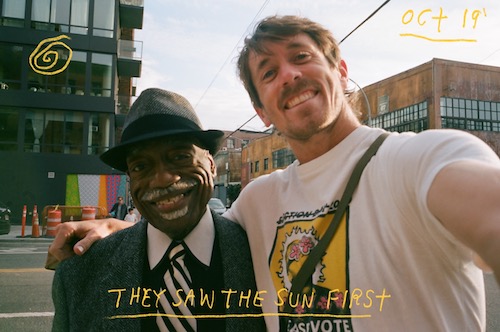
The film came from two triggers that drive Hunt to create. The first is his long-held desire to inspire change through creativity. The second was the realisation that he did not have any older guides in his life.
“The idea began with a conversation I had with an elder, Zenith, about the importance of eldership,” Hunt commented. “I realised during that conversation that all the advice and wisdom I soak up is generally from young people. It felt as though there was a lot to be uncovered but there wasn’t the platform for the elderly to share their insights from a very long life on this planet.
“So I began by interviewing elders around New York City, simply asking them about life, ageing, regret, fear and death. The words hit hard and left me asking the question – how do I get young people to listen to this wisdom?”
Hunt’s wife, Vanessa Marian, is a dancer and movement director. By living with dance, Hunt understood its power to capture imagination and emotion in a way other art forms can’t and to resonate with younger people.
Says Hunt, “We began to wonder what would happen if we mapped the words of the elderly onto young people’s bodies.”
This is the result:
The film called on, and developed, a number of the skills and understanding that Hunt has accumulated through his advertising work. The first of these is making a film resonate with its audience.
“When I’m moved by something, I want to try my absolute best to capture that heart in the film I’m creating. That comes first, before the technical film stuff. The hope is that maybe someone out there will watch the end result it and feel what I’m feeling too,” Hunt notes.
For Hunt, this depends greatly on the cast and crew he pulls together. “We had a tiny cast and crew on this project, so it was demanding. In pre-production I shared the interviews with everyone involved and we spoke at length about the intention of the project. Even the casting process was emotional. Each performer chose their favourite sentiment to embody in front of four people and a camcorder on a couch. Talk about vulnerability. That definitely set the tone for the shoot.”
That the film had a cause behind it is a characteristic of Hunt’s favourite commercial work.
“When you see great creative that moves you on a human level you feel excited at the prospect of adding your own touch to elevate it even more. The cast and crew I surround myself with impact the soul of what I’m able to create greatly. When there are like-minded folk around who are down to just share the message, work hard and show each other respect, the vibe just naturally bleeds into the work.”
Thirdly, there was the element of pressure.
“A great idea also gives me a healthy sense of pressure to deliver on it. I love that feeling. I get really excited by it,” Hunt admits.
Lastly, the film was a turning point for Hunt, a maturing of his style.
Exit executive producers, Declan Cahill and Leah Churchill Brown, commented, “We are so proud for Stef and his collaborators that they won this BAFTA. It is a different approach from Stefan in that it appeals emotionally but through methods that are less traditional and yet more powerful for that. To achieve this just reinforces that his ability to approach characters and performances is innovative but also accessible.”
Hunt notes, “The inside of my head is filled with double rainbows and flying dolphins. For this film, I forced myself to strip everything back and go with a ‘less is more’ approach. I only had one alley-way fear monster with glowing eyes, and this is huge for me. But, at the end of the day, the words of these elders are powerful and I didn’t want to distract the audience from that. I think we found that balance of simplicity with just the right amount of magic.”