
It’s the 40th anniversary of the frustration of solving the Rubik’s Cube. The Rubik’s Cube was invented by Erno Rubik, a Hungarian sculptor and architecture professor, in 1974. It took him several weeks to solve his own cube, so it’s not a humbling experience to be thwarted or resort to the many how-to-solve-Rubik’s posts online.
To celebrate 40 years of the puzzle that drove baby boomers mad, Google has collected designers, artists and creative coders to create digital reinterpretations and has invited all users to submit their own.
As well as creating Google Doodle – a fully playable digital version of professor Ernő Rubik’s cube – designers from the US and UK have released a series of interactive cubes via the Chrome Cube Lab experiments site.
The 12 experiments are:
- 808 Cube by Ray McClure
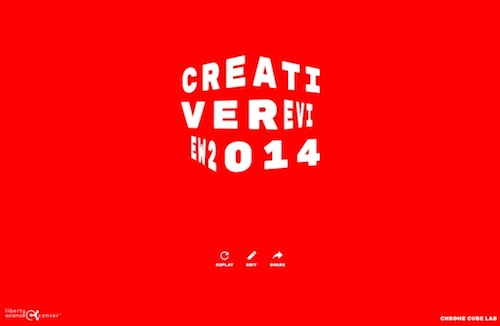
- Type Cube by Richard The
- Light Cube by Mark Lundin
- Synth Cube by Felix Turner
- Scanwich Cube by Jon Chonko
- I Am The Cube by Stewart Smith

- Future Cube by Chris Woebken
- Game Face by Jay Quercia
- Circle Cube by Paul Trillo
- Image Cube by Evan You
- Fruity by Wade Jeffre
- Static Cube by Steve Rura
They all make use of Google’s Chrome browser and its web fonts (the font, Rubik, was created for the project); three.js (the cross-browser script used to display 3D computer animations); HTML5 and CSS3…and Cuber, the programmable “cubing framework” which was originally conceived by designer Stewart Smith of stewdio.
The Lab itself is built on Google App Engine, a Google cloud platform for developing and hosting web applications. Users of the site may also request access to the code in order to build their own cube experiments.
Professor Rubik introduced the next step in his Cube’s journey on the Chrome Cube Lab website:
“The Cube was born in 1974 as a teaching tool to help me and my students better understand space and 3D,” he says. The Cube challenged us to find order in chaos. Since then, technology has made fantastic progress in bringing new possibilities to how we learn and how we tackle bewildering complexity.
“Chrome Cube Lab takes full advantage of that progress by encouraging curiosity and problem-solving skills-the very reason the Cube was created in the first place. I can’t wait to see people learn about three-dimensional objects through their browsers and to test the limits of what is possible when the Cube gets re-jigged using cutting edge web technologies. Cube on!”
You might also like