
It has taken a long time for women’s sports to be taken seriously. The slow trickle of growing appreciation has become a faster flow in the last twelve months, and no event has done more than the current World Cup to make that happen. But we’re not there yet. Still veiled are both the obstacles female footballers face and the leadership lessons that are hidden from girls when they are excluded from sport. Katrina Encanto, executive creative director at 180 Amsterdam explores both to explain “why women’s football is bigger than the game itself”.

The Women’s World Cup currently happening in New Zealand and Australia is the biggest female football event since its founding in 1991. Eight countries, including my homeland the Philippines, have made their debut on the world stage. We’ve seen the first Muslim player wear a hijab while playing. And in terms of ticket sales, it’s meant to be the most attended women’s sporting event in history.
All these historical feats may suggest huge progress. But the truth is, no matter where they are coming from in the world, every team has had to overcome hurdles that their men’s team did not have to, from gender bias and unequal pay to a lack of air time, support, funding or belief. And while some countries have achieved equal pay for both male and female players, the fact remains that female players this year will only earn a fourth of what their male counterparts earned in the World Cup last year.
The field for women’s football is uneven and sometimes unplayable. It makes the female footballers who make it to this world stage all the more admirable because they have made it despite these obstacles. They also often have to perform knowing that the world unfairly underestimates the spectacle that they can bring to the game of football as we saw so powerfully captured in Orange France’s World Cup ad.
And female footballers have shown up more than ever. In some ways, they have no choice but to play until the world can’t look away, to quote the new Adidas ad. Women are often denied a fair game, so they need to play until they are undeniable.
Yet the infrastructure that supports them has not kept up. Whether it’s the academies available to girls, or the shoes they wear, or the research done around training, the inequality surrounding women’s sport has also resulted in an increase in female players being injured. Highlighted recently in a Medicare campaign called ACL United, it shows why female football needs to be reimagined to keep women actually playing it.
What the Women’s World Cup really does is highlight the bigger game at stake. Because for every female player who steps foot onto the world stage, there are millions of girls who are excluded from even stepping onto any pitch at all. Research shows that girls are less likely to participate in sport than boys, and they drop out at staggering rates. Each country will have their own unique set of obstacles, from cultural messaging to financial barriers, but what’s true is that these obstacles will exist no matter what.
Which begs the question: when a girl is excluded from sport, what else is she missing out on?
A study by EY suggests that sport participation as a child is key to making young female leaders rise. In fact 94% of female CEOs have some sort of sporting background. But because globally girls still don’t get the same playing opportunities as boys do, they are excluded from the valuable lessons from sport that turn players into leaders. And this just reflects the reality in business leadership where only 3.4% of the world’s CEOs are female.
As a former varsity player, I know first-hand that the best leadership course I’ve had wasn’t learned within four walls. Through defeat and drills in mud, wins and warmups, sprains, sweat and sleeping on floors, travelling with a team on boats and buses, I learned things I didn’t pick up anywhere else but the pitch. Lessons like confidence, resilience, embracing pressure, accountability, and integrity. Lessons that are key for any woman trying to navigate the often unplayable pitch of life.
Sport teaches us a lot, and it’s time we stop girls from being excluded from this curriculum. Because any gender gap we see on the pitch is only reflective of any room we step into outside of it. And frankly, we need more women who are determined to be undeniable, even on unplayable ground, in roles that require their tenacity.
At 180, we’ve been working with a new team, She Has Fire created for the NGO Game of Our Lives to reveal the lessons learnt through sport that are hidden from girls worldwide when they can’t play.
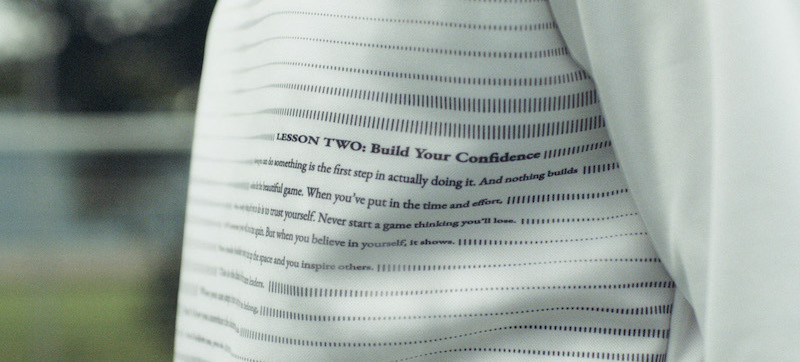
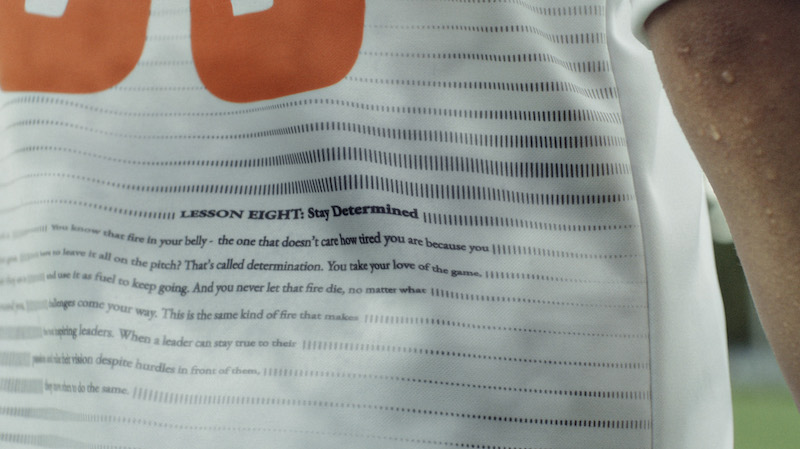
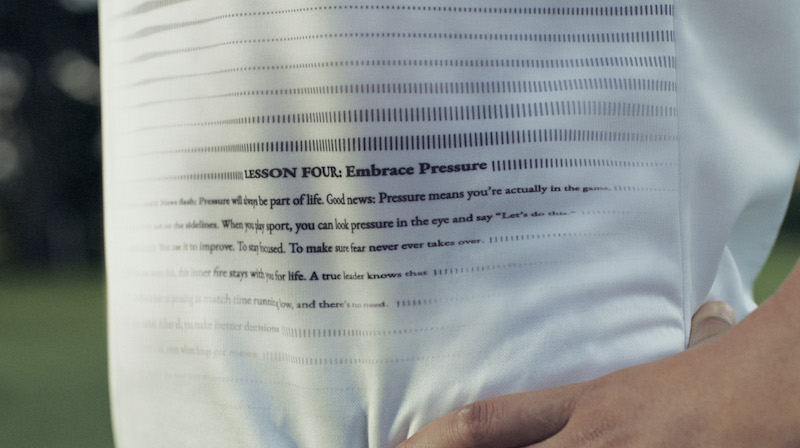
To launch the team, we created a new football kit, with ten lessons concealed within the shirt’s design.
These lessons are endorsed by Danish footballer, Afghani refugee and doctor, Nadia Nadim, who leads the She Has Fire team, and are on supported by a number of renowned international footballers including Wang Shuang (China), Nikita Parris (England), Ary Borges (Brazil), Gemma Bonner (England), Savannah de Melo (USA), Uchenna Kanu (Nigeria), Carson Pickett (USA) and Thembi Kgatlana (South Africa) among others. A beautiful film directed by Iman Whitfield and produced by a team of almost exclusively women from Eyeforce captures the sentiment of the campaign.
We’re sending the shirt to female footballers around the world, to affect change at any level, from grassroots to world-stage, and amplify our message that sport offers essential learnings for each and every girl who plays. And through the Game of Our Lives platform, you can play a role too, by signing up to Nadia’s team and giving time to the cause.
This is the bigger game we can all play for. Because the more we get girls on the pitch, the more women we’ll see leading in real life.