

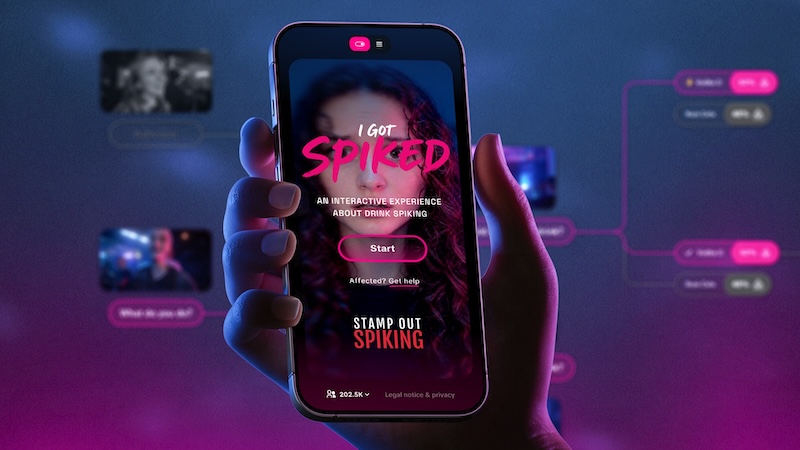
What if an anti-spiking awareness campaign did more than warn? What if it built experience in dealing with it? Independent agency, KNSK, has created I GOT SPIKED, for UK charity, Stamp Out Spiking. The film, powered by Choiz.io’s interactive technology and developed by Stunning Studio, puts young people inside the spiking moment, asking them to make decisions about what they notice and how they respond.
The interactive film follows a young woman called Lisa and her friends on a night out. As situations begin to shift, viewers make choices about what they notice and how they respond. The experience shows how unclear these moments can feel while they are actually happening, and how much the people around someone can matter.
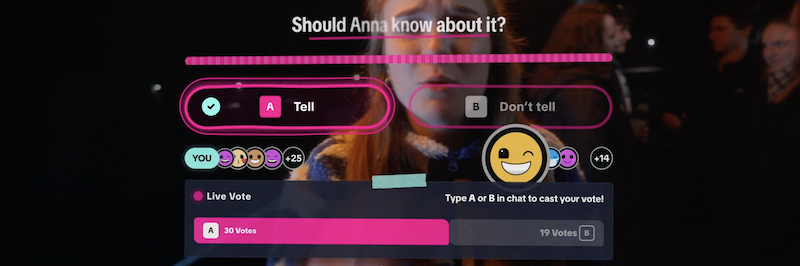
For the UK launch, the experience was played live by Twitch creators, EvieSindorei, Harrie and Alyska on November 25, with their communities voting through chat and collectively shaping how Lisa’s night unfolds.
“Platforms like Twitch are changing the way people experience content and interact with one another. To raise awareness of social issues, we need to rethink how we use these opportunities and make the most of them. I GOT SPIKED demonstrates how creativity, technology and community can come together to turn passive viewing into a shared experience,” stated Alexander Grapp, chief creative officer, KNSK.
The format gives Stamp Out Spiking, the UK charity at the heart of the UK launch, a way to bring the conversation directly into younger online communities that traditional awareness campaigns may not always reach.
“You can’t explain losing control on a poster. You have to feel it. In I GOT SPIKED you make choices, but you never control the whole night. And when a whole chat has to decide for Lisa together, nobody is just watching any more. Some call this a serious game. For us it is a story you can’t sit back from,” added Christine Niemann, co-founder, Stunning Studio.
The latest snapshot from Stamp Out Spiking and Cardiff University’s ongoing Victim’s Journey dataset, checked on November 5 2026 and based on responses from 1,000 people, found that 70.38% of victims had not reported being spiked to police. Among those who did report, 0% said their perpetrator received a prison or community sentence. Published 2025 findings from the same ongoing research show that 55% of survivors were aged 18–25, while only 24% noticed any physical sign that their drink had been tampered with.
Stamp Out Spiking’s work has achieved a significant legal shift – the Crime and Policing Act 2026 includes a new, single offence that explicitly covers spiking. But clearer recognition in law only goes so far if people still struggle to recognise what is happening in real life.
“We’ve spent years campaigning for spiking to be recognised more clearly, and seeing the law catch up matters enormously. But legislation can’t tell you when something is wrong with your friend, or help you recognise that what looks like drunkenness may be something else,” stated Dawn Dines, founder and CEO of Stamp Out Spiking. “We need to get better at looking out for one another. The responsibility for spiking always lies with the person who commits it, but friends, venues and the people around us can make a real difference in recognising when something isn’t right and knowing how to respond.”
The launch took place on the UN’s International Day for the Elimination of Violence against Women and the first day of the 16 Days of Activism Against Gender-Based Violence, just as festive nights out begin to ramp up.
I GOT SPIKED can be played at any time at www.igotspiked.com, alone or with friends. The site also brings together practical guidance on recognising the signs of spiking, what to do if it happens to you or someone you’re with, and where to get help.








Leave A Reply