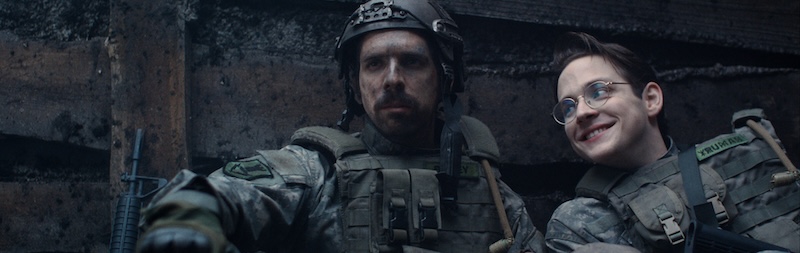
Greenpeace and agency, la chose, have stepped outside the expected environment awareness campaign. This one consists of three parody films to capture the attention of new audiences.
The unconventional portrayals of issues such as plastic pollution, oil production and deforestation depict absurd scenarios by twisting classic movie scenes, and raise awareness about the need to “change the scenario” of the current crisis without delay.
The videos were directed by Alexandre Courtès, known for his clips for Justice and Kavinsky, and for the parody series Au service de la France.
This trilogy, which presents facts as terrifying as they are real, uses humour to rally people around the need to change the scenario and to preserve our future.
Death Forestation highlight the problem of soy production. Every two seconds, the equivalent of a soccer field’s worth of forest disappears from the planet’s surface, dramatically affecting all living species there1. One of the main causes of this natural catastrophe is the growing demand for soy to feed livestock, which is leading to the destruction of numerous ecosystems: in Brazil in particular, entire regions are being deforested and replaced by huge fields of soya for exportation.
Greenpeace is committed to fighting the threat of deforestation and promoting ecological agriculture that respects all living beings.
Plastic Attack highlights the problem of over-consumption. The planet is suffocating under waste from the world’s plastic consumption. Pollution is visible to the naked eye on beaches or in streets, but it also affects us in a much more insidious way, damaging our health, aggravating North-South inequalities, destroying biodiversity and fueling the climate crisis.
Greenpeace is mobilising for the adoption of an international treaty against plastic pollution, which will protect the environment and human health by putting an end to the pollution caused by plastic throughout its life cycle, and by progressively reducing the plastic’s production worldwide.
Total Love urges getting rid of fossil fuels as soon as possible. The fossil fuel industry is responsible for 86% of CO₂ emissions worldwide2! Oil, gas and coal pollute at every stage of their lifespan, from extraction through transport to use.Despite numerous warnings, new fossil projects are being developed all over the world, and some could become veritable climate bombs3, emitting more than a billion tons of CO₂ over their lifetime. It’s urgent to get out of them.
Greenpeace is mobilising the world to stop the expansion of fossil industry projects and make oil and gas companies pay for the consequences of their destructive activities.
The three films will be broadcast exclusively via digital on social networks, a visual display campaign and TV replay.
Laurence Veyne, director of communications at Greenpeace France, stated, “Through these three films, which illustrate three current tragedies – deforestation, plastic pollution and the impact of fossil fuels on the climate – we want to raise awareness of the urgent need to change the scenario of ecological disaster. To write a different story, we need to radically change the rules of our system, which is exacerbating climate change, widening inequalities and destroying biodiversity: on our site, we propose to go further via a wide range of possible actions so that each and every one of us can commit with Greenpeace to building this other scenario to ensure, for us and for future generations, a viable future.”
For Charles Flamand, creative director of la chose agency, added, “The common good deserves big ideas to move forward. That’s why la chose has always stood by the side of great causes, designing communicative initiatives capable of transforming behavior, engaging diverse audiences through the encounter of meaning and surprising expression. Through this campaign, we invite you to “change the scenario” with Greenpeace in the face of the climate emergency. The originality of this statement is that beneath the humor and cruel irony lies meaning, as well as a positive definition of Greenpeace’s role.”
1FAO et PNUE. 2020. La situation des forêts du monde 2020. Forêts, biodiversité et activité humaine.
2Rapport du GIEC portant sur la dernière décennie (2021)
3Selon des travaux publiés dans la revue Energy policy, on en compte 425 dans le monde, réparties dans 48 pays (2022)
Credits
Client: Greenpeace France
Head of Communication: Laurence Veyne
Creative Director: Pierre Klipfel
Head of Audiovisual Production: Myrtille Gibaud
Agency: la chose
CEO & Executive Creative Director : Eric Tong Cuong
Creative Director: Charles Flamand
Art Director: Hugo Morius
Copywriter: Martin Epardaud
Strategic Planning: Céline Faure
Account Director: Gloria Amzallag
Head of New Business: Morgane Mathern-Nguyen
Production Company: Das Ding x Surfacefilms.tv
Director: Alexandre Courtès
Producer: Jeremy Assoun
Head of Production: Thibaut Coiraud
Executive Producer: Saint Gingembre @ Éclosion
Director of Photography: Valentin Vignet
Post Production: 42 Post
Editing: Nicolas Larrouquère
Sound: Solal Tong Cuong @ Baptiste Studio 48