
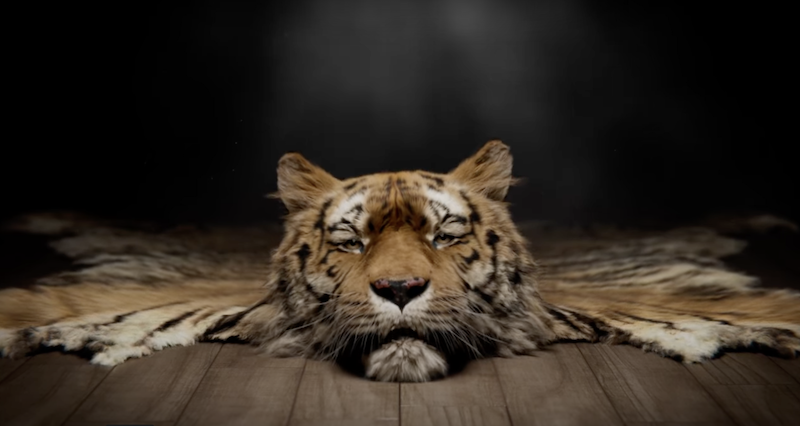
The title, Ray the Rug, gives away the surprise element of this film for tiger conservation organisation, Save Will Tigers – which, after all, is the film’s powercell. But the film does have ancillary power – not least of which is the urgency of its cause.
The 6-minute film features awarded British actor, Ray Winstone, as the voice of Ray, whose monologue highlights the global poaching crisis driving wild tigers towards extinction. The monologue describes the devastating effects of human activity on tigers, blending dark humour with hard-hitting truths.
The film is a collaboration between independent creative agencies, Monster Sauce and Worth Your While, and VFX agency Smoke & Mirrors Bangkok.
Steve Back, executive creative director, Monster Sauce, stated, “With first-hand experience, he is the perfect spokesman for the ever-dwindling global tiger population. You see, Ray is a tiger skin rug and more than that he represents the many illegal tiger parts poached from tigers. In the film, Ray tells us his life story, a simple delivery to camera that doesn’t let the viewer escape without feeling for Ray. The idea was a truly global collaboration, creatively led by Perth start-up Monster Sauce, working closely with WorthYourWhile Copenhagen and masterfully brought to life by the team at Smoke & Mirrors in Bangkok. Featuring the amazing voice of Ray Winstone as Ray the rug the short film is unforgettable.”
Tigers are a cultural and commercial icon, appearing in everything from advertising to fashion. Yet, without immediate action, future generations will only know these majestic animals through images and relics. Tigers have lost 96% of their habitat, contributing to their endangered status, and are threatened by illegal poaching for their skins, bones, and body parts, with as few as 4,900 tigers in the wild worldwide. In recent years they have become extinct in Cambodia, Laos and Vietnam and are now perilously close to extinction in China, Malaysia, Thailand and Myanmar – driven heavily by the illegal wildlife trade which is valued at around $20 billion annually.
Ray Winstone commented, “The decline of Wild Tigers is a sad reflection of what is going on in our world today. We are supposed to be the intellectual beasts of this planet, yet we often prove to be the most barbaric species of all”.
Simon Clinton, Founder Save Wild Tigers, added, “This has been an amazing creative collaboration, involving numerous talented individuals and agencies across multiple countries, with over 12 months in the making. The passion and creativity shown by everyone has been truly outstanding”.
Tim Pashen, executive creative director, Worth Your While, commented, “This campaign is an urgent call to action to save wild tigers, and by extension, broader ecosystems. We are aiming to spark global conversations about saving tigers and about conservation.”
Along with local NGO tiger charity partner, Malaysia RIMUA, Save Wild Tigers will distribute the film along with other educational materials on tigers, their habitat and how to reverse the endangered status, to thousands of schools across Malaysia and Singapore, with plans to continue the programme across the rest of South East Asia.
Mohammad Ali Shakeri, director at Smoke & Mirrors, commented, “When Save Wild Tigers approached us, as animal lovers, we were really motivated to help save these magnificent creatures. We had to study tigers in depth—different species, their anatomy, how they move (especially regarding facial expressions), and this informed how we were going to rise to the different technical challenges we would face. It was critical to translate the emotion of Ray Winstone’s recording into our final film and we all feel proud of the outcome.”
Save Wild Tigers also provides supports and funds to NGOs including their partner, the British based Environmental Investigation Agency (EIA) that is one of the world’s leading investigative agencies into wildlife crime.
Ray the Rug will be screened globally across multiple digital platforms and media channels, countries and audiences over the next 24 months.