
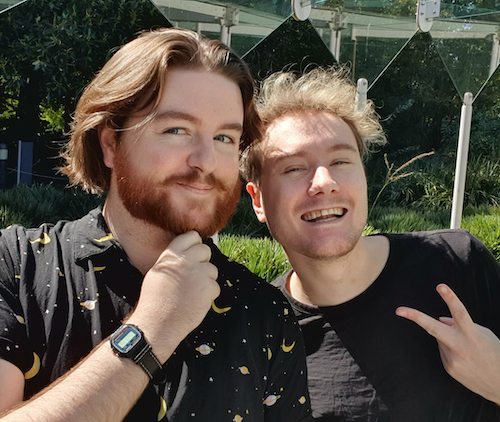
Justin McArthur is an audio producer at Ampel. Jack Eaton works as a self-employed podcast producer and presenter. They’ve been mates for more than a decade. It’s an unlikely pairing. Justin explains, “Jack’s an effervescent host who’s married-with-pets and loves AFL and Eurovision, while I’m a studious researcher/editor who loves spreadsheets and crosswords.” But it works. Justin reckons that’s because, “we’re strong cheerleaders for each other’s successes, and we’ve stuck it out when times were tough. The media industry can be a difficult place.”
One day in a coffee shop, Justin mentioned that he wanted to start a new science podcast for Ampel Audio. Jack confided that he’d always been interested in space “from Laika and Ham to alien conspiracies and billionaire vanity projects; from the glitz and glamour of the (literal) stars to the threatening infinity of the void beyond us.”
And so Mates in Space, the podcast Justin that says “combines my love of weird science facts with Jack’s spontaneous wit and charm,” was born.
Here is the whole wonderful story, told by Justin [host/writer/editor/producer]:
Some podcasts don’t have an origin story. But ours was always written in the stars.
The Australian government announced in July 2018 that they were forming an Australian Space Agency, with the goal of furthering Australia’s civil interests in space research, industry, exploration, and diplomacy.
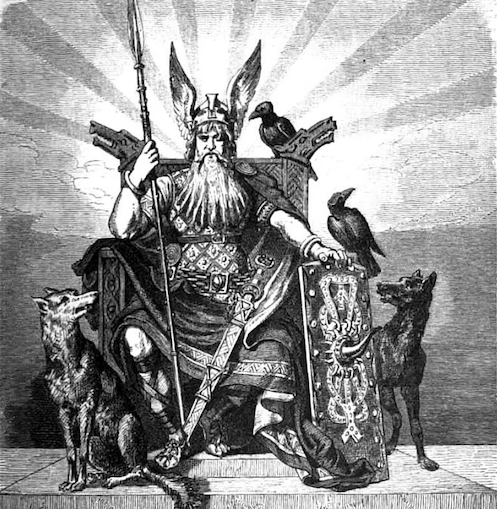
But little did they know of the Norse prophecy, wrought in the early days of the world, which foresaw two charming and handsome podcasters succeeding Dr Karl as Australia’s most beloved science communicators. When news of the Space Agency reached Odin, he tore his sacred Podcasting Locket into two pieces, and scattered them to the wind.
“Fly, my herald ravens!” said Odin. “Fly, my dark harbingers!”
Sure enough, on our travels that day, Jack was visited by Huginn, and I by Muninn. “You must find the locket and reunite it,” they told us.
Jack and I had met in 2011 or so, as fellow students at the University of Adelaide, and we had been immediately enamoured with each other’s enthusiasm and odd sense of humour. After a decade of mostly staying in touch over social media, we decided to bring together our podcasting talents to make a vaguely science-adjacent podcast.
Over coffee, I asked Jack: ‘What science-y things are you interested in at the moment?’
“Hmm – maybe space?” he replied. And so the prophecy was fulfilled.
The initial idea for a space podcast came during a coffee conversation between Jack and myself in November 2021. Both of us were tired of hearing about the billionaire space race between Bezos, Musk, and Branson, and we thought there must be more going on beneath the surface. We were both interested in space for vastly different reasons and saw that we could bring our different creative and comedic approaches to bear on the subject. To put it simply: it sounded interesting, and it sounded fun, both to listen to and to work on. Plus, we relished the thought of working together at last.
When I took the idea to my colleagues at Ampel, they saw the opportunity to do something quite new with Mates. As our GM, Michelle Lomas, framed it, MiS would almost be a ‘culture podcast about space’ rather than a ‘science podcast about space’. We went to work reframing the show under this new lens. In our first season, we decided to focus on ‘how we got where we are’: talking about the history of space food, beverages, animals, calendars, and the Australian Space Agency itself, which culminated in an unbelievable interview with South Australia’s Deputy Premier (and Minister for Defence and Space Industries), Dr Susan Close, as well as Dr Catherine Grace, Associate Director for Space at the South Australian Space Industry Centre (SASIC).
With a finale like that, I think we’ve set the bar pretty high for Season 2. If the story of S1 was ‘how we got where we are’, then the story of S2 will be a bit more about where that is, exactly: Where are we? What are the challenges we face? Who’s going to be leading the way? And what ethical beliefs/values do they hold, whether implicitly or explicitly?
I’ve joked in the past about unseating Dr Karl, but I’d really just like to shake his hand – what a legend! More than 40 years ago, he left a promising medical career so he could better promote vaccine efficacy, and look at him now. I think it’s wonderful that he’s become so beloved and prominent (especially given his remarkable fashion sense).

As a kid, I always wanted to ask him what a compass would do in space. Perhaps I’ll get to ask him one day, when we’re seated next to each other on our trip to the Moon.