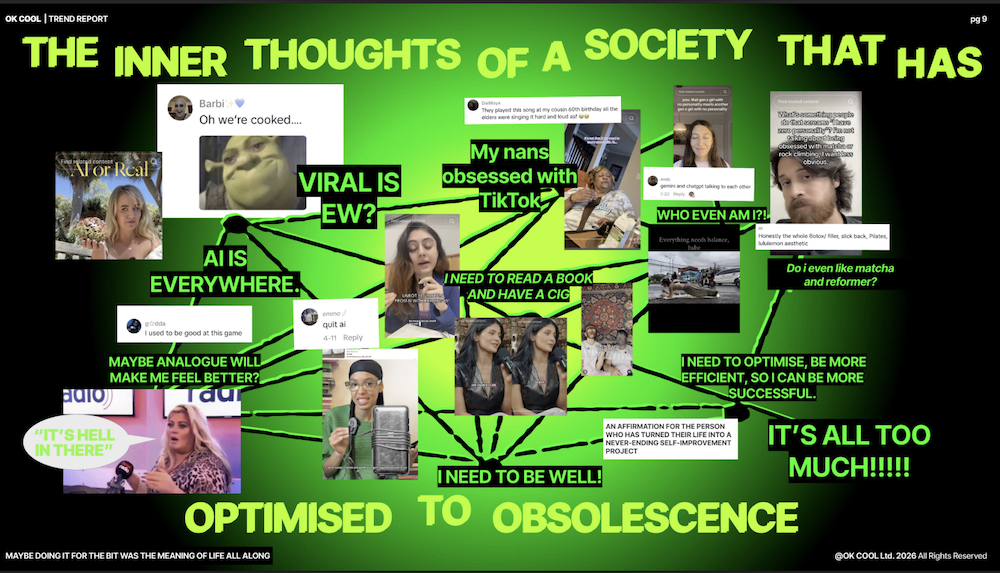
Nearly three quarters (73%) of people say optimisation is ruining their lives, according to new global research from creative agency, OK COOL, part of Residence. Audiences are pushing back against a broader flattening of culture and demand more effort, individuality and humanity.
The finding comes from OK COOL’s sixth annual trend report, with the provocative title, The Societal Ozempification of Personality and the Fight for System Reset.
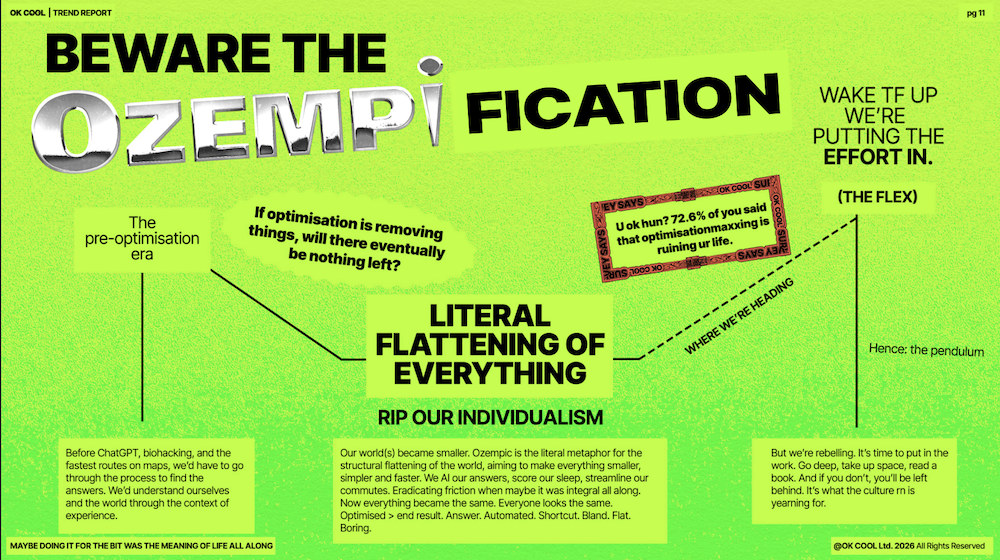
For OK COOL, the reference to Ozempic has nothing to do with GLP-1s. The agency cites it as a metaphor for a broader flattening of culture. After years of hacking, shortcutting and streamlining, audiences are actively rebuilding the friction that was optimised out of their lives, and they now expect brands to do the same.
Based on a proprietary global survey of over 2,900 respondents spanning Gen Alpha to Boomers, supported by cultural observation across platforms, OK COOL has identified five macro-consumer trends forecasting the decisive shift in what audiences value:
1. The optimisation era is dead, and high-effort humanity has taken its place – 73% of respondents say optimisation is ruining their life. The report cites the broader “Ozempification of culture”: a cultural flattening in which the desire to shortcut to the end goal has made everything smaller, simpler, faster, and considerably more boring.
Sixty-nine percent say they now see less individuality in the world, and as a result, there’s a wholesale rejection of the “nonchalance” trend.
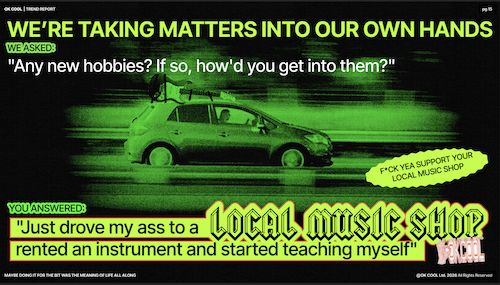
2. Cringe is the new cool – almost 80% of respondents believe that to be cringe is to be free, and 93% percent describe embarrassment as an essential part of the human condition, something that helps them connect, break the ice and discover new things. As one respondent put it, “Cringe is confidence without the fear of being perceived.” That reclamation is showing up as a hobbies boom, with respondents reporting everything from anarchist woodworking to queer line dancing to learning an instrument from scratch at 55.
3. Few say their algorithm truly “gets them.” The report argues that taste has been misunderstood as algorithmic influence and should instead be understood as a practice, a continuous undertaking, both earned and ongoing.
The data supports a population actively working at their taste. While almost half of respondents accept that taste might start on the algorithm, they insist they are putting in the work to craft it in the world, with only 18% admitting they have relied entirely on their algorithm to build their taste. Relationships with the algorithm are, at best, ambivalent: 52% percent describe theirs as a situationship, 27% percent call it toxic, and only 21% feel their algorithm knows their love language.
4. There is no online and offline anymore. This year OK COOL calls it plainly: the delineation between online and offline space has collapsed. Forty-one percent of respondents cannot tell the difference between the two, 22% are following their offline dreams and 39% are, happily or otherwise, online.
Platform behaviour is shifting with it. Instagram is enjoying a full renaissance, with 46% percent naming Reels as their dominant format against 30% TikTok. Fifty-two percent say they belong to exclusive online communities, seeking purpose and specificity over scale.
5. The creator economy is moving from influencer to consultant, where the creators cutting through today are the ones who have proven expertise.
Content is also becoming visibly more cinematic, with creators making a show of production values that rival ATL campaigns and television. Social profiles have become living archives of expertise and proof of process, building names and IP that can outlast any single trend or platform.
This year’s central finding for brands is clear: show you care as much as you want your audience to. Audiences have wised up to low-effort brand behaviour, and they now know exactly what their attention is worth.
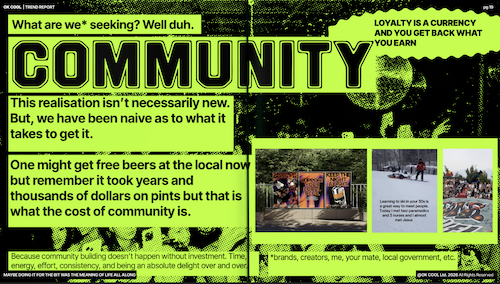
OK COOL’s four takeaways for brands:
- Always be evolving and adapting your approach to brand marketing. A tried and tested formula should not make you a one trick pony. Grow with the culture, prove to your audience you’re continuously putting in the work and don’t let past strategies limit innovation.
- Create for participation. Design your content and experiences in a way that activates the audience and encourages involvement, both online and offline.
- Find your distinction. Originality, perspective and opinion are the only things you have left that cannot be copied and;
- Remember that high effort does not mean high cost. Your consumers would rather see the effort you put into the process than polish and perfection.
“This year’s trend report is an ode to the people and culture pushing back and demanding more from a world trying to optimise itself (and us) into obsolescence. Audiences are seeking the antidote to this great flattening. And where they feel the investment of effort, they match it. But importantly, the trend report is our chance to set the standard for what brand work that asks for attention must actually deliver,” stated Annie House, head of strategy at OK COOL.
“When the Pope and Steven Bartlett end up in the same trend report, you know it’s worth a double click. Nearly three quarters of the people we surveyed told us optimisation is ruining their lives. They’re responding with square dancing, pickling and DJ debuts at 55. They’re putting effort back into the world, and they can tell which brands aren’t. Because if you can’t match that effort, you lose the right to ask for their attention. This year’s report breaks it all down with characteristic OK COOL energy,” added Jolyon Varley, co-founder and global head of brand at OK COOL.
The Societal Ozempification of Personality is available to view and download now at okcool.io.
OK COOL is offering a limited number of global brands a full briefing on the report in the coming weeks. To request a briefing, contact studio@okcool.io.








Leave A Reply