2016 was Creativity for Good’s third year as a stand alone D&AD category. And D&AD chooses its judges the way its judges choose Pencil winners – with the utmost rigour. But you’d have to expect that the Creativity for Good jury is selected with extra emphasis on excellence. Business depends more and more on excellent work for good.
Richard Bullock must have been seen as a natural candidate. He was creating for good long before adland realised it should. He was also creating long form content long before adland realised it should, which aligns him with D&AD’s forward thinking. And he has been so very often applauded for creative excellence, which aligns him with D&AD’s uncompromisingly high standards.
Bullock feels about creativity for good, and Creativity for Good, as D&AD does. “It’s really great to have this whole separate category that’s worrying about the moral rudder of this design and advertising business. It’s fantastic. It’s something to celebrate.
“And to highlight all that genius and all that money and creative cleverness in the doing good front and centre, to have it so you can take ideas to a business and not feel embarrassed because it’s helping people, that’s a really positive thing.”
The Stable was given the chance to talk to Richard Bullock after the Sydney screening of the D&AD 2016 Award winners, where he was one of four D&AD judges in its panel discussion, hosted by The Glue Society’s Jonathan Kneebone.
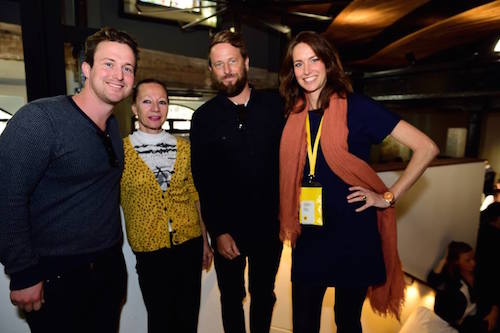
Richard Bullock is the tall bloke in the centre. l-r: Josh Mullens, executive producer and head of projects at Will O’Rourke; The Stable’s editor, Candide McDonald; director, Richard Bullock and Sara Verd, D&AD’s international manager Aus and NZ.
The Stable: What struck you most in the judging room?
Richard Bullock: What stood out for me most was the fact that I wasn’t judging or reviewing charity ads asking for money. Or I wasn’t reviewing a television commercial or a poster. I was reviewing conceptual design ideas, innovations, social behaviour change, movements…things that were so much bigger and more complex than a show about ads for good causes. It was much deeper than that.
And while the brands in Music Video didn’t do so well, our thing was all about brands. The real intention for the category, Creativity for Good, as Andy Sandoz remind us, is profit with a purpose. He said, it’s not a category that’s just for good causes. In many cases it’s about working out how to re-engineer your business or what you’re marketing to have a wider or social benefit. It’s actually a beautiful category because if you do it properly, you’re leveraging squillions of dollars that would normally just go out into the ether for say an entertaining sports ad for a sports brand, and perhaps instead using that money to build sporting fields in schools for kids or get more girls into sport or buy football boots for kids that don’t have them…It’s about brands to rethink how they relate to their customers in the world.
TS: Individual pieces that stood out for you?
RB: Obviously the three that won – M&C Saatchi’s Clever Buoy for Optus, Fairphone 2 by seymourpowell and Security Moms by Ogilvy Brasil for Sport Clube do Recife. But two Brazilian campaigns really stood out for me. Security Moms was one.
The other was for the Good Blood Club blood bank by Leo Burnett Tailor Made, where the blood bank got its employees to tap the shoulders of people who were queuing for restaurants and movie theatres and offer to mind their places while they left the queue to donate blood at a mobile blood bank set up nearby. It was so simple.
Security Moms stood out for me because violence is usually curbed with violence – the “riot squad” is called in with shields, and helmets and batons or whatever – and this was peaceful. Ogilvy called in the mums of the supporters who’d been causing the most violence at football matches to be security guards. And that reduced the number of violent incidents to zero immediately. It stood out, too, because it didn’t have huge numbers to tout (18 to zero) and it was held once, at one local football event. It was just a brilliant, brilliant idea.
And there was one more entry, Droga5’s Fuelled by Bulls**it. It was really good on all levels and it was also very funny and light-hearted in a category that’s normally associated with heavy things. And it was a big brand campaign to launch a car that was done for the wider purpose of alternative tech for the automotive industry.
TS: What were the controversial entries?
RB: We didn’t have too many battles. There were no major disagreements. The jury got to the end of the game with everyone sort of feeling the same way. We were looking for real integrity in the entries, those that had super-super high authenticity about them – that they were solving a real problem, and that it was done for real in a real way and we delved into a lot of entries to make sure they stood up to that. We didn’t want to have things getting through that ended up with someone finding out something less honourable about them. There weren’t many entries ended up distrusting. We did look at the impact or results of each entry to assess it. And was it truly a use of creativity for good. Was it really trying to do that? There are plenty of other categories for entertainment, for being a clever idea, or a cute thing or a funny thing or whatever. This category sits only in the area of creativity for good, so it has to be pretty solid in that.
TS: There were no “traditional ads” in the Black or White Pencil winners?
RB: Yeah. None of the traditional formats. Instead there’s Clever Buoy, a piece of technology. The what3words one is a topographical mapping technique. Security Moms was an event, an experiential thing. I think what lets down what was traditionally a way of approaching a social issue – for example, you might have done a television commercial that raised awareness – is that it can’t compete with something that raised awareness, changed behaviour and solved a problem. So the traditional ad entries tended to fall short against formidable ideas that did the whole gamut.
TS: What were the campaigns that everyone at judging was excited about?
RB: what3words, I think. Because of the sheer scale of it, and also because of the nature of the problem. The problem was something that nobody had even observed – 4 billion people don’t have a proper address. Its genius was the creativity of discovering the problem and finding a great solution for it. It was a clear Black Pencil, and in a very strong category. I mean you has Samsung, Toyota – the best companies putting their biggest money into this category in some cases. It wasn’t a side issue, it was the central focus of their campaigns for some of them.