

Do You Know What You’re Here For? Is not the usual fashion film. As edgy, and often esoteric, as those get, this one stands out for its difference – and its appeal. It follows four characters on the search for a clandestine rave, traversing the highs and lows of club culture, the dynamics of the underground club community and touching on themes of consent, sexual assault, drug use and more. It was written and directed by Joseph Delaney and executive produced by Hannah Bellil, global head of Stink Rising & music video, Stink Films. The film was commissioned by London pre-owned fashion company, Aro Archive. Delaney is head of special projects at Aro Archive, overseeing all visual output of the company and finding ways to breathe life into the collection so it’s not stuck behind closed doors.

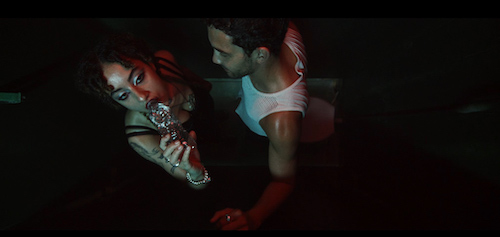
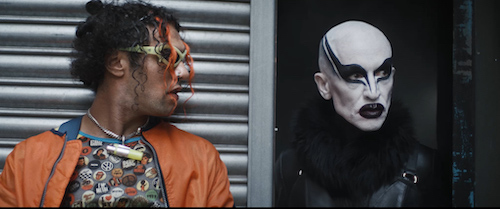
The film was commissioned by London pre-owned fashion company, Aro Archive, and uses clothes entirely sourced from its 10-thousand piece collection, mostly pieces made for or inspired by rave and club culture and styled by stylist and creative director Matt King – from ranges by Calvin Klein, Helmut Lang, IsseyMiyake, Jean Paul Gaultier, Maison Margiela, Prada, Stone Island, Walter Van Beirendonck and Yohji Yamamoto, with its four key cast almost entirely dressed in pieces by club-culture favourites, Daniel Poole and Dexter Wong.
It was shot in and around east London, using a cast of actors and extras from the contemporary club community that surround its creators, including regulars from the doorways and dance floors of some of the city’s most extreme underground clubs. The film’s music made in collaboration with London producer, Severin Black, and it will premiere with a midnight screening on November 25 at London’s Rio cinema, an iconic independent Hackney landmark cultural and geographical centre to the real club community drawn on for the film’s cast and themes.

The film is being supported with print, Instagram Stories, TikTok stories and looks teasers
Here is a little of what lives behind the scenes:
What were the film’s ambitions?
Joseph Delaney: “The ambition for this film and all of Aro’s creative output is to breathe life back into the clothes, in a way that references their past, but at the same time imagines a new life for them that feels modern and rooted in the now. For this film, we wanted to pay homage to British club culture (that’s tied to the designers, Daniel Poole and Dexter Wong, but also that played such a huge part in the origin story of Aro and everyone that works for Aro) but avoiding the overly nostalgia-led approach we’ve all seen so much. Rather, we wanted to tell a linear story that viewers could connect to, to present characters they would feel familiar with and could fall in love with, to join them as they ride the emotional rollercoaster that is the highs and lows of a (particularly messy) night out.
The clothes, then, as in life, as well as adding some vibrancy and texture, act as little symbolic nods that indicate who these characters are, and who they want to be, even if that’s just for a night. Beyond that we wanted to tell a story that touched on real experiences, that didn’t shy away from the often ugly, but also beautiful reality of these situations.

What were the challenges in the filmmaking process?
JD: The main challenge in the development process was in the delicate nature of representing certain experiences on screen as a company and a collective — the film touches on subjects such as consent, sexual assault, drug use and the interplay of social dynamics that come with these things — and so understanding what that meant for both a company and a group of people to hold up those themes was important. The process brought a lot of conversations, largely about consent, the presentation of abuse on screen and the need or not for a sense of justice or retribution and whether that was needed in a story, or whether it was more important to represent what’s more often the truth of such situations — that there is no justice served, that the interpersonal dynamic of groups can enable situations fertile for taking advantage; that a culture and context whose main drive is a search for freedom and disconnect can come with its own trappings, of how easily ecstasy can turn to distress, often literally, and how that cycle of substance-driven search for freedom can become its own prison.
What defines you as a filmmaker?
JD: I think that everything I do draws very much from real experiences, but I’m not interested in depic4ng an objective outside view of a scenario, rather what something feels like.