
Hyundai’s Mopsters have returned to Australian TV screens ion Innocean’s newest campaign for the brand, introducing the brand’s first fully electric Australian small SUV. Their whirling, dancing antics highlight the new Kona Electric’s technological advancements, which include a 450km real-world range, instant acceleration, clever regenerative breaking and a battery that can charge while you sleep.
The films were directed by Sweetshop’s Alexander Brown. Here’s an insight into the creativity behind them:
Tell us about the core of the film?
Alexander Brown: Hyundai is launching an entirely electric version of the Kona, so the core of the project was essentially to make a film which demonstrated the key features. I saw this as an evolution of what we have seen before, so the ever popular Mopsters are back – the colourful car wash brushes that came alive in the first and the heroes of two previous commercials. In the first, they followed the Hyundai Kona out of the car wash to continue cleaning it, dancing around it, twerking and bumping and grinding against it as they go. In the second, they were in hot pursuit of it across the city and into a car park. But this time, it’s all about the electric features of the Kona and getting that story out into the world. So, everything about this car is electric and we wanted the commercial to feel equally electric.
How did you approach the film?
AB: When I was briefed about the project, there was a choice to either embrace CGI and do it all in post or try to create the sequences practically. In the end we decided that doing things in camera would make for a much more satisfying outcome. I like it when you have those limitations. We knew we wouldn’t be shooting in the streets, and we knew that any CGI involving glowing Mopsters would be fiendishly difficult to do well in the time we had to complete production.
And your stylistic technique?
AB: I wanted to find a technique which would give us everything at once with a single technique. I think the best outcomes have a constraint in the approach that you work with. There’s something so much more impressive about in-camera effects. But then, there’s no point building very technical Mopster costumes and then rotoscoping them into a CGI world. I think once we committed to doing everything in camera, it became apparent that we would need a specific technique to build this electric world around them.
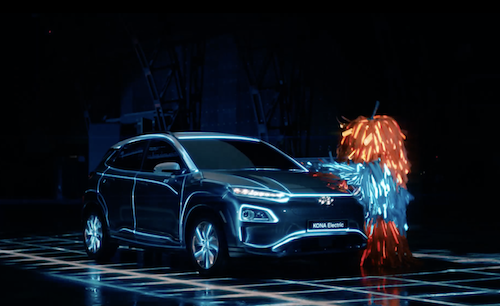
We considered a number of options – LED screens, set builds and light setups. But the one that I thought was the most interesting was projection mapping. Projection mapping feels like one of those things that everyone explored back in 2008 and then just moved on from, but looking back at what was made at the time, they always looked to me like tech demos rather than a technique that had found its stride. What made revisiting project mapping interesting to me was that we could tell the story of the car travelling through an electric world but we could still have an in-camera look, include the electric Mopsters and have everything playing together at once.
The projectors and the technology have advanced so much since then too – the projectors are so bright we had to turn them down at times. We could project directly onto the car too (instead of having to put the car in a white sock), so the whole approach was quite elegant from a technical standpoint.
If you watch the commercial, at no point does the car actually move, it was locked into one spot. Everything that moves around it is projected. Approaching it this way gave us a great amount of freedom to move around the car with a crane and create shots that you would normally need an army of grips and Russian arms to achieve.
The real challenge of a job like this, is that you end up having to do the post production in the pre-production stage, in the same way that you might build a whole street set for a scene, but perhaps see 10% of it on screen in the final edit. Instead of making the CGI for a three-second edit, you need to craft a 10-second sequence to give the crew enough time to shoot it. It meant we had to design the world that the car would travel through in advance, because the projection map would generate the reflections within the bodywork of the car.
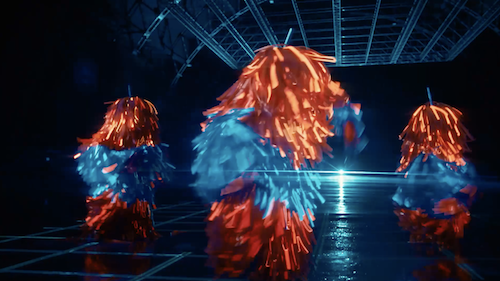
The moment the lights dip it’s as if the audience dives into a different world. What were you trying to create here?
AB: I think this idea of having a family car that is completely electric feels like something from the Jetsons. It’s very futuristic. I wanted to make a film which reminded people of how forward thinking and ambitious this kind of car is. We’re so familiar with car commercials, a car gliding along a pacific highway or through an urban jungle, but with this I wanted to remind people of that flavour of the fantastical and the futuristic. I wanted to make people feel excited about this car.
The colours are electrifying. What was your thinking here?
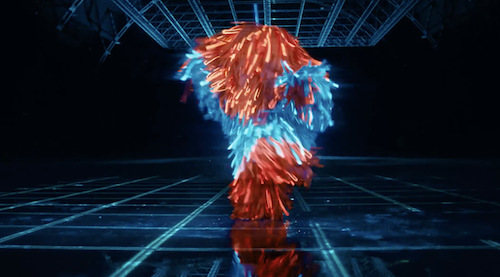
AB: It was always really important to me that the whole spot felt electric. If the car is completely electric, then the film should be too. So, having colours and techniques that felt faithful to this feature led us to this look and feel.
Are the Mopsters real people in costumes or CGI?
AB: They are real and very warm people underneath those layers of foam. The costumes are identical to the ones on previous campaigns, but we modified them with glow paint and EL wire. It was quite a journey to craft that look because there is just so much going on in the costumes to then add a layer of circuitry. It was quite the undertaking by Anthony and his team to realise the vision.
Do you enjoy working with cars and lights:)?
AB: The creative gave me a flexibility in terms of the way I could approach it. Sometimes every aspect has been sold in to the client so you are locked down to a structure before you even begin production, whereas this was quite free. The initial brief from the agency was a grand vision, not a locked down plan. It was really refreshing to be able to take charge and have fun with it.
Credits:
Agency: Innocean
Executive Creative Director: Steve Jackson
Creative Director: Paul Bruce
Art Director: Rod Soares
Writer: Rod Cunha
Group Business Director: Philip Sherar
Senior Business Director: Jo Movizio
Executive Producer: Craig Sloane
Production Company: Sweetshop
Director: Alexander Brown
Managing Director: Edward Pontifex
DOP: Danny Ruhlmann
Art Director: Peter Davies
Projection Mapping: Kit Webster Studio
Post Production – Edit: Arc Edit
Editor: Dave Whittaker
Post Production – VFX: Heckler
VFX Supervisor: Jamie Watson
Executive Producer: Bonnie Law
Colourist: Greg Constantaras
Online: Maxence Peillo