“I can’t wait to see who will prove to be the most consistent young talent in this exhilarating time. Because they are the ones who will be creating something that the world has never seen.” [Rei Inamoto, Former Worldwide chief creative officer, AKQA]
The ones – the Young Glory winners – are Australian. They are two young creatives from Ogilvy Sydney – copywriter, Jane Le, and art director, Ash Myburgh, with 153 points. The competition tests determination as much as the consistency it claims to test. There are eight briefs over eight months. You can enter more than one campaign per brief. The more entries you submit, the more chances you have to win Gold, Silver, Bronze or Finalist which add points to your score. The winner or winning team is the one that accumulates the most points.
These two young hyper-achievers conquered jet lag and a very long day to answer some interview questions from Canada for The Stable. Here is what makes Jane Le and Ash Myburgh tick.
The Stable: With 140 points after round 7 you were 42 points ahead of the #2 team? What were your feelings at this point?
Jane Le & Ash Myburgh: Considering the way the competition scoring system is structured (with the potential for multiple ideas to be awarded in every round), we still knew it could be anyone’s game. If someone really pulled out all the stops in the last brief, they could easily catch up, and the Banjo boys were consistently churning out great ideas. They’d been on our tail the entire time. The fact that we were at the top of the leader board calmed our anxiety a bit and gave us some confidence, as we knew we were in the best position to win, but we also knew that we couldn’t get complacent with this last round. Which is why we found ourselves at the Sussex Hotel one Friday afternoon vowing to give the last brief everything we had. The thought of leading the entire time only to fall at the final hurdle was simply unbearable and we knew we’d never forgive ourselves if we didn’t do whatever it took to win. Luckily, it worked and we didn’t have to hear the dreaded words… second place.
The Stable: Why did each of you enter Young Glory?
Jane Le: For so long I’d been working to get into the creative department at an ad agency.Then one day I realised I’d been employed as a copywriter for almost two years. I really wanted to do Young Glory to see how Ash and I compared to young creative teams across the world, especially when faced with a wide range of different briefs and judges. And after we made it to the second round of Young Lions in 2016 and didn’t do as well as we would have liked, we really wanted to do something that would help us come up with better ideas more quickly and more consistently.
Ash Myburgh: For me personally, I never did Award School or Creative School. I was fresh out of graphic design waters and learned everything about adland on the job. So I treated the Young Glory competition as a mini ad school, eight really open briefs that would challenge my thinking and give me that intensive “training” that I think I felt I was missing. But it was also great to do it with Jane as we had just come from doing the Young Lions competition and we wanted to improve our creative process, especially on tough, open briefs.
The Stable: What were your favourite briefs and why?
Le & Myburgh: Brief 3 (Driverless cars): We loved this brief because it felt like something we could actually be working on in five to ten years’ time, and it made it us feel really excited for the future of advertising and our careers. We loved the idea that as advertising professionals, we could potentially be the ones to introduce the world to history changing technology. We were also very proud of our Drivers of Tomorrow idea. It was our first fully fleshed out campaign of the competition, and we always referred back to it and used it as a benchmark when developing work for later rounds.
The brief for Volvo began with the insight that “if we want a better future, we need no drivers at all”. Le and Myburgh’s campaign aimed to show Volvos commitment to eliminating road accident deaths by 2020, not with better drivers but driverless cars. Driver of Tomorrow began like this:
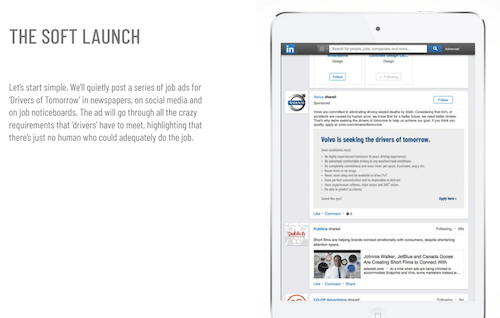
It moved into a series of OOH, press and digital ads inviting people to find out if they qualify as a driver of tomorrow, followed by an interactive driving test, a content series in which five driving instructors (the people responsible for creating the drivers of tomorrow) were challenged to pass a driving test set at the same standard as that used for driverless cars and a week-long ride-share event (accessed by an app) in which people could test “drive” driverless cars.
The girls won Silver in this brief. Read their campaign in full here: Seeking Drivers of Tomorrow_Jane&Ash
Brief 6 (Expedia/Japanese vacation time): We liked this brief because it was such a straightforward advertising brief. We had something concrete to sell, which was a refreshing change from the more lofty, strategic briefs of previous months. After all, selling is what we do on a day-to-day basis. We had a lot of fun with this brief, learning about a different culture and developing strong behavioural insights to create an engaging campaign around (we’ve always considered insights to be one of our main strengths as a creative team).
The girls won Silver for their February campaign, TAKE ONE LIKE A TEAM.
And they won Silver, for The Other Lifetime Commitment:
Read the brief here, and the judge’s notes here.
Brief 8 (Climate change): With this final brief, we learnt so much about an incredibly important topic that will affect all of us. In fact, one of favourite things about the competition is that we now know so much about all these super interesting social issues – like online radicalisation, gun control, the Japanese overwork culture.
We are incredibly proud of the ideas we came up with for this brief. The World of War campaign is something we’d actually really like to see run one day, and we were honoured to present it to an international audience on the main stage at the C2 conference in Montreal and receive some really positive feedback. For this experience alone, we’ll always look back on this brief fondly.
Read the full campaign here: WORLD AT WAR
The Stable: Which were the most challenging?
Le & Myburgh: We really struggled with the January brief on Indian sanitation. It was such unfamiliar territory for us. We didn’t have any prior knowledge at all on the topic or our audience, and it is almost impossible to create a campaign that will resonate with people when you have no idea how those people think, what they care about, what they want and what they need. There were so many cultural nuances that we didn’t understand. We also struggled with time management and work/life balance on this brief too. This brief required a lot of research that we just couldn’t find time for, as January was filled with personal holiday plans and a big campaign at work.
Read the brief here, and the judge’s notes here.
We also found the October brief (Online radicalisation) difficult. It was such an open brief for a very broad topic and we didn’t know where to start. However, we gave it our best shot and October was actually one of our best months in terms of points scored.
The girls won Silver with their October campaign, A YouTube Perspective for You. No Golds were awarded.
They also won Bronze in October for Kickstart a Fearless World:
Read the brief here, and the judge’s notes here.
They won Silver with One Day to Change, in March:
Read the brief here, and the judge’s notes here.
And in the first brief (September), Le and Myburgh won Bronze, with Shoot For The Moon: