
In Brazil, violence against women is not only a public safety issue. It also has a narrative problem. Every day, cases of stalking, abuse, and femicide make headlines. Yet in the way such stories are told, something essential is often missing – the perpetrator. This is largely due to the media’s frequent use of the passive voice in such cases.
Expressions such as “woman is killed” or “woman is assaulted” remain common, even in a context where 84.2% of femicides are committed by the victim’s partner and 64.3% occur inside the home, according to the Brazilian Public Security Yearbook. By placing the victim as the subject of the sentence and omitting the perpetrator, this language contributes to diluting responsibility and making the violence seem diffuse.
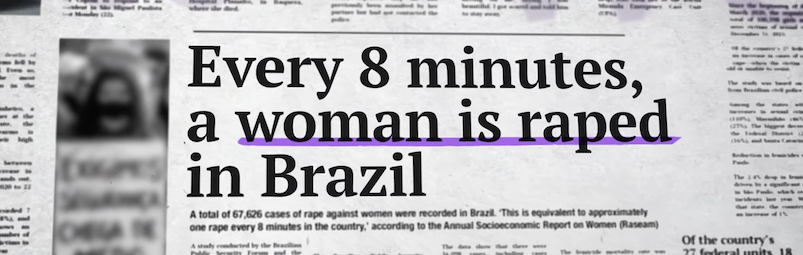
To shift how violence is narrated, and therefore seen, Artplan and UN Women Brazil have launched the Active Voice movement. The initiative proposes a direct shift in how these cases are told, replacing passive constructions with the active voice, a way of writing that makes it explicit that violence against women always has a perpetrator.
“Advancing legislation and strengthening support services for women is essential, but it is not enough. Cultural change must happen alongside it. The way society talks about violence against women directly influences how it is understood. When language hides the aggressor, responsibility is also hidden. The press plays a central role in this and can help reshape this narrative, without normalization,” stated Gallianne Palayret, UN Women representative in Brazil.
More than a provocation about language, the movement will unfold into a practical tool designed for everyday newsroom use, and for the general public as well with an editorial guide to complement existing newsroom stylebooks, and guidance on how to apply the active voice in cases of violence against women.
“For years, we’ve grown used to reading about violence as if it simply happens. But violence doesn’t just happen, someone commits it. And when that someone disappears from the sentence, responsibility disappears with it,” stated Roberta Moraes, executive creative director at Artplan.
The campaign is introduced through a film built from real headlines and a manifesto highlighting the impact of this narrative choice. The initiative also includes engagement with journalists, content creators, and experts, aiming to encourage a broader reassessment of how violence against women is portrayed and, consequently, understood in society.
Credits:
Agency: Artplan
Dreamers Group CCOs: Rodrigo Almeida and Rafael Gil
Artplan CCOs: Marcello Noronha, Rafael Gil and Rodrigo Almeida
ECDs: Luiza Valdetaro, Roberta Moraes, Alex Adati and Renato Simon
Creative Direction: Pedro Galdi, Pedro Rosas, Leila Germano, Gustavo Dois and Thiago Diniz
Creatives: Ana Scala, Michel Martins, Fábio Henrique, Danielle Menezes, Nayara Gonçalves, Milo Araújo, Thayná Moura
Artplan Brasília General Director: Duda Moncalvo
Head of Client Services, Business and Operations: Cacá Malta
Client Services and Business Director: Clara Bianchi
Client Services Manager: Vanessa Braun
National Head of Planning: Paula Lagrotta
Projects Director: Aurora Blotta
Head of Media: Joana Chulam
Creative Data Director: Carolina Amorim
Executive Production Director: Camila Naito
Audiovisual Director: Felipe Cunha
Senior Producer: Lilian Santos
Diversity and Inclusion: Debora Moura
PR: Cláudia Nascimento and Luciana Thomaz
Client: UN Women
UN Women Team: Gallianne Palayret, Ana Carolina Querino, Pedro Nogueira, Ilca Guimarães, Amina Jorge, Bárbara Miranda
Audio Production: Raw
Motion: Rafa Barnette