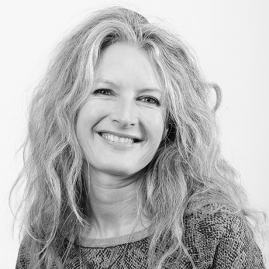
Kate Stanners is among the next generations of ad legends, no question. She’s just not old enough to be there yet. She is, though, old enough to have been there when women weren’t exactly welcome, although she always just thought of herself as an ad creative. She is now chairwoman and global chief creative officer, Saatchi & Saatchi.
Stanners tackled some of the hard questions for The Stable, beginning with…
The Stable: What the hell is going in the business of advertising?
Kate Stanners: I think this is a really fantastic time. You look at Sorrell stepping down. Is that a good thing? I think it probably is for WPP. But does it signal an end of a type of leadership? Possibly. Does it spell the end of the make-up of the holding company? There are lots of analysts saying yes. Once the industry had no holding companies. Our CEO, Arthur Sadoun, (Publicis Group) talks about the holding company as a platform. I like that. If you can get to a place where it doesn’t constrain and hold, and you get to a place where it is genuinely a platform to accentuate and help stuff on its way to popularise the world, that would be exciting.
Right now, everyone is transforming. The one thing for sure is that everything has to change. I think no one knows into what and quite possibly, there will never be an into what. I think we might be in a perpetual state of transformation. Maybe that’s healthy as well?
TS: It seems as though media and creative are realigning?
KS: Yes, we’re making sure that media and creatives work together again. That’s how it was when I started. It just makes sense. I started in an agency with Dave Trott and I don’t think he will be upset when I share that what he would say, and there was a huge sign in the agency that reminded us, is “We’re not about the media we buy, we’re about the media that talks about us. And now you can see that was prophetic. We always tried to make work that people talked about – both in the news and in the pub. Essentially that’s what we’re doing on a bigger scale now. I think we can blame Dave Trott.
TS: What are your challenges to achieving creative excellence right now?
KS: I think the tensions are targeting and scale, speed to deliver and agility – but craft. I think what we’d believe we can do is and/and, rather than either/or. But in the industry there are people leaning towards either/or and looking to specialise in one or the other. There’s also the quality-cost debate – reduced cost fighting with increased craft. Personalised vs general is another tension. And then data and technology driving but not taking over.
TS: Is data hampering creativity?
KS: Data people tell you, “we can tell you if the logo should be red or blue.” “We can tell you if it should be in the left or right corner.” Every time you hear that, you could say a bit of you dies or you could say, “actually it’s helpful if some of those decisions are made for me,” but if it’s going to make the work more effective. I’ve got to believe that great creativity makes work better. Data and creativity have to be in tandem. One can’t overrun the other. One can influence the other, but I don’t think it can dominate. I also think the industry has seen that ads produced at scale have produced this problem. When we look at the work produced in places like Facebook, we can see that it doesn’t work. So, you’ve got a huge discussion around context. Also, this is an industry that leaps on things and then it decides, “OK, not so good.” And I think we’re seeing that happening with our holding companies as well right now.
TS: Is there too much timidity at the moment?
KS: Yes. I totally think there is. I’m a passionate believer in mistakes being OK, and that without them you don’t get to great. I think we’re in danger of being a culture that finds mistakes unacceptable. I think that’s really difficult. It creates timidity because you don’t want to step one way or the other. You can mitigate against mistakes, but I think you always have to build them into your process and your culture if you’re going to move forward. Hopefully mistakes don’t end up monumental, but usually they don’t. Another problem is that sometimes you talk to clients and the response is, “Oh my god, that sounds like too much hard work and really I want to say, “It isn’t – for you”. Because it’s our job to make sure it isn’t hard for clients. It’s our job to make sure an idea doesn’t feel difficult. And actually we should take on things that are hard, because doing something new is going to be harder than doing something that’s been done before.
That’s really one of the contributions of the D&AD Awards and Festival. You can see where people have taken the lead and done the hard thing. And their doing the hard thing paves the way for work to get better.
TS: What stood out for you in the Integrated jury room?
KS: At first when we were doing the pre-judging, I thought, “my god there’s a lot of work and actually a lot of it is good. We’re going to end up with too many Pencils”. But you filter, and filter. You discuss. You all have different opinions. And, in truth, when we all came together today, a lot of the same work had been discussed in different categories. We, though were looking at whether or not each appeared in lots of different media. That each was the kind of idea that couldn’t be constrained by one media channel. That it existed between the lines on a media plan and benefited from how it integrated into something.
I removed myself from the conversation, but the It’s A Tide Ad commercials stood out. Everyone talked about that campaign as integrating itself into the live broadcast of the Super Bowl. It wove itself throughout and owned all of it.
And then there was Fearless Girl, which integrated itself into society, and integrated itself from being a very physical outdoor piece into a social phenomenon.
Then we had Nike Londoner, which integrated itself into London society, but didn’t really go much further. It is interesting that that campaign, which resonated so intensely within its London target market, and especially young London teens, was not seen as an outstanding piece of the Nike ad collection outside the UK.
Wieden + Kennedy London: Nike embeds itself in the spirit of London
I particularly liked the way Trash Isles was an exponent of what we do as an industry. We package things up so that people can grasp them. It took a huge problem, plastic waste, and turned it into a physical, visual thing that people could imagine.
Trash Isles: The floating plastic island on its way to becoming a nation state
Lastly, a personal favourite of mine was Burger King getting people to dress up as a clown for Halloween, essentially a scary Ronald McDonald, and come into Burger King. These are true integrations. They don’t just run down a check list, yes we did a press ad, yes we did a film and so on.