Reporters Without Borders has produced some powerful campaigns with various advertising agencies. This one, by DDB Berlin and MediaMonks, is the most striking. The partners have built a library within Minecraft where censored stories are published and can be read. In many countries, the information that can be accessed online is controlled and limited by oppressive leaders and regimes. This control can take many forms: blocking websites, deleting articles – and in some instances imprisoning journalists and even killing them. In countries where websites, blogs and free press in general are strictly limited, Minecraft, with more than 145 million players every month, is still accessible for everyone. It also reaches young people, the next generation, giving them the understanding to create change.
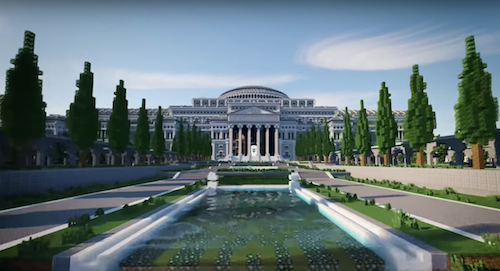
The Uncensored Library was launched to coincide with World Day Against Cyber Censorship. It is accessible on an open server for Minecraft players around the globe and filled with books, containing articles censored in the country of their origin. Articles hidden from government surveillance technologies. The books can be read by anyone and their content cannot be changed. Moreover, the library is growing, with new books being added every week.
Tobias Natterer, senior copywriter DDB, commented, “Minecraft is an open world that gives you a feeling of unlimited freedom and the ability to create unimaginable things out of blocks. We used the creative possibilities of this game to bring censored articles back into oppressive countries.”
Patrik Lenhart, Creative Director, DDB, stated, “The Uncensored Library is proof that creativity will always find new ways to overcome borders. We managed to create a digital safe space for independent information, where more and more journalists can make their voices heard again.”
Robert-Jan Blonk, interactive producer, MediaMonks, added, “It has been incredible to be part of a project which overcomes press censorship in such an ingenious way. To use a video game to publish articles, and to overcome press censorship is a brilliant way to help address this issue among a younger audience. Some of the consequences they may not be as much aware of.”

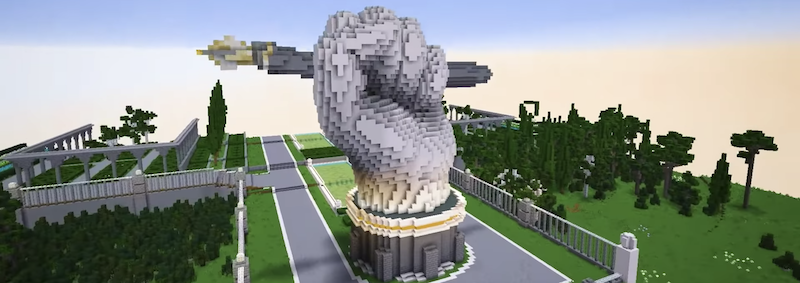
The Uncensored Library was built with BlockWorks, an internationally acclaimed design studio experienced in working with Minecraft. It took three months to build, stands in 1km squared of gardens, and is made from over 12.5 million blocks. 18 builders from 12 different countries designed and created the library over 250 hours. The library’s main dome is nearly 300 metres wide, which would make it the second largest in the world.
The library was designed in a neoclassical architectural style, derived from the traditions of ancient Roman and Greek architecture. Neoclassicism is a style often used in the design of public buildings around the world – museums, libraries and government offices. It is an architectural style that represents culture, knowledge, power and authority. BlockWorks used this style to design a building with an alternative meaning. the Uncensored Library represents freedom of knowledge, and resistance against oppressive government authorities and regimes.

Journalists from Mexico, Egypt, Saudi Arabia, Vietnam and Russia now have a place to make their voices heard again, despite having been banned, jailed, exiled and even killed. Books will be republished in English and in their original language. Arabic articles will also be available as an audio file. In addition to banned articles, visitors can find a report on the current press freedom situation of 180 countries in the world.
The Uncensored Library is accessible through the Minecraft with the server address, visit.uncensoredlibrary.com. The Library is being promoted with a launch film, a 360° walkthrough experience of the library including books, a making-of film, and the full Uncensored Library Minecraft map available as a download to be shared and experienced offline.

The campaign runs under the hashtag: #TruthFindsAWay
Censored articles from five different countries and various journalists have been republished in Minecraft books sofar:
Egypt:
RSF World Press Freedom Index: 163rd of 180 countries
Egypt is one of the world’s biggest jailers of journalists. Most of the media is now controlled directly or indirectly by the state. More than 500 websites are blocked, and more and more people are getting arrested because of their social network posts.
Inside the Uncensored Library visitors can read articles from Mada Masr. Since 2013 the news portal has reported about corruption and security issues in a manner that is often critical of the government. It is the last professional news website that reports independently and is one of the most important sources of quality journalism in Egypt. Since May 2017 the website has been blocked in the country.
Mexico:
RSF World Press Freedom Index: 144th of 180 countries
Although not at war, Mexico is one of the world’s deadliest countries for journalists and even surpasses Syria. Collusion between officials and organized crime poses a grave threat to journalists’ safety and cripples the judicial system at all levels. Journalists who cover sensitive political stories or organized crime are warned, threatened and often gunned down in cold blood. Others are abducted and never seen again.
Inside the Uncensored Library visitors can read articles from Javier Valdez. He was a journalist and founder of the newspaper Riodoce, a weekly dedicated to crime and corruption in Sinaloa, one of Mexico’s most violent states. He was also the author of several books on drug trafficking. Valdez was killed on May 23, 2017 by gunmen. He was 50 years old.
Russia: RSF World Press Freedom Index: 149th of 180 countries
Since the widespread protests in 2011/12 the Russian leadership tightened the grip on critical journalists. Each year dozens of people are sentenced to prison because of their online activities, a simple “like” can put someone in jail. The state has been building the infrastructure for systematic mass surveillance and wants to prevent anonymous or encrypted communication. With Russia’s sovereign internet law, the government is attempting to gain control over the infrastructure of the web and, if necessary, be able to cut the Russian internet off from the worldwide web.
Yulia Berezovskaia is editor in chief of one of Russia’s many blocked websites. She is collaborating with the Uncensored Library to republish articles from grani.ru, a popular news source for protest activities, politically motivated trials and civil society activism. On March 13, 2014 grani.ru was blocked by the Russian government.
Saudi Arabia:
RSF World Press Freedom Index: 172nd of 180 countries
Saudi Arabia permits no independent media. Despite his talk of reform, Mohammad bin Salman has intensified the repression since his appointment as crown prince in June 2017. The number of journalists and citizen journalists in detention has tripled since the start of 2017. Everyone censors themselves, and authorities keep Saudi journalists under close surveillance – as the case of Jamal Khashoggi illustrated.
Jamal Khashoggi was a Saudi Arabian journalist and his articles can now be read in the Uncensored Library. Khashoggi fled Saudi Arabia in September 2017 and went into self-imposed exile. In the U.S. he worked as a columnist for The Washington Post. Khashoggi was a sharp critic of some of the policies of Saudi Arabia’s crown prince. On October 2, 2018, Khashoggi was killed and dismembered inside the Saudi consulate in Istanbul.
Vietnam:
RSF World Press Freedom Index: 176th out of 180 countries
As Vietnam’s media all follow the Communist Party’s orders, the only sources of independently reported information are bloggers and citizen journalists. The level of terror has risen sharply in the past three years, with many citizen journalists being jailed or expelled. In December 2017 the military unveiled the existence of a 10,000-strong military cyberwarfare department, which is tasked with defending the Party and targeting dissident bloggers.
Inside the Uncensored Library visitors can read articles from Nguyen Van Dai. He is a Vietnamese human rights lawyer, democracy activist and blogger. In 2006 he founded the Committee for Human Rights in Vietnam, to fight for civil empowerment through legal means. In April 2018 Dai was sentenced to 15 years of prison with an additional 5 years of house arrest but got later released and exiled to Germany.
Credits:
Client: Reporters Without Borders
Managing Director: Christian Mihr
Media and Public Relations Officer: Kristin Bässe
Agency: DDB Berlin GmbH
Chief Creative Officer: Dennis May
Creative Director: Patrik Lenhart
Senior Art Director: Marco Lemcke
Senior Copywriter: Tobias Natterer
Art Director: Sandro Heierli
Junior Art Director: Sirena Grace Martinelli
Managing Directors: Jan Harbeck & David Mously
Build: BlockWorks
Founder and Managing Director: James Delaney
Production: MediaMonks
Senior Producer: Robert-Jan Blonk
Senior Project Manager: Javier Sancho Rodriguez
Senior Creative: Jamie Moodley
UX Designer: Jeroen Hol
Front End Developer Lead: Rene Drieënhuizen
Technical 3D Developer: Johan Holwerd
R&D Developer: Reinder Nijhoff
PR: The Humblebrag
Managing Partner: Jessica Hartley