
Dyslexic thinkers have a different way of viewing the world. This can be very valuable. On October 8, global Dyslexia Awareness Day global charity, Made By Dyslexia, revealed for the first time the economic value of Dyslexic Thinking – highlighting that the global economy is missing out on a staggering $US3.2 trillion, as well as spotlighting figures for the UK, USand top 20 most innovative countries.
An OOH campaign and the new Return on Dyslexic Thinking report by DDB Melbourne in conjunction with the world’s largest recruitment company, Randstad Enterprise, shows that by empowering all dyslexics, the UK could more than triple the contribution of Dyslexic Thinking to the UK economy from £29.5 billion to £98.2 billion. The report poses The Trillion Dollar Question – can we afford not to empower Dyslexic Thinking?
The global out-of-home campaign, supported by Ocean Outdoor, is running in the UK across prime billboard and poster sites. The posters point to the fact that without harnessing Dyslexic Thinking, the world is missing out.

Kate Griggs, founder of Made By Dyslexia, stated, “Dyslexic thinkers have the skills needed to collaborate with AI and turbocharge innovation in this new age. The ‘Return on Dyslexic Thinking’ should give every workplace a financial imperative to harness these skills. Leading companies aren’t asking if they should empower dyslexic talent, but how fast.”
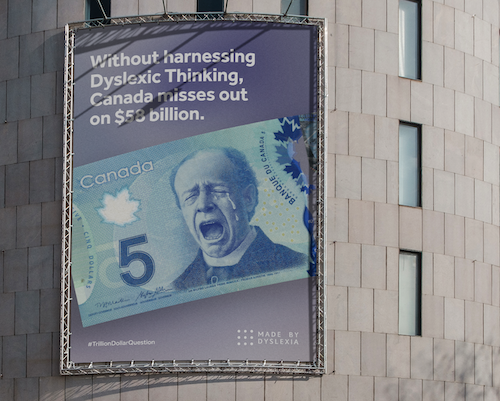
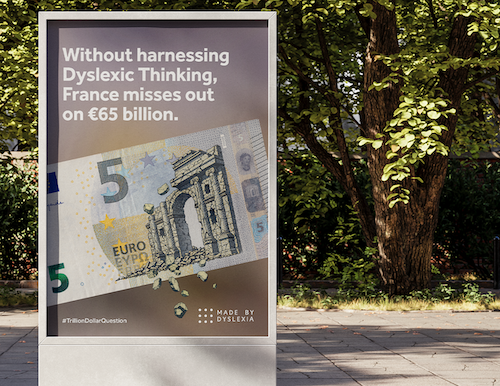
Both the report and campaign are supported by companies, entrepreneurs and high-profile dyslexics, including HSBC, Cisco, GCHQ, Randstad Enterprise, Nick Jones and Dame Maggie Aderin-Pocock. The work shows that organisations that empower dyslexic thinkers to lean into their strengths will be able to unlock more growth and innovation and contribute larger amounts to the economy. Alongside Randstad Enterprise, the charity is working with FTSE 100, S&P 500, and other leading organisations to show how empowerment levels can be raised using The Dyslexic Thinking Workplace Guide, a free interactive resource with simple tools to help organisations hire, support and empower dyslexic talent.
Mike Smith, chief executive, Randstad Enterprise, commented, “Empowering Dyslexic Thinking isn’t a tick-box exercise. For organisations and nations that want to grow, lead and innovate, the ‘Return on Dyslexic Thinking’ makes the business case to recruit and empower this talent.”
Psembi Kinstan, chief creative officer, DDB Group Melbourne, added,“We are once again incredibly proud to partner with Kate to prove the value of Dyslexic Thinking. This report is a critical step towards one of our largest campaigns to date. Watch this space.”
The new activity follows this year’s campaign with Virgin and Sir Richard Branson, highlighting the value of dyslexic entrepreneurs across the UK.