
Men are mentioned four times (81%) more often than women (19%) in UK Key Stage 3 history textbooks. Furthermore, 64% of people in a Censuswide study last month believe the omission of women’s accomplishments has directly influenced attitudes to modern gender roles.
That’s not good enough, and Ancestry has teamed up with Weber Shandwick to help to highlight gender bias in historical documentation and redress the balance by encouraging the public to trace their female heritage, using its access to over 70 billion records from 80 countries.
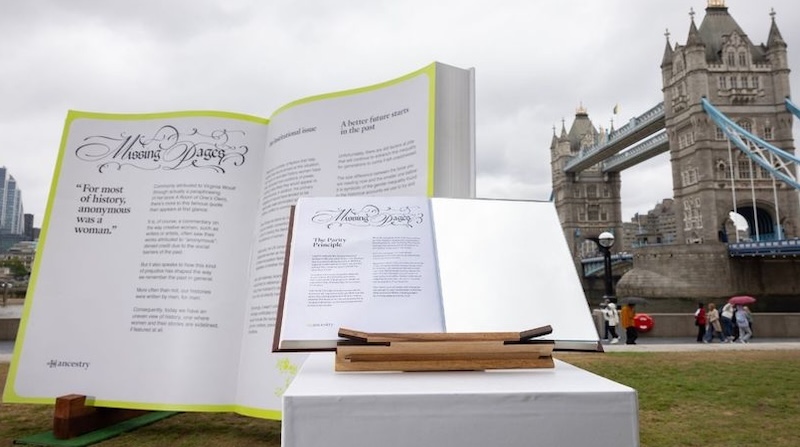
To create awareness of this mission Weber Shandwick and Ancestry erected the Missing Pages installation in London’s Potters Field Park.
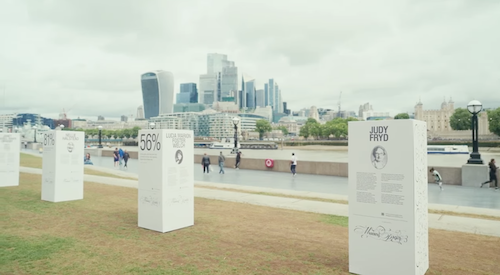
To demonstrate the wealth of stories waiting to be discovered, Ancestry has partnered with Historic England to highlight 25 remarkable women championed through public nominations to the National Blue Plaque scheme. The lives of unsung female war heroes, pioneering scientists, and the country’s first policewomen found within records such as the 1921 Census of England and Wales on Ancestry, prove that there is no shortage of inspiring women in our families whose stories are just waiting to be discovered. Dr Annie Hyatt was one of fewer than 500 female doctors in Edwardian Britain, for example, the first woman appointed Deputy Medical Officer of Health, and a trailblazer who built an entirely self-sufficient professional life outside of marriage. Mary Cartwright, a groundbreaking mathematician laid the vital foundations for chaos theory and the Butterfly Effect, becoming the first female President of the London Mathematical Society. However, both women, and 23 others uncovered by Ancestry, remain largely unknown or celebrated.
And to give the public and educators the tools to ascertain whether historical works offer a complete picture of the past, Ancestry has developed The Parity Principle, with historian, Dr Amy Boyington.
The Parity Principle is the first ever formal framework has been created to help address that. It provides a simple set of criteria for historians, educators, and the public to assess whether historical works offer a complete picture of the past by including the experiences of both men and women. To pass the test, an educational module or historical account must feature the same number of named women as men within the main thrust of the historical narrative, discussed on their own terms, rather than in their relation to others (e.g. as a spouse or a victim), and provide insight into their own notable achievements and/or the general life experience of women at the time.
Find out more about these incredible women or The Parity Principle and how to apply it, here.