GPY&R got 2,500 people to audition, 87 countries to take part and 400,000 off their bums and marching for the Climate Reality Project.
The story about GPY&R Sydney’s winning the Al Gore climate change pitch was told throughout the world. But it was just the story’s beginning…
…At the UN Climate Summit on September 23, GPY&R’s global climate change campaign reached its biggest moment.
Eight representatives, from the ages of 13 to 21, presented the video compiled from over 2,500 video auditions that GPY&R’s campaign received from across the world.
The business, political and religious leaders and representatives from all UN member countries heard the voices of the generation that climate change will affect most.
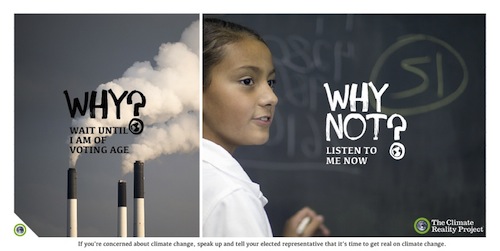
The campaign amplified into one of the world’s biggest ever climate marches, where the Why? Why Not? banner was carried in a throng of 400,000 people.
The creative was originally focused on eight countries – Australia, Brazil, Canada, China, India, Philippines, South Africa, and the USA – but grew into a global phenomenon across 87 countries.
Climate change matters. This was an important campaign. It was also an unmitigated success. The Stable wanted to know how GPY&R made that happen.
So we asked Andrew Dowling, Group Managing Director, Y&R Group Sydney.
TS: Why do you think the campaign was successful?
AD: The campaign’s intent was to make climate change a voting issue, and we did this in a way that hasn’t been achieved before. We used the innocence of children to address world leaders not as politicians, but as parents, in Jon Steel’s words,
‘Every parent wants a life for their child that is at least as good as the one they have had themselves, and preferably better.’
We knew that today’s youth would be the driving force behind the campaign’s success. From the outset our idea for Climate Reality Project garnered support from many quarters however we knew we were onto a winner when the United Nations decided to actively support the campaign, resulting in our young people having a voice at the UN Summit, alongside the likes of Al Gore, Ban Ki-moon, Barack Obama and Leonardo DiCaprio.
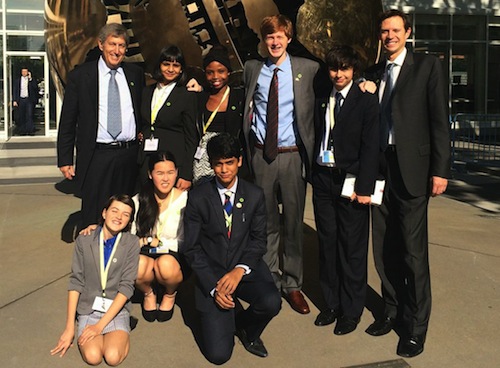
Why? Why not? campaign winners in New York
TS: What did GPY&R find out about young people (and their attitudes to climate change) before starting the campaign?
AD: The first realisation was that the next generation would have the most to lose; yet they do not have a voice in the climate change debate. Once we started collecting their thoughts on the issue, we realised just how committed they are to the cause and to making a difference. They have a heightened sense of engagement in this issue as the people who will inherit the world we leave behind. They have the energy and optimism to know that their actions can make a real difference, and therefore have a right to voice their concerns on a global stage.
Climate Reality Project: Why? Why Not? from Young & Rubicam Group on Vimeo.
TS: Where did the idea come from? What were the “aha” moments during the development of the campaign?
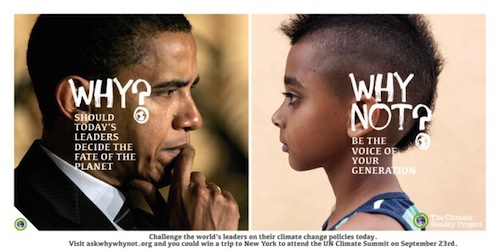
AD: The idea was generated by our joint ECD’s of GPY&R Sydney, David Joubert and Bart Pawlak. The first ‘aha’ moment was that every child around the world, in every language asks the same questions over and over, Why? and Why Not? They ask the first to understand the world around them, and they ask the second when they want to change their world. And the people, who keep asking those questions into adulthood, tend to be the ones who are responsible for humankind’s greatest advances. As David Joubert put it at the time,
“We wanted people of all ages to ask those questions, and keep asking them until, the lies run out”.
Why? Why Not? aimed to help people understand not only the environmental benefits of renewable energy, but also the benefits to the economy, along with the national security that comes from reduced reliance on fossil fuels.
One of the key epiphanies was when Bart and Dave had the idea to have children attend the 2014 UN Climate Summit to be the voice of their generation. The mechanism was simple, submit your audition online by asking your leaders, Why? and Why Not? Questions.
The final ‘aha’ moment wasn’t during the development of the campaign, but watching our idea come to life at one of the biggest demonstrations in history – the Climate March which saw over 400,000 people bring 80 New York blocks to a standstill.
TS: ‘Creativity without borders’ is a noticeable phenomenon. Is an ‘adland without geographical borders’ the next big thing?
AD: In my opinion, the best and most impactful ideas have always been based on a basic human truth, which inherently makes them universal, this isn’t new. In our case, Why? Why Not? is in its very nature, a global idea that also worked on a local and personal level. We simply felt, the climate doesn’t have geographical borders, nor should the message.
What has made this campaign exciting was that Sir Martin Sorrel, Jon Steel and John O’Keefe gathered a global WPP team to develop the campaign and this meant that meetings, presentations, decisions and arrangements were made across 4 global cities from New York City to Shanghai, London and Sydney.
What made this team ‘without borders’ possible was the development of a single communications strategy and plan. Our Head of Planning, Lucielle Vardy, along with David Sharrod from our Y&R NYC office and Maxus NYC held the campaign and team together, providing a central source of information. To us it is proof that a team does not necessarily have to sit in the same location to make a great campaign. Talent is scattered all over the world and technology has made communication much easier in bringing that talent together. It might not be the industry’s next big thing, but for projects of a global scale, it certainly is a good option.
Campaign leaders:
Climate Reality Project: Al Gore
GPY&R Sydney: Andrew Dowling, Lucielle Vardy, Bart Pawlak &David Joubert
Y&R New York: David Sharrod
WPP: Jon Steel & John O’Keefe
Campaign agencies:
GPY&R Sydney; JWT; Maxus; The Futures Company; PPR; The Glover Park Group; Blue State Digital; and affiliate company VICE.
You might also like