Women drive 70-80% of all consumer purchasing, through a combination of their buying power and influence [Forbes]. They control up to two thirds of the global $18 trillion of consumer spending. If you want the brands you work on to engage with them, you’d better know what they think.
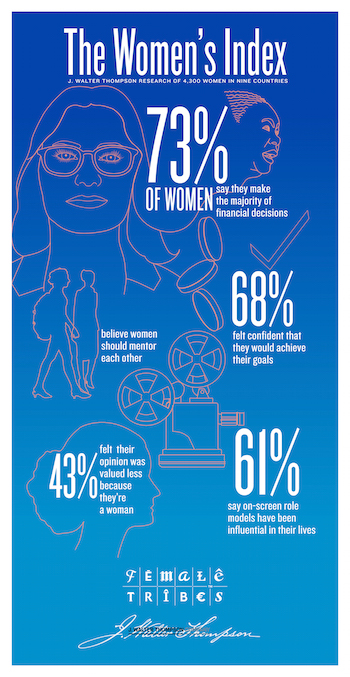
J.Walter Thompson has taken the trouble to find out exactly what women think about almost everything from career, ambition, religion and finance to sexuality, looks, attractiveness, parenting and health. The result is its Women’s Index, a bank of insight about women and Female Tribes, a profile of the 20 groups that represent the diversity of women in the world.
86% think femininity is a strength. 76% think there’s never been a better time to be a woman.
73% think they make the majority of financial decisions.

Women are more complex than they have ever been. The idea that they see themselves as mothers first is defunct. They are often on equal terms with men when it comes to providing for themselves and their family. They are often on equal terms when it comes to making decisions in the house.
These attitudes compiled in J.Walter Thompson’s Women’s Index, cover women in 9 countries – US, China, Australia, Brazil, UK, Saudi Arabia, Russia, India and South Africa – and represents the answers from more than 4,300 women.
50% of the women questioned were the major breadwinner.
What women think:
- 84% believed that it is important for women to step up as mentors for younger women
- 57% said they felt sexually empowered
- 19% found manage the expectations they have for themselves challenging
- 78% of Baby Boomers agreed that sexual fulfilment isn’t just for the young
- 74% agreed that their work is linked to who they are.
- 79% agreed that having children has made them work in a more productive and focused way
- 56% believed that I am more ambitious than my spouse/significant other
- 44% agreed that they’d delay having children or getting married to focus on their career
- 76% felt it had never been a better time to be a woman.
- 59% believed that they have a more senior/responsible role than their spouse/significant other
James Whitehead, executive partner, J. Walter Thompson London, noted, “By creating this proprietary research and the 20 Female Tribes, we can deliver true insight into modern women around the world. This allows us to offer better creative, consultancy and pioneering services to our clients, helping their businesses better serve the biggest consumer group in the world.”
Rachel Pashley, global planner at J. Walter Thompson, commented, “While the world is familiar with the idea of women as consumers, we witness women as wealth creators in their own right. We believe the concept of Female Capital will be transformative not just for business but for society as a whole.”
“We feel that culturally we’re still not reflecting women’s true status and influence in society, we view women through a narrow lens of parental responsibility, when we could be and should be celebrating women’s achievements and aspirations- and this opens up a world of possibilities.
“When you consider that onscreen role models influence not just women’s career decisions but their life decisions: so 1 in 4 women in Brazil have left an abusive relationship just through the influence of what they see on screen – then it becomes harder to dismiss advertising as trivial, and that changing the cultural narrative around women could be game changing.”
Meet 3 Female Tribes:
Asian Alphas – Modern Asian women are shedding the docile home-maker stereotype to become an economic powerhouse. Asia is home to the highest ratio of female to male CEOs in the world, and two thirds of the female self-made billionaires are Chinese. In China, women are much more likely in their youth to prioritise education and a career over friendships and fun. 50% of women in China aspire to be ‘aggressive’ and ‘maternal’ and 63% say they use their femininity as a means of power and influence.

Teen Activist – One of the interesting contradictions with the Teen Activists is how level headed and mature they are – more likely to conform, on the one hand, but also how passionate they are about changing the world around them. Growing up in a hostile world has given them a desire to change it and armed with idealism and social media connectivity they’re making their voices heard.
In our Generation Z report based on a survey of 1,000 12- to 19-year-olds we asked them what they worried about. 61% mentioned terrorism and 60% said wars around the world. This was followed by fears about the state of the planet (57%) and the economy (53%). Just 56% thought men and women were treated equally in the workplace and 87% said racial discrimination still exists
Cultural Icons – Hollywood has predicted 2016 as the era of the female hero, with more attention devoted to female actresses, female led storylines and female directors than ever before. No doubt the spectre of female led films out earning male led films at the Box Office by up to 30% has something to do with the increased screen time devoted to women. In fact, in our Women’s Index Research, 80% felt that women should have a louder voice in terms of cultural influence.