Russia is attacking a democracy, killing families, destroying cities and kidnapping thousands of children. The international support for Ukraine and its citizens is strong, but I can’t help thinking about the response from the creative community. Looking at recent award shows, I see many creative projects in support of Ukraine, often with a technological dimension. But there seems to be a lack of a strong unifying visual response to the Russian invasion. Graphic communication with potential to reach, and be remembered by, a much wider audience than award shows and case videos. Something that maybe could help change the course of history for the better and become a symbol of our times.
You might not realise it, but as a creative person you are in control of a superpower – the ability to, even with small means, create and convey a message that a great number of people will respond to. The building blocks of this superpower are usually general knowledge, intelligence, wit and aesthetics.
Many of the best practitioners in the history of our craft have used this ability to protest against wrongdoing and evil. But now few people use it.
Perhaps at look at the work from some of the greats can inspire a change?
John Heartfield (1891-1968) was a German graphic artist and Dadaist who pioneered photomontage with George Grosz. He used this technique to combat the lies and propaganda of Hitler’s Germany. His montages were published in the magazine AIZ. The effectiveness of Heartfield’s montages was acknowledged when he rose to number five on the Gestapo’s most-wanted list (not bad for a graphic designer). The photomontage, Little man asks for big gifts depicts Hitler receiving a donation from a wealthy German industrialist using the Hitler salute.
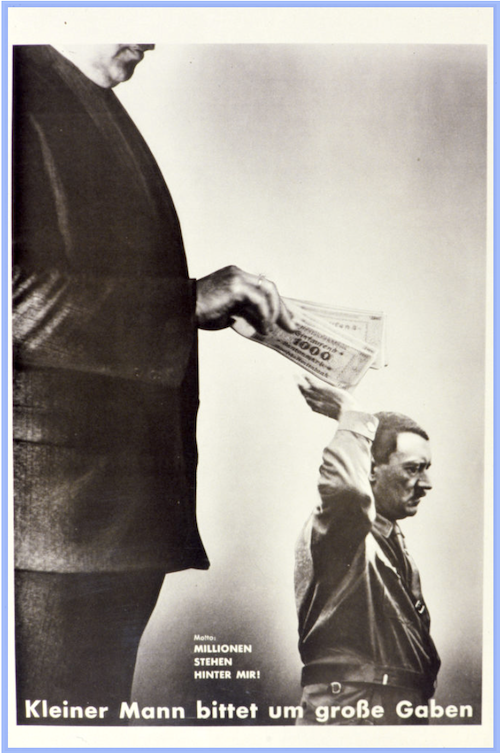
Image: City Gallery Wellington
George Lois (1931-2022), a prodigious Greek-American art director who ran his creative ad agency PKL on weekdays during the ’60s and designed covers for Esquire magazine on weekends. When heavyweight champion, Muhammad Ali, refused to fight in the Vietnam war he faced criminal charges. His title was taken from him and he was stopped from boxing for several years. In support of Ali, George Lois and photographer, Carl Fisher, portrayed him as the early Christian martyr, Saint Sebastian, who according to traditional belief was tied to a tree and shot by arrows. The result is probably the most striking and beautiful magazine cover ever made.
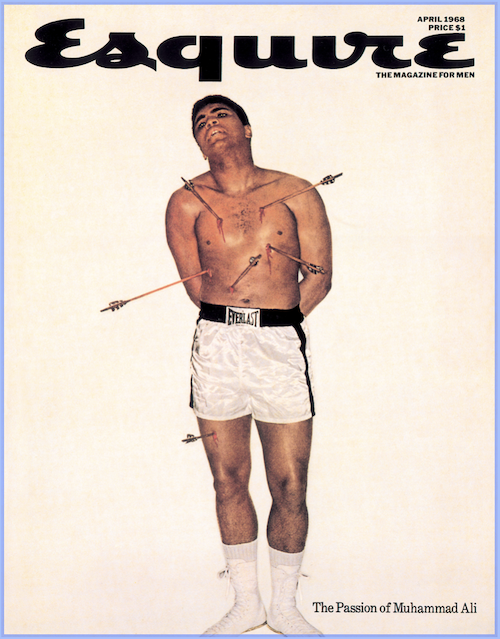
Image: MoMa
Corita Kent (1918-1986) was an American artist, designer and nun, whose work promoted social justice. Inspired by early pop art, she used silk screen printing to make affordable art for the masses. In 1967, Newsweek magazine put Corita and her work on the cover of its Christmas issue. But tensions between Kent and church leadership were mounting. When the archbishop of Los Angeles labelled her work as blasphemous, she returned to secular life. In 1969 she designed News of the Week, an anti Vietnam war screen print. Corita Kent was posthumously awarded the AIGA medal in 2016.
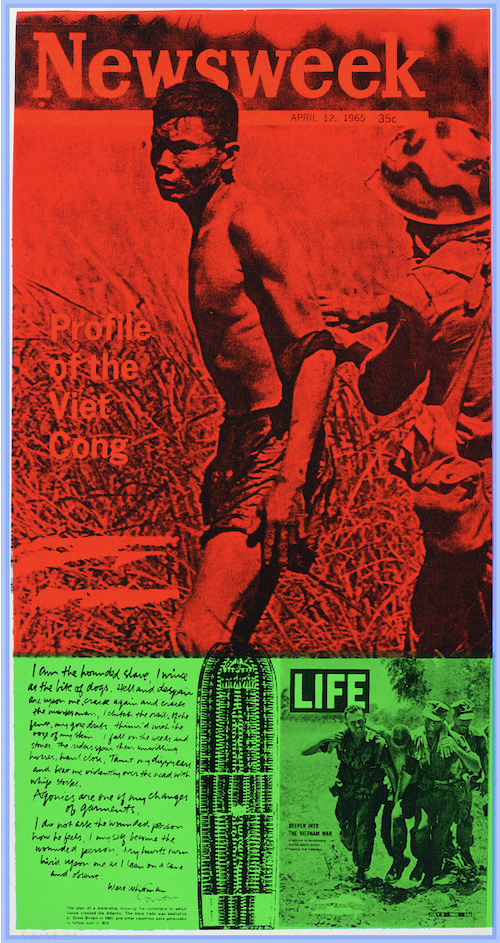
Image: The Corita Art Center
When the UK joined the US coalition for the invasion of Iraq in 2003, the protests in the UK were huge (and rightly so, the invasion was later proven to be based on fabricated false evidence of weapons of mass destruction in Iraq). Ad agency, Karmarama, designed a protest sign that became popular with the protesters. A photomontage of PM Tony Blair holding a machine gun and wearing a teacup as a helmet with the headline, Make tea, not war. Intelligent, witty and effective. What more could you possibly want from a protest sign?
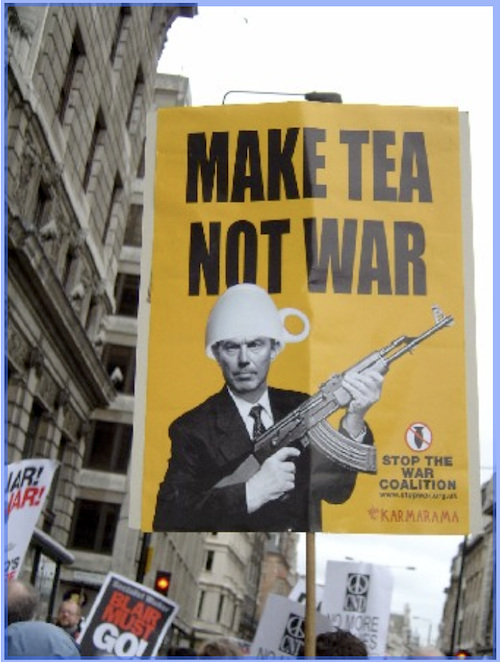
Image: Nessa
Got enough inspiration? Now it’s your turn.
Johan Gustafsson is an art director at Differ Agency, Stockholm
Johan and his colleagues, Linda Iuta Fryxell and Johan Angantyr, created the viral ABSOLUT BOYCOTT image that pressured Pernod Ricard to stop the resumed export of Absolut Vodka to Russia in April 2023.