Day One at MAD STARS featured two star performers, Conversation with the Executive Jury and Cheil’s keynote, The Ambidextrous Agency: Harmonizing AI and Human Creativity. Yes, AI crept into one and was the epicentre of the other, but despite everything that has already been said, written and filmed about it, AI seems to be a topic that still draws a crowd.
“AI is the most enthusiastic junior art director and junior copywriter in your team,” stated exeuctive juror, Ashish Charavarty, executive director and India head of creative at McCann, in a casual comment with far more profundity than he may have realised.
For those who missed these talks, here is The Stable’s synopsis:
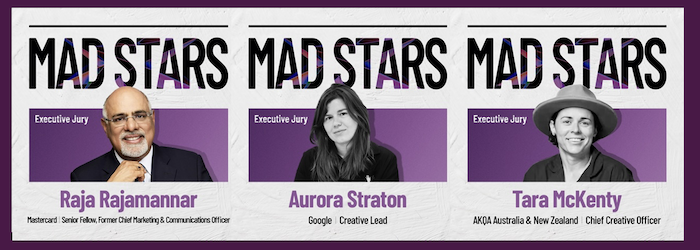
Conversation with the Executive Jury is one of MAD STARS’ annual highlights. It’s a little insider information made especially for ambitious adpeople.
Moderated by Sangsoo Chong, MAD STARS vice chairman and CCO, the judges shared their views one by one. First, they were asked what impressed them most in their jury room in one or two words. (Note creatives choose their own paths. More words were given.)
For Alex Abrante, CCO, North America, Iris Worldwide, it was that creativity was at the centre; it was the quality of the work and how craft was taken very seriously – and that all three were seen across work for big brands as well as for local brands.
It opened up his eyes, too, to the importance of diversity – of different perspectives that open up your mind, even to familiar work. The surprise of fresh eyes, he said, was a joy.
For Ashish Chakravarty, executive director and India head of creative at McCann, it was surprise. Work that stood out went where you didn’t expect it to go.That made it a source of joy. He also noted the thoroughness in the submissions. You could dive into them to see all aspects covered.
For Alejandro Di Trolio, European creative chairman, Cheil, it was the connections between the jurors from across the world, providing different viewpoints. A day-meets-night, aka creativity-meets-culture, view of each piece of work.
For Tawana Murphy Burnett, head of top accounts and agencies at Meta, it was insights. She was impressed by the quality of the jurors, the expertise in the room that opened discussions about what great work looks like. It was a chance, she added, for the jurors to learn and elevate their craft as well, by sharing insights, nuances and cultural context.
Second, the jurors were asked to nominate one piece of work that stood out for them.
For Abrante, it was KitKat Break Break Bar (VML Philippines) “Such a simple idea, so right for the brand,” he noted. It’s a global brand, he added, so it’s hard to be relevant to individual local markets.
For Charavarty, it was Plot Farming (POP5). “A wonderful idea and scalable to any part of the world.”
Bangladesh is a small agrarian nation with 175 million people, faces a growing challenge. Rapid urbanisation is swallowing up fertile lands, while the country remains heavily dependent on food imports. Real estate companies acquire and sell these lands to buyers who see them as long-term investments, leaving them empty for decades. Simultaneously, landless farmers, struggling below the poverty line, migrate to cities in search of better opportunities, often finding themselves in precarious conditions. Shopnodhora, an eco-friendly Bangladeshi real estate company, transformed unused housing plots into productive farmlands. Landless farmers were paired with these plots and began cultivation under careful supervision. The company monitored the entire process, ensuring that the farming activities were well-supported and productive. The idea revitalised urban spaces and provided sustainable livelihoods to landless farmers.
For Di Trolio, it was Uncle KFC’s Rice Bowl (Wolf BKK). “In Europe, humour is complicated. We’re still trying to be serious, to save the world as superheroes. This showed that humour and difference can work, and that insightful storytelling (in this case surreal) is powerful.”
For Murphy Burnett, it was Whoscall Scammer Pages (VML Thailand). “You know a campaign if great when it causes a hush in the jury room.”
The final conversation about AI, reiterated that AI is not going to go away but it is not going replace human creativity either. Humans are innately drawn to human stories. “AI is a very good partner at understanding how to get new audiences, finding nuance and insight and helping brands and business understand what is resonating.” [Murphy Burnett]
“AI is the most enthusiastic junior art director and junior copywriter in your team.” [Charavarty]
AI was covered in more depth, though by keynote speaker, John Jonghyun Kim, global president and CEO of Cheil. His talk, The Ambidextrous Agency: Harmonizing AI and Human Creativity, beganwith the surprising (perhaps) fact 1/8 of the world’s population had used AI at least once by August 2025. Chat GPT use had soared from 1m in January 2023 to 1 bn in August 2025. Apparently, AI is doing a lot of things for a lot of people throughout the world.
Kim explored the advantages of AI in advertising. First speed, turning time-consuming tasks – targeting, planning, production implementation and analysis – from weeks-long undertakings to seconds-long. He outlined a study testing AI’s creatiivty in which three groups pf people were given a creative task – group one without AI, group two using an idea based on AI and group three using as many a five AI references. AI won for originality, usefulness and quality, but there was a rider. The stories resembled one another. The more you use AI to refine the work, the more AI creations fade into similarity (like making print copies over and over.)
He also identified four types of future working styles: The Lonely Craftsman – characterised by ingenuity and insight with low AI capability, and so limited scale and slow execution; the Soulless Factory – high AI, low creativity producing a lot of content quickly that fails to resonate, so clutter rather than connection; The Dinosaur – inefficient and uncreative, sop will be the first to become obsolete…and the Ambdextrous, a powerful asynergy using AI to enhance human creativity, so exceptional value and impactful results.
All of this led to Cheil’s working AI model, aka The Ambidextrous Agency model. It has three ground rules:
- AI executes, humans steer
- AI drafts, humans breathe in soul
- AI suggests, humans decide
Whatever AI does or doesn’t become, Cheil has stripped out the insecurity of an unknown but unignorable new entity in our world, harnessed its usefulness and made it controllable, and integrated it into an agency model that actually is different. Few can claim anything like that.
You might also like