MAD STARS preliminary judging is over and the finalists have been announced. Mateusz Mroszczak, chief creative officer at VML Singapore, was one of the judges.
A third generation adman, Mroszczak joined VML with CCO expertise from nearly four years at Wunderman Thompson in Singapore. Prior to that role, he was executive creative director at BBDO Singapore, and group creative director at Happiness Saigon and then Brussels. He has also worked in New York and Ho Chi Minh City earlier in his career. He has worked with global brands across a range of categories – Land Rover, Campbell’s, Unilever, VISA, Colgate, AIA and Pepsi among them.
Mroszczak’s work has been recognised more than 200 times in both national and international awards shows including Golds at Cannes Lions, Eurobest, London International Awards, Clio’s and CCB. Most notably, his Coins of Hope campaign for Child Focus was awarded five Cannes Lions at the 2017 Festival. He has also been invited to judge by New York Festivals, LIA, Creative Club of Belgium and Golden Drum.
What does he believe a great campaign is made of, The Stable asked? And what does a great creative career rely on?
The Stable: Nominate three to five campaigns – from any period in time outside MAD STARS’ 2025 submissions period, that you think are the greatest of all time (so far).
Mateusz Mroszczak: The following campaigns are the ones I rank highest — not because they were the most awarded (though many were) but because they changed something in me. They shifted how I think about ideas. It’s like they opened a new compartment in my brain. “Hey, come check what’s behind this door — there’s a whole dimension here we’ve never seen before.”
Droga5 – UNICEF Tap Project (2007)
This one blew my mind. Turning something already embedded in American dining culture, tap water, into a commercial transaction for good. Simple. Clever. And suddenly, it wasn’t just water anymore.
Launched for World Water Day, restaurants asked customers to donate $1 for tap water (which is usually free), with proceeds funding clean water access for kids.
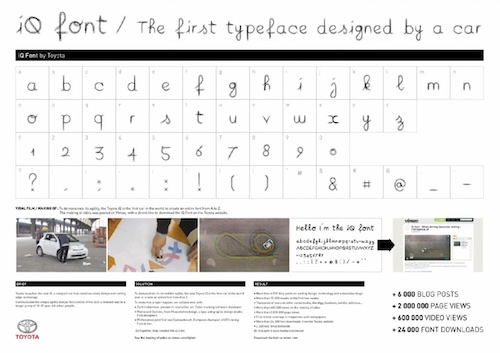
Happiness Brussels – Toyota iQ Font (2009)
Instead of another epic car film, they used the car’s compact turning circle to create… a typeface. In a category full of testosterone‑fuelled film storytelling, this felt like a whisper that made more noise than a shout.
GPS tracking of the iQ’s turning radius literally drew each letter of the alphabet — then released as a free, functional typeface.
JWT Amsterdam – The Next Rembrandt (2016)
This one was a huge moment of reflection. It made me question everything – about art, about AI, about the line between man and machine. It didn’t just use technology — it questioned it. It pushed the conversation forward before we even had the words for it.
An AI trained on all of Rembrandt’s works generated a completely new, 3D‑printed painting that looked and felt like Rembrandt… but never existed before.
Clemenger BBDO Melbourne – Meet Graham (2016)
This one’s just unforgettable. And again, making something physical that belongs in an art gallery rather than just another impactful film. That’s the kind of conceptual leap I always appreciate.
Commissioned by Australia’s Transport Accident Commission, Graham was created with a trauma surgeon, road safety expert, and sculptor, Patricia Piccinini, anatomically engineered to survive a high-impact crash.
If I think of the more recent work, maybe less of a conceptual piece, but in terms of craft and storytelling, one that I’m madly in love with:
The Monkeys Sydney – Play It Safe (2023)
I must have watched this a million times. Every viewing reveals something new. It’s satire. It’s social commentary. It’s a punch in the gut and a wink at the same time. And it does what we all should do: vividly celebrate creative bravery.
Directed by Kim Gehrig for the Sydney Opera House’s 50th anniversary, featuring Tim Minchin and other iconic Australian performers, the film argues that playing it safe is the real risk.
The Stable: What skills, attributes and experience do a creative need to reach the top tiers?
Mateusz Mroszczak: I honestly don’t think there’s a script or a template. So many of the greats who’ve touched this industry all seem to have had wildly different journeys. And I genuinely believe the next generation will have their own path entirely. The tools are different. The landscape is different. What worked for us might not work for them and that’s okay.
That being said, there’s one thing I think we consistently underestimate in this business: luck. I really believe it plays a much bigger role than we like to admit. Being in the right room, at the right moment, with the right brief, the right idea, the right client, the right team, the right budget— that’s luck. A lot of us have a lot to thank it for.
So if I had to distil it down, I’d say: a bit of talent, a whole lot of hard work, a few amazing people… and a shit ton of luck.