If advertising industry festivals are meant to trigger new thinking, Day Two at MAD STARS did its job well. Here are three new ways of thinking by three global creative leaders.
There is anything more human than algorithm, by Alejandro di Trolio, European creative chairman of Cheil, Spain.
In 1968, Stanley Kubrick filled our heads with the idea of evil technology. When it comes to new technology, we still live in the grip of fear. “Big Brother is watching.” “Robots will take over everything.” “AIgorithms will control us.” Alejandro di Trolio, European creative chairman of Cheil, joined the Day Two speakers at MAD STARS, with a new view of AI. Not a Black Mirror future, but a Trojan Horse future – the algorithm outside and creativity inside.
Yes, it was a talk about the AI achievements of the agency’s biggest client, Samsung, but in the current chaos of ideas about the algorithm, it was a remarkable view. The algorithm, he said, is “water”. It’s formless. You can shape it how you want. He presented two case studies that showed how Samsung was “hacking the algorithm”. The first was Impulse, that used the vibration feature in every phone to create a rhythmic beat that allowed those who stutter to talk clearly.
The second was The Mind Guardian, that hacked game play, to become a test for early onset dementia. (It can detect Alzheimer’s signs in 5 minutes with 97% accuracy.)
It’s Not about the Sound. It’s about Who’s Listening: Culture, Curiosity and AI-vertising, Erik Reiff, founding partner of Black Cat White Cat Music, Japan.
Erik Reiff, founding partner of Black Cat White Cat Music reminded us that AI is nothing new in music. In the 1950s, the Illiac computer created a string quartet. So, AI can write music, he noted, is this the death of music art? No, he answered, it’s a new instrument. He then presented AI as two metaphors. The first is a sandbox – sand grains mean nothing until human hands shape the castle. The second is a mirror. AI reflects our culture and our assumptions but it’s up to us to stretch that mirror.
AI hears everything, he added, but doesn’t care about anything. It can’t take risks and has no empathy. Taste can’t be outsourced and meaning still belongs to us. Reiff could let AI write his music, but he doesn’t. He might ask it to create something specific as a starting point so he can challenge its answer with his own creativity. But mostly, he uses AI (ChatGPT and Gemini) for background info – like finding out about cultural nuances that can then inform his work. The power of using AI is not for it to do the work for us, but to help us ask better questions.
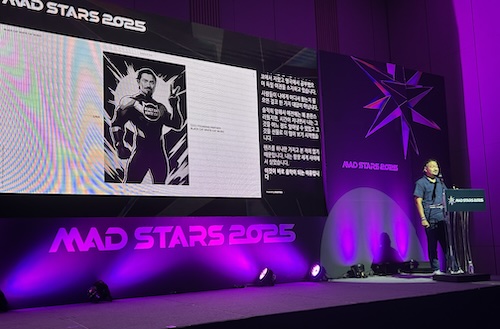
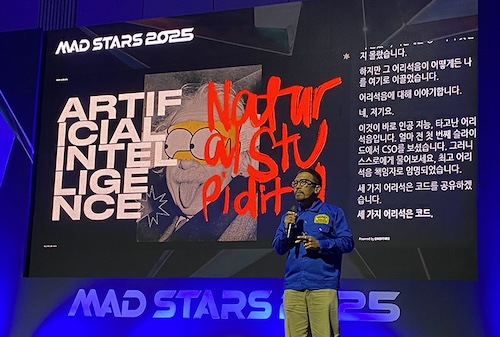
Artificial Intelligence, Natural Stupidity, Nino Gupana, global creative specialist, Our LEGO Agency of The LEGO Group, Denmark.
Nino Gupana, global creative specialist, Our LEGO Agency of The LEGO Group, began his talk by telling the story of the stupidest thing he has done in (actually trying to start) his career. He won his audience immediately and there was more in that vein to come. Natural stupidity is our super-power was his argument. We are the undisputed expert in oops. AI is powerful, brilliant and never tired. But also too smart. What happens when everything is optimised is that you lose the beautiful chaos that is human.
Gupana then outlined the three stupid codes to craft success with stupidity. 1.) Error to Eureka “Mistakes aren’t failures, this is where the magic comes in.” – like penicillin and the Postit note. 2.) Humour is human. Humour connects us. Gupana cited Uncle KFC’s Rice Bowl as an example, where a deep human truth was told through a deep human laugh. 3.) Bravely – silly. Some of the bravest people are the silliest, he said. Lastly, Gupana left his audience with the message, don’t outsmart AI. The world doesn’t change because of the brightest person in the room, it changes because there’s someone stupid enough to want to change it.