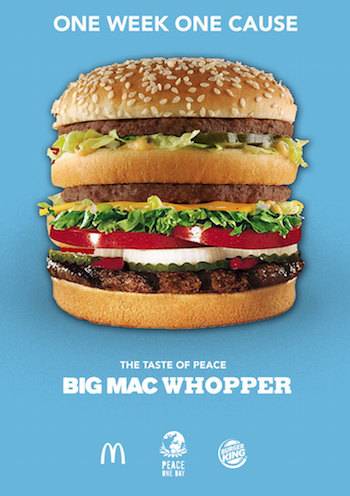
It’s pleasingly apt that the McWhopper campaign is why Y&R New Zealand has won D&AD’s Most Awarded Agency of the Year and Burger King’s D&AD Most Awarded Client of the Year awards. The campaign was ignited by D&AD’s inaugural White Pencil brief, for Peace One Day in 2011.
McWhopper has won 6 Yellow Pencils, 1 Graphite and 1 Wood at this year’s D&AD Awards.
Granted, the agency didn’t develop the idea in time to meet that deadline, but the idea refused to die quietly like so many others do. If two corporations who are ferocious rivals (enemies, even) can come together for Peace Day (and in the case of Burger King and McDonald’s collaborate on a product with the PR spin, find out what peace tastes like) then anyone can. Isn’t that what Peace Day is about?
The name, McWhopper, the concept, Burger Wars, and the fact that Burger King was a Y&R Media client kept making the idea spontaneously reignite. Eventually, Y&R got its…um, idea…together and took it to Burger King New Zealand. That went well, so Y&R had not only the confidence, but also an ally, with which to approach Fernando Machado, senior vice president of Burger King global brand management in head office, Miami.
The agency put together a three minute video and emailed it to him.
He wrote back, “I FUCKING LOVE THE IDEA. Sorry, I curse a lot. Especially when I like something. And I hope that by now you know I walk the talk on doing big and bold things. I want to help make this happen. Call me as soon as you can.”
Of course, Burger King’s agency of record in the US, David, could have been a buzzkill. But it wasn’t. The idea continued to spread peace and win allies.
It needed that. Burger King proposed that six elements would be taken from each signature burger to create the hybrid, which would be sold for one day only at a pop-up shop in Atlanta, with proceeds going to the charity and the two brands doing their bit to promote world peace.
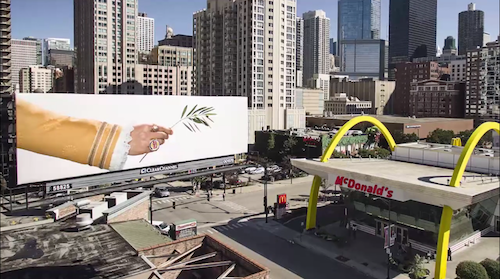
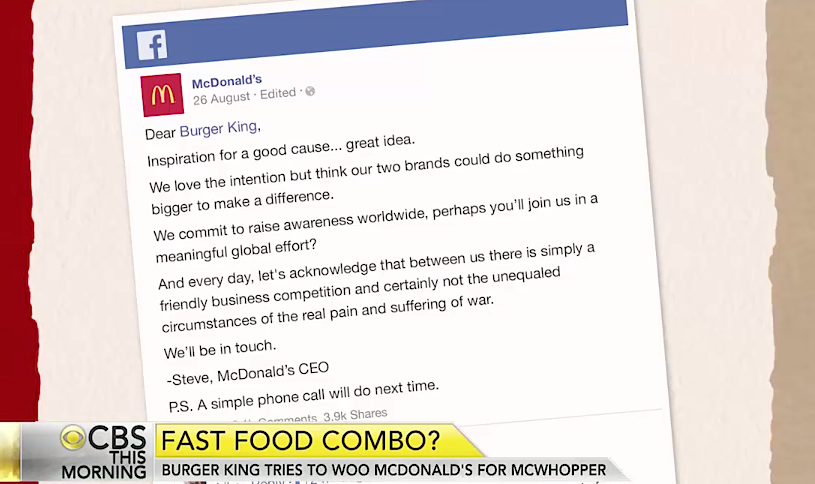
When Burger King put the idea to McDonald’s (which it did publicly, on social media), its response was…shall we say, lukewarm.

So the agency went with plan B, DIY McWhoppers, which could live whether McDonald’s were on board or not. It produced a step-by-step burger build film for mcwhopper.com, hoping that the public would build the burger themselves and generate further content. Countless McWhoppers were created, reviewed, and shared on social and mainstream media.
It ceased to matter that McDonald’s had said no.
Meanwhile the official burger evolved into a product even more important than the initial proposal, the Peace Day Burger.
Four other competitors, large and small, wanted a slice of the action. Denny’s published an open letter in the New York Times saying “we’ll join you”, adding that it was up to Burger King to start walking the talk.”
Wayback Burger, Krystal and Giraffas, a Brazilian chain, came on board.
Together, the five restaurants collaborated to create the Peace Day Burger, a hybrid containing a key ingredient from each restaurant’s signature burger, served at a pop-up on Peace Day, September 21.

And McDonald’s eventually came to the Peace Day party. Supported by Burger King, Facebook, Google, MasterCard, and several other large corporations, McDonald’s created a 30 second animated spot in aid of the UN World Food Programme, that aired in 38 countries on Peace Day.
By the end of the campaign there had been 8.9 billion media impressions around the world. (The Y&R team worked with nine Burger King PR agencies to help that along.) It became the number one trending topic on Reddit and there was a 40% spike in Peace One Day Awareness, $182 earned media and, for Burger King itself, a direct McWhopper effect on brand consideration in post-campaign research.
And it began to win awards. 6 D&AD Yellow Pencils among them.