A handful of years ago in another editor role, I asked an Australian ECD to comment on the topic of the moment, that “the end of the world was nigh” for advertising. (Yes, that question wasn’t born in 2019.) He answered that the industry has the most remarkable ability to remake itself. Always has, always will. What it seems to lack are self-confidence and courage. [:ed]
Some ad people lack neither. Here’s a dish of really nourishing food for thought by Edu Pou, executive creative director of We Are Social Australia.
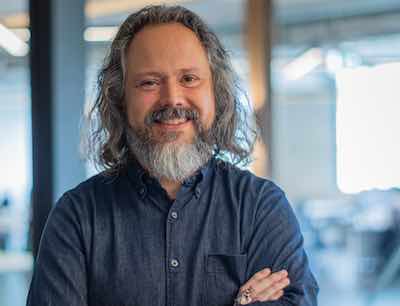
I’m a nomad. I’ve lived in Barcelona, Madrid, Miami, Boulder, Amsterdam, New York, Kingston, and Sydney, with curiosity as my only travel guide. It’s been an exhilarating adventure, although not everybody would agree. In True and False, David Mamet writes: “You will encounter in your travels, folks of your own age who chose the institutional path, who became the arts administrators rather than the actors, the casting agents rather than the writers. (…) It is not childish to live with uncertainty, to devote oneself to a craft rather than a career, to an idea rather than an institution. It’s courageous and requires a courage of the order that the institutionally co-opted are ill-equipped to perceive. They are so unequipped to perceive it that they can only call it childish, and so excuse their exploitation of you.” I wouldn’t go that far, because I’m in no position to judge anyone’s life choices, but I agree with Mamet that uncertainty demands courage. When you try to leave comfort behind, you also part ways with your old friends, your family, and your culture. Suddenly, your concept of home and identity calls for a new definition. But not every creative journey requires a valid passport.
Nomadism is a mindset. Without trying to sound too new age, you can find what’s fascinating even in the most mundane. As ad people, we’re probably doing it all the time, anyway. Even at an unconscious level. We constantly revisit our certainties and have an endless thirst for what’s new. That’s the only way to stay current, and that’s our currency. Pop culture is the playground and if there’s one thing pop culture wants to do is change. That change affects everything: formats, audiences, platforms… What succeeded in the past may be the flop of today. And the other way around. It’s wise to challenge wisdom, distrust process, and challenge templates. Shortcuts often take you faster nowhere.
Time and time again, we hear about advertising as an industry in crisis. Projects vs retainers, tighter budgets and timings, creatives going client-side, in-house studios… The headlines may be bigger, and the language may sound a bit more daunting, but advertising has always been in flux. Everything in society is changing all the time, and some seem to expect a formula defined in Madison Avenue in the ‘50s to be immutable. The least we can do is adapt, but our goal should be to anticipate. Our expertise should be applied not only to our projects but to ourselves. Again, keeping an open mind and finding a source of inspiration elsewhere may help.
Working on social-first ideas keeps you on your toes. Just like a stand-up comedian testing a new routine, you get instant feedback from your audience. You’ll have fans that help your task and you’ll have hecklers that you’ll have to deal with. There’s no room for anything in between if you’re doing it right. Whoever coined the expression “better safe than sorry” didn’t know a thing about social media. Expected is boring, and boring doesn’t get any attention. Remember how Elon Musk smashed the windows of his pickup truck to demonstrate that they were bullet-proof? Well, he still got record-breaking sales in one day. We better get our steel balls ready.
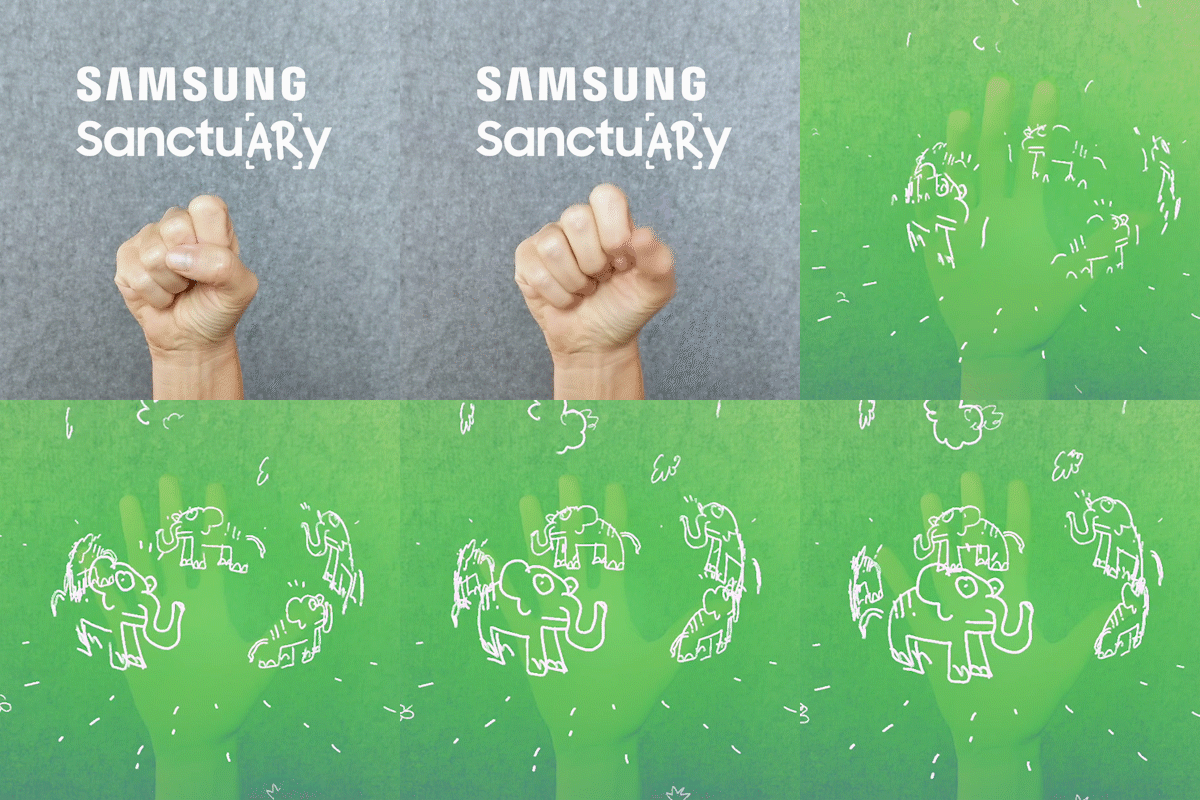
There’s a project that we’ve recently launched at We Are Social that represents all the above. It’s daring, it has a global insight and local relevance, it brings technology and people together, and it came to life in front of a live audience in Bangkok – no smoke and mirrors. It’s called SanctuARy and it brings Thai creators together to raise awareness about endangered species in Thailand. The things is that to bring the story to life they used the AR Doodle feature on their Galaxy Note10 as a tool. With the help of Facebook as a platform and the tech team at Resn, we unveil each story in Augmented Reality exactly where the future of those animals lies: the palm of your hand.
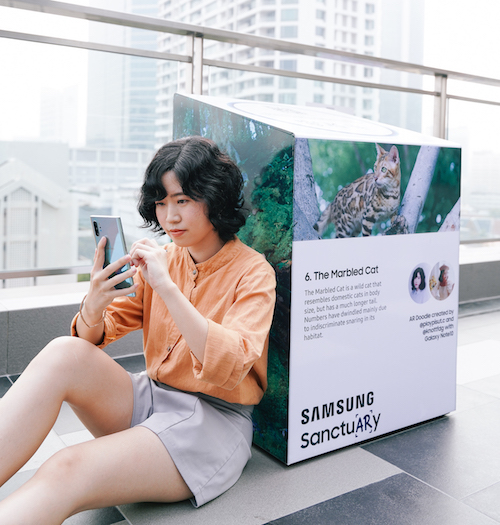
There’s something magical about creating stories with a gap that can only be filled with the active participation of the audience. The task shouldn’t be challenging, but it should be essential. In our case, they only had to open their hand in front of their phones for elephants, tigers or koupreys to appear out of thin air. Nothing replaces the awe you feel when you discover something by yourself. That moment of wizardry is something you can’t keep to yourself. As Maya Angelou said, “People will forget what you said. People will forget what you did. But people will never forget what you make them feel.” Going back to the start, there’s nothing childish about looking at the world around you with the excitement of a child.
We Are Social: Samsung creates a virtual sanctuary to save endangered animals
[Cover image: Mindy Mcgregor]