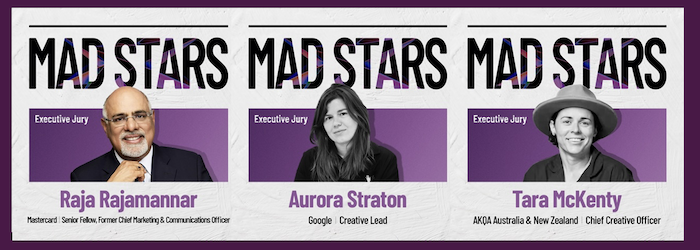
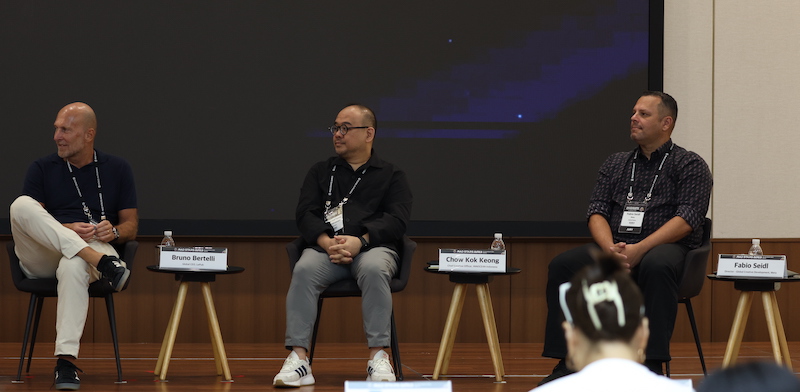
Fabio Seidl is Director of Global Creative Development at Meta. He presided over the Print and Design jury and was one of five executive jurors who chose MAD STARS’ Grands Prix of the Year. Seidl’s deep understanding of the challenges and opportunities lying in front of advertising creativity comes from a career as a creative leader in top tier agencies. He has been executive creative director at DDB NY, VMLY&R NY, Leo Burnett Chicago a group creative director at 360i New York, and group creative director at 360i NY, moving from Brazil, where he worked at Ogilvy & Mather, McCann and Africa.
The Stable: What were you looking for while you were judging at MAD STARS?
Fabio Seidl: New ideas and fewer old tricks. That was one of the main discussions we were having in the jury. How can we separate what is a formula form what is authentic, original, thinking about a human insight, brand insight, a concept that we’ve never seen before. And then how it was executed afterwards. It’s interesting for me because I spent most of my career in advertising agencies in South America, Europe, the USA, working in the big networks and going to these festivals as a contender. And being at Meta for almost four and a half years now, you start to see things from a little bit far away. And that gave me this sense of, wait a second, they’re still doing this? They’re still trying to use this trick? I think our mission in the jury was to separate what was fresh and new and exciting and inspire better work next time.
The Stable: What stood out? What really struck you in the jury rooms?
Fabio Seidl: I think we’re living in a moment that I particularly like. We’re moving away from, hey, let’s save the world, but not really, to let’s have serious conversations with people. And sometimes let’s have fun conversations with people. Let’s have entertaining conversations with people. And most importantly, let’s give people the tools for them to create something. I think that if you look back at advertising before the pandemic, we were always trying to save the world, save nature, save people from injustice and prejudice and inequality, but it was very superficial. And I think that now we’re maturing that, and some brands are really committed to creating a greater impact. That’s one piece of it. The other piece is how people and brands are engaging and tackling culture. Because culture now is coming from anywhere. It’s not just from Hollywood. It’s not just from TV. It’s coming from Korea. It’s coming from Australia. It’s coming from Brazil. Music is coming from everywhere. Movies, series, literature. So advertising should reflect that. It should reflect the influence of culture from different parts. It was a very refreshing experience at MAD STARS to see a festival that is international, but predominantly more from Asia. You could see how cultures were influencing the work. That was really great and surprising for me.
The Stable: What in your view are the biggest challenges to creativity right now?
Fabio Seidl: It’s understanding that it’s not a centralised process anymore. As creatives and as leaders of this industry, we have the responsibility to understand that it belongs to the audience now. I’m not saying that we’re not doing anything else. I’m just saying that we need to listen much more. I think that we came from an era of everybody, every brand and every agency wanting to be a storyteller. We need now to be story listeners, to take a look at what creators are doing. To take a look at what kids are doing in Hongdae, Seoul, or what kids are doing in the outskirts of New York or in Africa. Because a lot of new stuff is coming from there. Everybody has a camera, everybody has a recorder, everybody has a platform. So why do we still believe that creatives are the centre of gravity, of everything? I think creatives need to be more curators and then creatives. So instead of thinking there’s a unit, and there’s a department that is responsible for all the creativity in the world, we have to understand that the world is responsible for all the creativity in the world, and as creatives, we need to take it to the next level and make sure that it talks to people and connects brands with people. I think that’s the challenge now. But I also think that finally we’re getting there, and it was a great experience to come to MAD STARS and see that brands are getting it, brands are doing it.
The Stable: What are you personally most proud of? What is the best work that you’ve done?
Fabio Seidl: During the pandemic at Meta there was a moment where we had to reprioritise what we were doing and take a look at the small businesses that were dying, especially minority-owned businesses. It was a tough moment for humanity. And I remember that we had this conversation with the leaders of the business unit of the company saying, “hey, what are we going to do? There’s someone that can do something that’s us.” The data was showing us that small businesses were going down and of them, 80% of the minority owned small businesses were going to suffer more because they had less access to technology. The pandemic proved how important technology is for us right now. It’s a matter of survival.
So we did a project there called Reinvent. It focused most of our business marketing into giving small business owners the tools to survive the pandemic. We gave them grants and free education, access to advertising that they never had before. We built communities to show their community how it was working, because I think that’s another important thing. When a brand tells you something, you receive it one way. When someone like you tells you something, you receive it differently. So, we realised we needed first to create a community of small business owners that are doing well, and ask them to teach the ones that are not doing well how they can survive. How can they set up an Instagram shop, a delivery online? How can they use WhatsApp to communicate with the customers, how can they create a video to promote their business? And it worked. Hundreds of millions of people were impacted by that.
The follow-up to this campaign is the campaign that we released last year called Good Ideas Deserve to be Found, which celebrates how small businesses, and businesses in general actually, are being found by people that are important for them and vice versa. So that was a moment for me and Meta to say, “Okay, I’ve made a difference for a lot of people in a tough moment for them.”