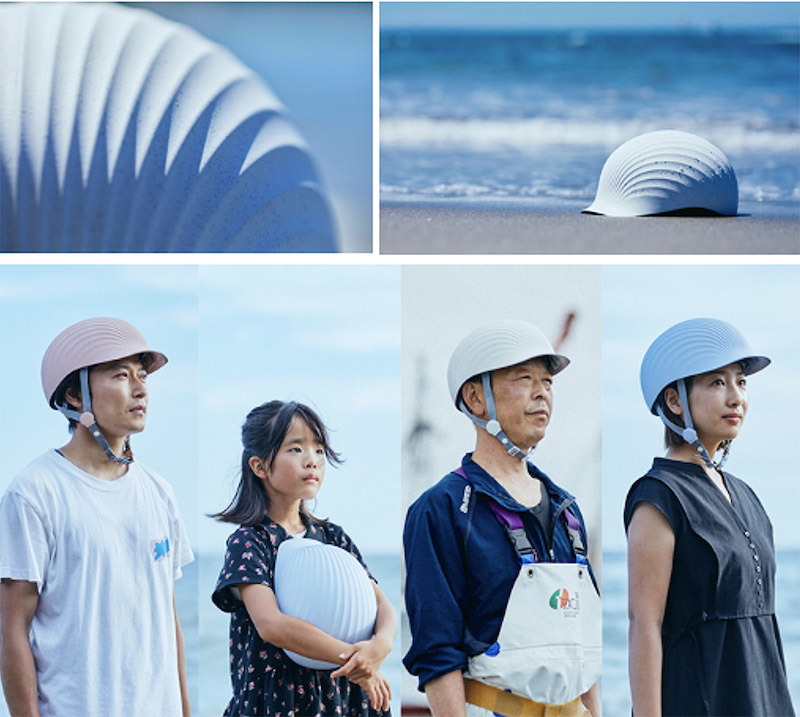
Sea animals have shells to protect themselves from external enemies. TBWA\Hakuhodo Tokyo has borrowed the idea. Its shells are protecting people and the planet. TBWA\Hakuhodo and partner, Koushi Chemical Industry Co., have launched an environment friendly helmet, Shellmet, made from wasted scallop shells and recycled plastic, in Sarufutsu Village, Hokkaido.
In 2021 the export of scallop shells ceased causing concern for Soya district, where Sarufutsu Village is located, due to the area generating approximately 40,000 tons of shells as marine waste annually. The environmental impact of storing the scallops on the ground is hazardous and can lead to serious soil contamination, creating a social issue for the local community.
The main component of seashells is calcium carbonate. TBWA\Hakuhodo realised it could be reused as a raw material for a completely new material. The agency team began efforts to recycle the material, which would become an important resource to support the village.
In Sarufutsu Village, approximately 270 fishermen wear plastic helmets daily. TBWA\Hakuhodo will promote the use of eco-plastic by using helmets made of shell-derived eco-plastic as a trial starting in the northern hemisphere spring of 2023.
Shellmet was obvious as protective wear for fishermen. But Hokkaido is also regularly hit by major earthquakes, and the risk of disasters such as heavy rain and snow damage due to abnormal weather increasing so TBWA\Hakuhodo and Koushi Chemical Industry Co. developed the product for use by villagers as disaster prevention helmets to protect themselves.
TBWA\HAKUHODO developed the name of “Shellstic (a combination of words, Shell, and ,plastic) and the logo for the new recycled material, a combination of wasted scallop shells and waste plastic.
Characteristics of Shellstic:
- Contributes to a maximum 36% reduction in CO2 emissions compared to the use of 100% new plastic
- Contributes to a 20% reduction in CO2 emissions compared to limestone-derived eco-plastics.
- By mixing scallop shells into the plastic, strength (bending modulus) is improved by about 33%.
Furthermore, because Shellstic is an upcycled material, which uses waste, the amount of waste will be reduced to not only help solve waste at a local level, but also globally.

Characteristics of Shellmet:
Shellmet incorporates a special ribbed structure in its design that mimics the structure of scallop shells, which is part of the material used for helmet production. As a result, the durability of Shellmet is improved by about 30% compared to the case without the ribbed structure, even though less material is used.
From material development to product design, creating a product with minimal burden on the environment and sustainability has been central to this process. Shellmet upcycles scallop shells that would have otherwise been discarded.
The product is available in a total of five colours: coral white, sand cream, deep black, ocean blue, and sunset pink, all colours inspired by the oceans, and can be used for a variety of purposes, including disaster prevention, work, and commuting by bicycle.
TBWA\Hakuhodo plans to develop Shellmet gradually by stockpiling it as a disaster prevention product, selling it to the general public, and introducing it as a tax return gift for hometowns * (*Furusato Nozei: Japan’s tax reduction system for the taxpayers who donate to local municipalities). Through this initiative, the agency aims to promote the active use of reusable materials and raise awareness of disaster prevention among village residents.
TBWA\HAKUHODO, creative director, Masatoshi Usami, commented, “Scallops are the most commonly eaten shellfish by Japanese people – and it is also the shellfish that results in the most amount of waste. If scallop shells are viewed as a resource, rather than waste, they offer new possibilities as a sustainable material. Shellmet is the first of these. Shells that have protected itself from external enemies can now be used to protect human lives. We hope this project will spread throughout society as a new form of environmental conservation that solves the problem of ocean discards and protects the fishing industry.”
Product designer, Shintaro Monden from quantum, added, “Shellmet’s shell-like structure is based on the idea of biomimicry and designed to be both visually pleasing and functionally thoughtful. From material development to design, we aimed to create a sustainable product with minimal burden on the environment. With its minimalistic design, the lightweight and robust Shellmet can be used for a long period of time in various situations, from daily use to work sites. Not only the helmet itself, but also other parts including the buckle are all original designs, which give the wearer the feeling that every detail has been carefully crafted, giving the pleasure to own Shellmet.”
Koushi Chemical Industry Co., Planning & Development Supervisor, Tetsuya Nambara, said: “Various new eco-plastics are currently being released under the theme of SDGs. However, the reality is that true eco-plastics that meet cost, quality, and sustainability requirements are very limited at this time. While new materials are being mass-produced, hundreds of thousands of tons of waste are incinerated or landfilled each year that could still be used. We believe that it is essential to recycle more waste than ever before in order to promote a sustainable society.”
Credits
Agency: TBWA\Hakuhodo
Chief Creative Director: Takahiro Hosoda
Creative Director: Masatoshi Usami
Senior Art Director: Yuhei Ito
Art Director: Takeshi Matsuda
PR Planners: Kyosuke Hashimoto & Suguru Kato
Producers: Yuki Sakamot & Omu Inoue
Product Designer: Shintaro Monden @ quantum
CAD Modeling: Minatsu Takekoshi @ quantum
Director: Kohei Inoue @ Robot Communications
Photographer: Junya Taguchi
Designer Hisahiro Tomonaga @ spice
Retoucher Takumu Koshiba @ CONTRAST In)
PR Promoter Eri Sato @ KMC
PR Promoter Takayuki Tamada @ KMC