Everyone has felt the power of a simple thank you note. DT has built that power into its new campaign leading up to R U OK?Day on September 10.
“Thanks for asking,” is the natural response to R U OK? And it supports the supporter. It should also keep the conversation going, creating a win-win cycle that keeps caring alive and people safe.
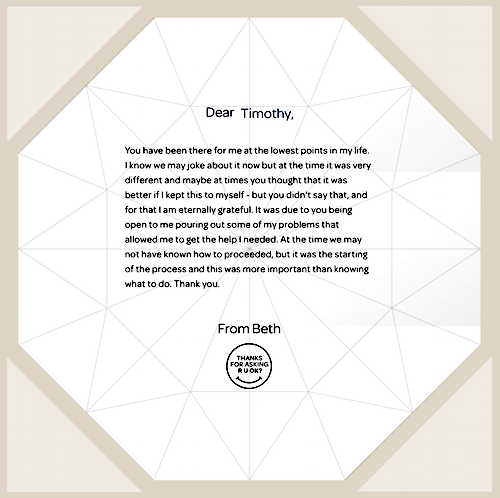
DT’s Thanks For Asking campaign encourages people to write a note of thanks to those who have helped them. Every one of the notes placed on ruok.org.au is then analysed by an algorithm created by DT that develops a unique origami shape based on the placement and number of letters in the note.
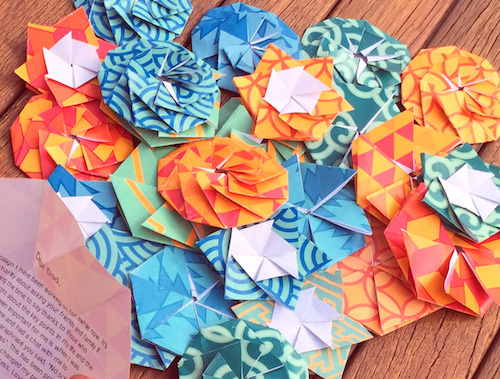
DT also designed beautifully coloured patterns, derived from the R U OK? brand identity, with inspiration from traditional origami patterns that hold different and relevant meanings.
The result is a collection of thousands of unique thank you notes, each with its own unique origami shape. These can be shared on social networks, via a link, or printed out and folded by hand with instructions on how to create the unique fold.
DT executive creative director, Jerker Fagerstrom, commented, “For this year’s R U OK? campaign, we wanted to acknowledge the people who already ask that question and remind them – and others – that a caring conversation can take someone out of the darkness, into a brighter and more hopeful place.
“By creating an easy way for people to say thanks, we have empowered people to celebrate the start of something new. Our aim was to do justice to each word in those notes – unique and heartfelt. For this, we found inspiration far from our shores, in a Japanese custom – the revered letter writing and folding art form of origami. Prayers and thoughts, wrapped perfectly.
“This was exactly what we needed. Each letter in the note defined a unique origami shape.”
The result that looks so simple is a complex work of art. The algorithm that analyses every aspect of those notes plots a 3D co-ordinate creating a unique origami shape in real time using WebGL (In-browser).
The technology and use of javascript frameworks pushed front- and back- end infrastructure (AngularJS, BabylonJS, Node.js and ExpressJS) to its limits to ensure flawless integration across different devices, browsers and channels. The platform has been engineered to scale and is underpinned by nginx, MongoDB and integrated with CloudFlare (CDN).
“We hid the complexity of the tools functions behind the scenes, appearing as a single-page application – reconfiguring, adapting and revealing content all based on the action of the user, rather than having to continually reload pages,” Fagerstrom noted.
Creative credits:
Rebecca Lewisz: Campaign Director, R U OK?
Agency: DT
Executive creative director: Jerker Fagerstrom
Creative director: Tim Devine
Creatives: Shiko Murai: Emma Borland, Lucy Downs, Sam Dickson & Cam Bell
Experience designer : Krez Cukljek
Content lead: Ian Hammond
Front-end developer: Chris Jerochim & Nathan Kelly
Creative technologist: Michael Ford