
More than 33 million men in the US believe that “real” men don’t show their emotions; doing so is a sign of weakness.
White Ribbon is commemorating its 30th anniversary by exploring the power of music to challenge societal norms about masculinities. It wants to help men to show their emotions to support its effort to end all forms of gender-based violence.
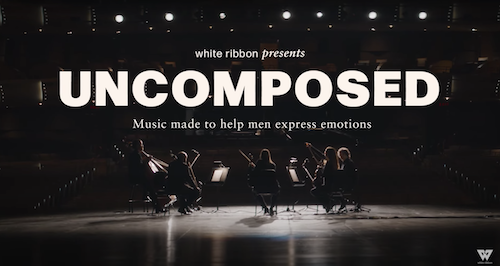
The campaign, Uncomposed, Bensimon Byrne, OneMethod & Narrative, is an exploration of music made to help men express their emotions. The global initiative is made up of an original composition, a documentary and a survey about perceptions of masculinities.
“Our goal is to ignite societal change that promotes emotional literacy and healthy masculinities,” stated Humberto Carolo, executive director, White Ribbon. “For too long, society has taught men to be ‘strong’ by repressing their emotions. It has heroized this version of masculinity. Uncomposed will start a conversation and encourage men and boys to acknowledge and express a range of complex emotions. We can help end gender-based violence by normalizing and promoting emotional literacy and healthy masculinities among men and boys, and emphasising that strength is the ability to show vulnerability.”

A recent 2021 study commissioned by White Ribbon reveals the prevalence of gender biases related to the expression of emotions. 76% of North Americans believe boys and girls are taught differently about expressing emotions. And while almost 150 million North Americans would feel relief if showing emotion was more widely accepted, at least 30 million have told their sons not to cry.
The Uncomposed campaign explores how men are socialised to dismiss their feelings, particularly sensitivity and vulnerability, which results in emotional withdrawal, disconnection, violence, self-medication and risk-taking. While anger and frustration have long been the stereotypically accepted “male” emotions, White Ribbon aims to help men express a healthy emotional range, so they feel free to be themselves. When men express joy, sadness, hurt and fear, they create deeper connections with their loved ones, friends, and peers.
According to the survey, more than 81 million North American men say they are reluctant to cry for fear of looking weak. Another 46% say they find it difficult to express their emotions to anyone outside of their immediate family and partner.
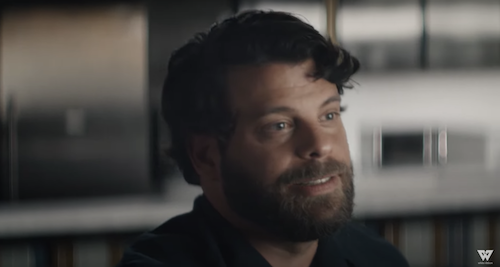
The Uncomposed music was developed by world-renowned producer, Jared Kuemper, with support from Canadian Opera Company Music Director Johannes Debus, as well as notable North American music cognitive scientists. It was performed live by a quintet, in partnership with the Canadian Opera Company at the Four Seasons Centre for the Performing Arts. A video of the recording documents the experiences of four men of diverse backgrounds as they hear the composition for the first time.
“Research has shown that music is capable of triggering strong emotional reactions,” stated Dr Elizabeth Margulis, professor and director of Music Cognition Lab at Princeton University. “Some studies focus on features like repetition and tempo, and others on the effect of culture and prior experience. It’s clear that these factors work together to contribute to music’s emotional power.”
The survey results overwhelmingly support the use of music as a tool to start to address and undo these engrained behaviours. More than three-quarters (76%) of survey respondents agreed that music helps release emotions.
“As a conductor, I see first-hand how music has the power to unlock our emotions – and to help us process them,” Debus commented. “Live music can tap into a listener’s memories and collective experiences, allowing us to reconnect with moments and sensations we may have long forgotten about. As a composition, the ebb and flow of Uncomposed invites the listener to explore their own emotions, while the slow tempo induces feelings of rest and reflection.”
“It was surprising to me that a three-minute piece of music could have such a cathartic effect. It helped me self-reflect and gave me a tool to take back to my boys,” stated Scott Johnson, a documentary subject and single father of two sons. “If acknowledging sensitivity and vulnerability is strength, I think I’ve become a better man through this process.”
Credits:
Client: White Ribbon Canada
Executive Director: Humberto Carolo
Senior Program Manager: Louise Moyer
Creative Agencies: Bensimon Byrne, OneMethod & Narrative
Partner/ Chief Creative Officer: Joseph Bonnici
Executive Creative Directors: Debbie Chan & David Mueller
Art Directors: Ana Segurajauregui & Angelica Carreno
Writer: Sophia Wilby
Business Lead: Marli Bennett
Project Manager: Efi Eman
Agency Producer: Michelle Pilling
Production Manager: Dan Rankin
Media Agency: Bensimon Byrne
Social Media Director: Kristina Kosa
Social Media Supervisor: Rebecca Milner
Social Media Specialist: Emily Wanamaker
PR Agency: Narrative
Executive Creative Director: Debbie Chan
Vice President: Lauren Baswick
Vice President: Stefania Yarhi
Senior Account Manager: Cole Douglas
Director Experiential: Melissa Da Costa
Account Manager – XM: Jaclyn Kirk
Production House: Soft Citizen
Executive Producer: Link York
Executive Producer: Jaclyn Morga
Director: Henry Lu
Director of Photography: James Arthur
Line Producer: Michelle Pilling
Casting: Power House
Post Production: Button Factory
Editor: Tim Pienta
Transfer: Alter Ego
Colourist: Wade Odlum
Audio House: Berkeley Inc.
Creative Director: Jared Kuemper
Executive Producer: Tyna Maerzke
Assistant Engineer: Tyler Young
Original Music: Berkeley Inc.
Composers: Kristian Alexandrov, Shannon Gaye & Jared Kuemper
Canadian Opera Company Music Director: Johannes Debus