D&AD was set up as an educational charity. What sets it apart connects the next generation of talent to the best awarded work currently available. It connects its awards to its education programme. This makes its education essentially a free product as well as grounding that education in the world’s most remarkable work. Its aim is to establish a connection between what the industry needs and what education teaches. It’s also about promoting the industry to new people, new thinkers, getting a diverse voice coming into the industry. Mission control for all of this is the D&AD Foundation. Paul Drake is its director.
The Stable asked him for a behind-the-scenes view.
The Stable: Where are you up to now and what do you hope to achieve in the near future?
PD: Our aims are threefold. One is that we want the next generation of talent to come bursting into the industry with as much creative flow as possible. What we see is that we need to do more work with institutions – predominately we work with universities – for them to understand where industry is going and challenge back the state of education. These days, in the UK, most of Europe [and Australia: ed], education is driven primarily by bums on seats, which means that what’s missing is what the industry and the individual might need.

The second aim is diversity – a massive issue globally and in the UK a huge, huge problem in terms of who’s coming into the industry and who’s getting to the top. So to help people with the talent to achieve their right place at the table, we’ve partnered with Google and delivered RARE with the Glue Society in Australia. It’s an accelerated programme, largely for women, who are massively underrepresented at the top of the game, but also for other underrepresented groups, to try to get them to flourish and develop a network of people they can rely on to be mentored by some of the best in the business.
To get people into the industry, we’ve started to do projects with schools to get them to understand that this even exists. Not many kids, at least in the UK, know that they can forge a great career from ideas, from craft and make serious money from it at the same time if they play their cards right.
One of RARE’s supporters is the Berlin School of Creative Leadership’s, which has kicked in a €20,000 scholarship for its Executive MBA program.
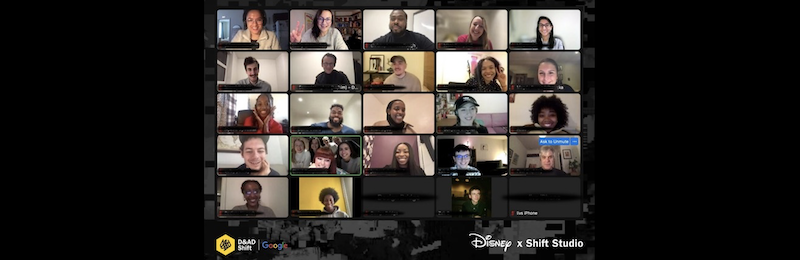
The third thing we’ve done is to develop a night school called Shift. This is for people who are already makers and doers. They’re already doing great things but they’re just not making a career out of it. They can’t afford to go to university or it’s not for them. And they’re not networked. I mean, how many times do you hear in this industry, “Oh, I got a great team for mate?” So we’re trying to break that cycle. We truly believe that creativity can be anywhere, found anywhere and that we need to work harder as an industry to get those great people, great minds into the industry. And maybe we’ll see some best work as a benefit. The night school works over four months. It focuses predominately on mindsets, ideation and prototyping – so we do a lot around bravery, resilience, confidence building, storytelling and now we’re looking at moving that into a digital sphere. Shift is completely free of charge, two nights a week and weekends and all delivered by industry – thirty-five agencies that help host, mentor, teach. We give them the curriculum and they just blast it. The best thing about it is that we get so many interested people that can identify with the problem and want to help D&AD solve it.
Shift has run in the UK and New York. Next on the list is Australia. It’s just looking for the funding it needs.
TS: What can agencies do to help?
PD: There are a few things. One is that it would be nice if this industry came together a little bit more. We see so many small initiatives and I think we’re at the stage now where we need to do something at scale. And that means we might need to put our own individual agency hats to one side and collaborate as a whole to tackle this. We’re in a tricky place right now as an industry and we need to acknowledge that and think that people coming into the business can be the solution and the people leaving the industry can be the solution. We need to work together to make the kinds of changes required.
Businesses can do that by teaching and mentoring the next generation of talent. They can give people an opportunity – that’s all people – and be open to giving different types of people an opportunity. And I think they need to reflect on the way they currently do business. Some agency environments do not enable diverse talent to flourish and that’s to the detriment of the agency in the long term. We need some internal shifts as well.