
“May contain traces of nuts” is a universal disclaimer on food packaging and for those people with life-threatening allergies, it’s a vital warning about hidden toxic ingredients.
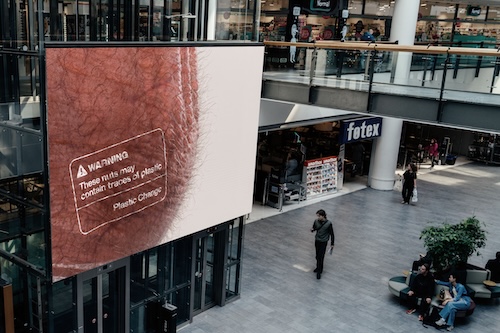
Creative indie, Worth Your While, has given that an attention-magnet twist – These Nuts May Contain Traces of Plastic. And human nuts feature in the campaign for Danish NGO, Plastic Change, and World Environment Day.
The provocative visuals grab attention to warn about traces of something even more harmful than edible nuts that’s been sneaking into human bodies, including the most private parts – microplastics.
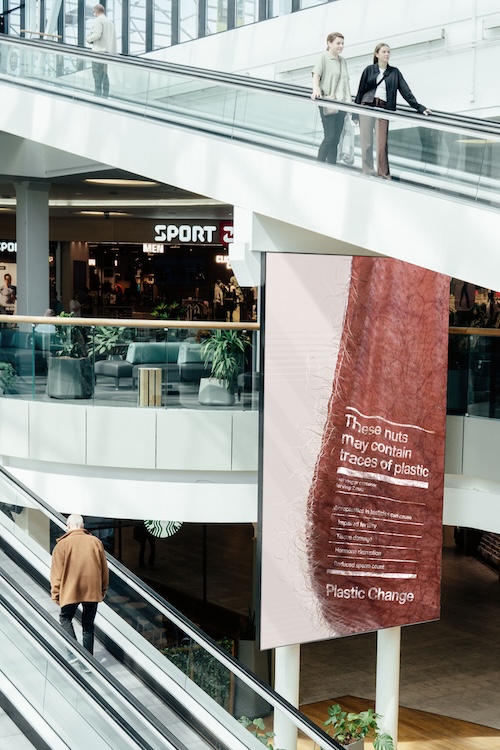
The campaign’s deliberately shocking OOH executions are running across Denmark. Hyper-real, close-up visuals of wrinkled testicle skin are presented like packaging, complete with nutrition-style labels listing microplastics as an “ingredient,” alongside potential side effects including infertility, hormone disruption and reduced sperm count. Part visual gag, part health warning, the campaign is designed to stop people in their tracks, acting as a kick in the nuts (please pardon the pun).
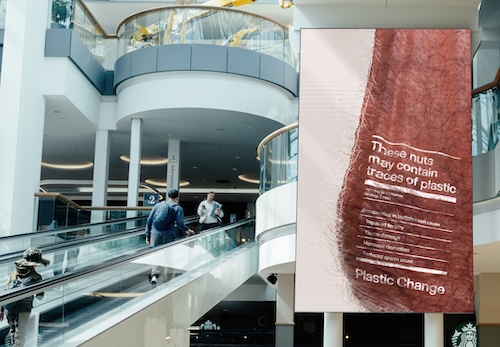
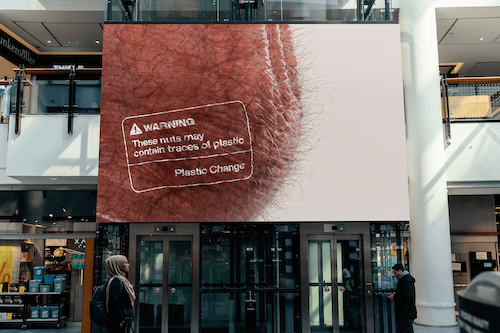
The campaign, that twists a familiar food alert into a provocative double-meaning, follows the release of Netflix documentary in March, The Plastic Detox, that drew widespread attention to the reproductive health implications of microplastics. The campaign takes the conversation out of streaming and into the real world.
Behind its provocative visuals, created by digital imagery studio We Are Eli, lies a serious message, backed up by credible research. Microplastics have been found in semen, testicles, and even penile tissue*, with preliminary findings showing that men with microplastics in their testicular tissue have sperm counts roughly half those of men without**. Meanwhile, microplastic accumulation has been shown to suppress testosterone and the hormones that control male fertility, disrupting the body’s reproductive system at its root***. Global sperm counts have declined by more than 50% over the past half century****, with environmental factors, including plastic exposure, increasingly under scrutiny as contributors to this growing fertility crisis. Yet despite mounting scientific evidence, awareness of the issue remains low, particularly among men.
Worth Your While’s creative strategy taps into a key behavioural insight – many men disengage from environmental messaging*****. By reframing microplastics as a direct threat to male fertility, the campaign transforms a distant global issue into something immediate and personal, their own bodies. This year, Plastic Change is asking men to think hard about what else they might be passing on and what needs to change before they do.
Tim Pashen, creative director & partner, Worth Your While, commented, “Environmental campaigns often struggle because the consequences feel distant, abstract or someone else’s problem. We wanted to find a way to make the issue impossible to ignore by connecting it to something deeply personal. The creative leap was taking a familiar packaging warning and turning it into a warning about our own bodies. If microplastics are showing up in places as intimate as testicular tissue, then plastic pollution is no longer just an environmental issue, it’s a human issue. Sometimes the most effective way to start a serious conversation is with an idea that makes people laugh, wince and think all at the same time.”
Henrik Beha Pedersen, founder of the NGO Plastic Change and environmental biologist, stated “We are left in the darkness, not only men and their testicles, but humans in general, are left alone with microplastics in our bodies. We know that tiny plastic particles are invading our bodies. No one protects us from the health consequences. Plastic is not regulated by law. It’s a disgrace. The EU just backed down on a planned revision of the chemicals law REACH and thereby also the intention to make plastic polymer registration mandatory. The industry pressure has a direct and unacceptable effect; humans are not protected against microplastics in our bodies. We need a plastic change. Otherwise, we walk on towards an unknown future.”
These Nuts May Contain Traces of Plastic launches on World Environment Day, Friday June 5, and will roll out across OOH, alongside social, PR and earned media.
Credits:
Client: Plastic Change
Creative: Worth Your While
Creative Directors & Partners: Tim Pashen & Lukas Lund
Design Director & Partner: Carl Angelo
Creatives: Katrine Winblad, Monique Marie Funch, Isa Bella Madelena Normark, Frederik Emil Vedersø Larsen, Frida Snekkerup
Chief Strategy Officer: Tali Madsen
Project Management: Christine Gyrsting Lorentzen
Production: We Are Eli
Media Agency: WPP Media
Media Placement: Ocean Outdoor
The campaign follows the equally provocative Bottle Bulge in August 2025.
Hello men, here’s the problem:
*Penile tissue. Codrington et al. (2024), International Journal of Impotence Research · The first study to detect microplastics in human penile tissue, finding them in 80% of samples taken from men undergoing surgery for erectile dysfunction.
Semen. Li et al. (2024), Science of the Total Environment · Microplastics were found in every one of 40 semen samples from healthy men in Jinan, China. Eight plastics were identified, the most common being polystyrene, followed by polyethylene and PVC.
Testes. Hu et al. (2024), Toxicological Sciences · Microplastics were found in every one of 23 human testicles studied. The researchers said the discovery may be linked to the decades-long decline in sperm counts.
**Sperm count. Grigoryan et al. (2025), Human Reproduction · Preliminary findings from a review of 15 studies covering 1,200 men, presented at the ESHRE 2025 conference, found that men with microplastics in their testicular tissue had sperm counts of 12 million/mL, against 26 million/mL in those without (roughly half).
***Hormones. Qu et al. (2024), Science of the Total Environment · Microplastics accumulating in the testes suppressed testosterone and the hormones that govern male fertility — FSH, LH and GnRH — demonstrating cause and effect in a controlled study.
****Global sperm decline. Levine et al. (2023), Human Reproduction Update · A landmark global analysis showing average sperm counts have fallen by more than 50% over the past fifty years, with environmental factors including plastics among the suspected causes.
*****Behavioural insight. Brough et al. (2016), Journal of Consumer Research · Seven studies found that men often avoid eco-friendly behaviours because green choices are stereotyped as feminine, leading some to disengage to protect their masculine identity.
Netflix doc: